

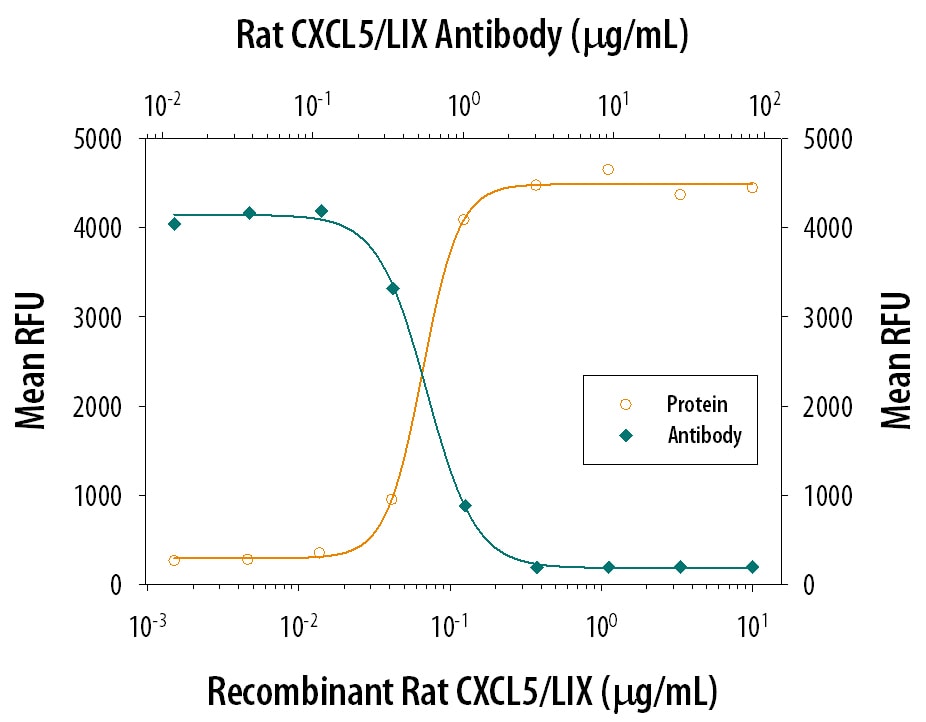
LPS-induced CXC chemokine (LIX) is a chemokine originally cloned from LPS-stimulated mouse fibroblasts. Rat LIX shares approximately 74% amino acid (aa) sequence identity with mouse LIX and is likely the rat orthologue to mouse LIX. Rat LIX cDNA encodes a 130 aa residue precursor with a predicted 37 aa residue signal peptide and a 93 aa residue mature protein. Among human CXC chemokines, rat LIX is most closely related to human GCP-2 and ENA-78. Rat LIX also differs from these two human proteins by having an extended carboxy-terminus. The amino-terminal 115 residues of rat LIX shares 59% and 53% aa sequence homology with human GCP-2 and ENA-78, respectively. It is not clear if LIX should be considered an orthologue of GCP-2 or ENA-78. Yet, mouse LIX was alternatively named mouse GCP-2.
Purified recombinant rat LIX is C-terminally truncated. This is consistent with the observation that natural mouse LIX purified from fibroblasts and epithelial cells also contains multiple amino-terminal and carboxy-terminal truncated isoforms. The shorter isoforms of the natural protein were reported to be more active than the longer forms. The bioactivity of rat LIX can be mediated through CXCR2.
 Powered by Bioz
