
GMP
Best Seller
Recombinant Human KGF/FGF-7 GMP Protein, CF
R&D Systems | Catalog # BT-KGF-GMP

Loading...
Key Product Details
- KGF/FGF-7 Manufactured in Bio-Techne's new GMP facility
- Lot-to-lot consistency
- Stringent guidelines for patient safety
- Scalability necessary to support successful therapeutics
- Learn more about manufacturing in our new GMP facility
- Test it in your process! Request a sample of GMP KGF
- A DMF is on file for this protein
Source
E. coli
Accession Number
Applications
Bioactivity
Loading...
Product Specifications
Source
E. coli-derived human KGF/FGF-7 protein
Cys32 - Thr194, with an N-terminal Met
Produced using non-animal reagents in an animal-free laboratory.Manufactured and tested under cGMP guidelines.
Cys32 - Thr194, with an N-terminal Met
Produced using non-animal reagents in an animal-free laboratory.Manufactured and tested under cGMP guidelines.
Purity
>97%, by SDS-PAGE with quantitative densitometry by Coomassie® Blue Staining. The molecular weight by mass spectrometry is 18927 Da ± 61 Da.
Endotoxin Level
<0.10 EU per 1 μg of the protein by the LAL method.
N-terminal Sequence Analysis
(Cys)32-Asn-Asp-Met-Thr-Pro-Glu-Gln-Met-Ala
Asn33-Asp-Met-Thr-Pro-Glu-Gln-Met-Ala-Thr
Predicted Molecular Mass
19 kDa
SDS-PAGE
20 kDa, under reducing conditions.
Activity
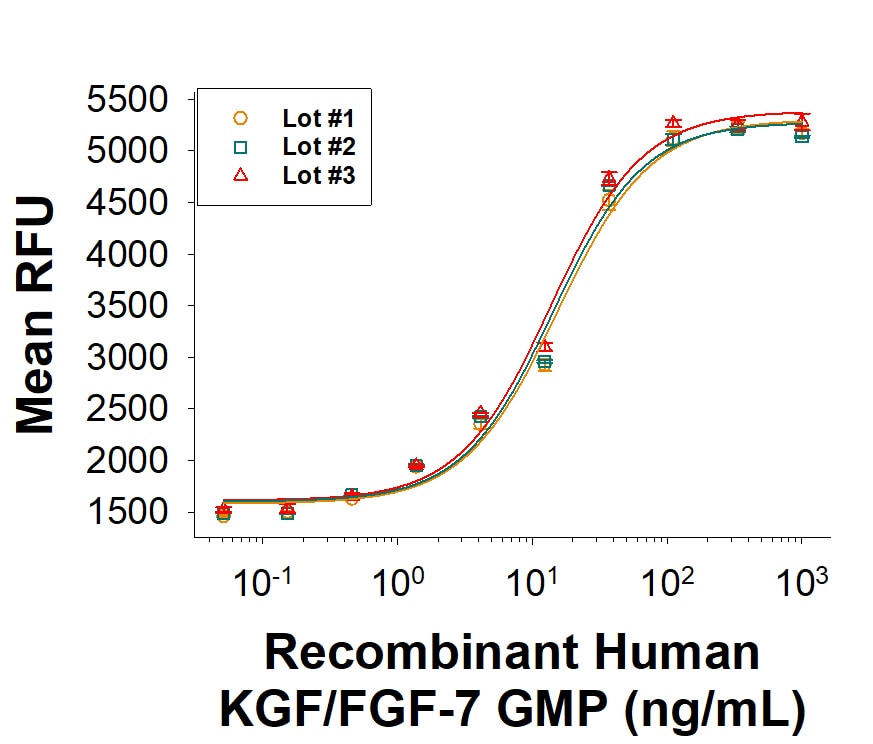
Measured in a cell proliferation assay using Ba/F3 mouse pro B cells transfected with human FGF RIIb.
The ED50 for this effect is 6.00-60.0 ng/mL.
The ED50 for this effect is 6.00-60.0 ng/mL.
The specific activity of recombinant human KGF/FGF-7 is >8.16 x 10⁵ units/mg, which is calibrated against the human KGF/FGF-7 WHO Standard (NIBSC code: 03/150).
Host Cell Protein
<0.500 ng per μg of protein when tested by ELISA.
Mycoplasma
Negative for Mycoplasma.
Host Cell DNA
<0.00150 ng per µg of protein when tested by PCR.
Scientific Data Images for Recombinant Human KGF/FGF-7 GMP Protein, CF
Recombinant Human KGF/FGF‑7 GMP Protein Bioactivity.
The bioactivity of Recombinant Human KGF/FGF‑7 GMP Protein (Catalog # BT-KGF-GMP) was measured in a cell proliferationassay using Ba/F3 mouse pro B cells transfected with human FGF RIIb. The ED50 for this effect is 6.00 ‑ 60.0 ng/mL. Threeindependent lots were tested for bioactivity and plotted on the same graph to show lot-to-lotconsistency of GMP KGF/FGF‑7 protein.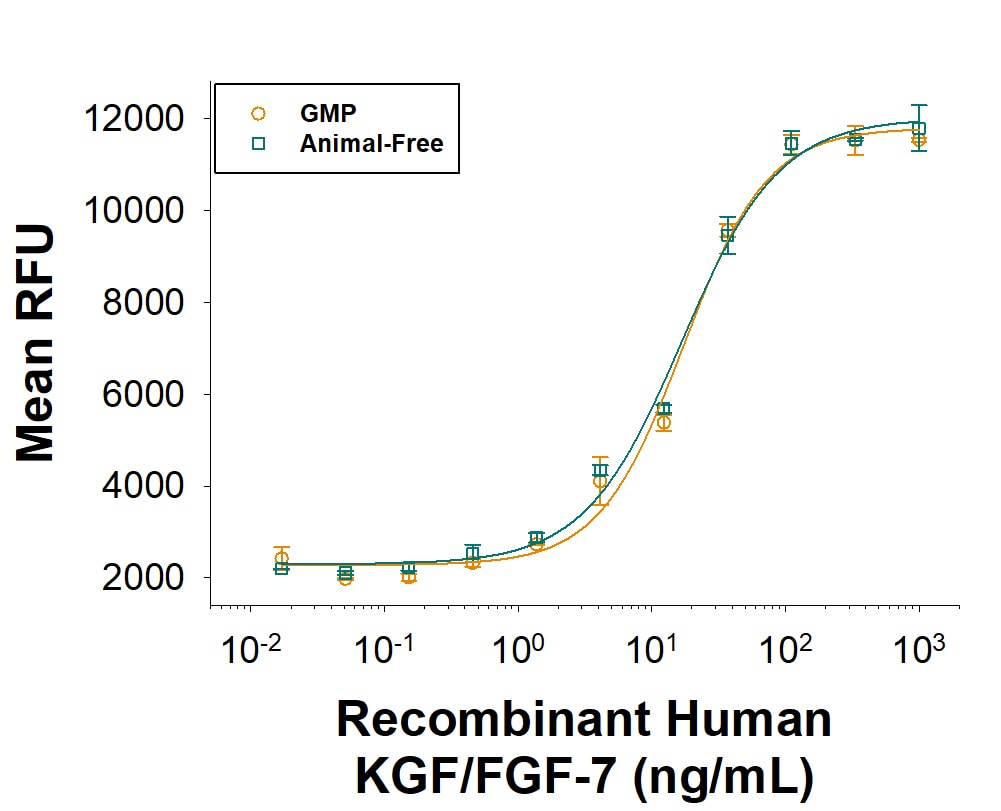
Equivalent Bioactivity of GMPand Animal-Free grades ofRecombinant Human KGF/FGF-7.
Equivalent bioactivity of GMP(Catalog # BT-KGF-GMP) andAnimal-Free (BT-KGF-AFL) grades of RecombinantHuman KGF/FGF-7 measured in a cell proliferationassay using Ba/F3 mouse pro Bcells transfected with human FGFRIIb (orange and green, respectively).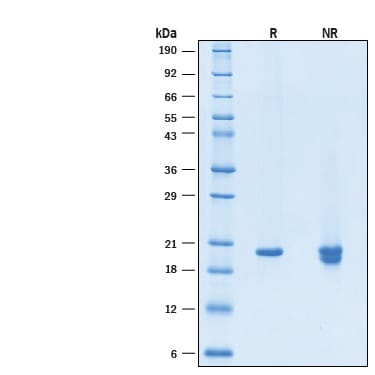
Recombinant Human KGF/FGF‑7 GMP Protein SDS-PAGE.
2 μg/lane of Recombinant Human KGF/FGF‑7 GMP Protein (Catalog # BT-KGF-GMP) was resolved with SDS-PAGE under reducing (R) and non-reducing (NR) conditions and visualized by Coomassie® Blue staining, showing bands at 20 kDa, under reducing conditions.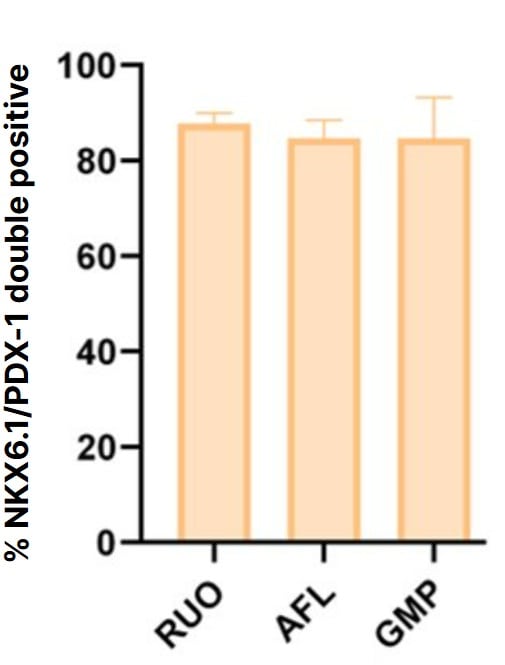
All KGF lots support the differentiation of iPSC to pancreatic progenitor cells.
Characterization of the pancreatic progenitor cells differentiated from iPSCs using different grades of Recombinant Human KGF Protein (Catalog # BT-KGF, BT-KGF-AFL, and BT-KGF-GMP). The iPSC cells (1210a cell line) were cultured in a 24-well plate and differentiated into pancreatic progenitor cells using different lots of KGF and other differentiation factors. Expression of pancreatic progenitor markers was analyzed via flow cytometry with anti-PDX-1 (Catalog # MAB2419) and anti-NKX6.1 antibodies. The PDX-1+/NKX6.1+ double positive cell population was quantified as the pancreatic progenitor cells. The data is represented as the average of three technical replicates.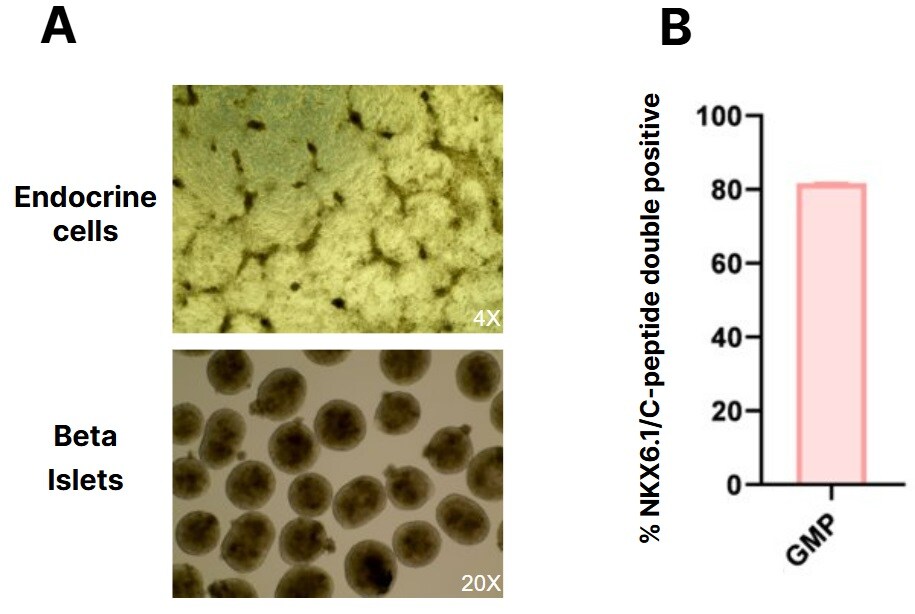
Pancreatic progenitor cells can be further differentiated into beta islets.
Characterization of the endocrine cells and beta islets differentiated from iPSCs using Recombinant Human KGF/FGF-7 GMP Protein (Catalog # BT-KGF-GMP). A) Brightfield images of the endocrine cells and beta islets. GMP KGF was used for further differentiation of the pancreatic progenitor cells first into endocrine cells and then beta islets. The endocrine cells and beta islets were imaged with an EVOS Cell Imaging System. B) The expression of beta islet markers was analyzed via flow cytometry with anti-NKX6.1 and anti-C-peptide antibodies. The C-peptide+/NKX6.1+ double positive cell population was quantified as the target beta cells. The data is represented as the average of three technical replicates.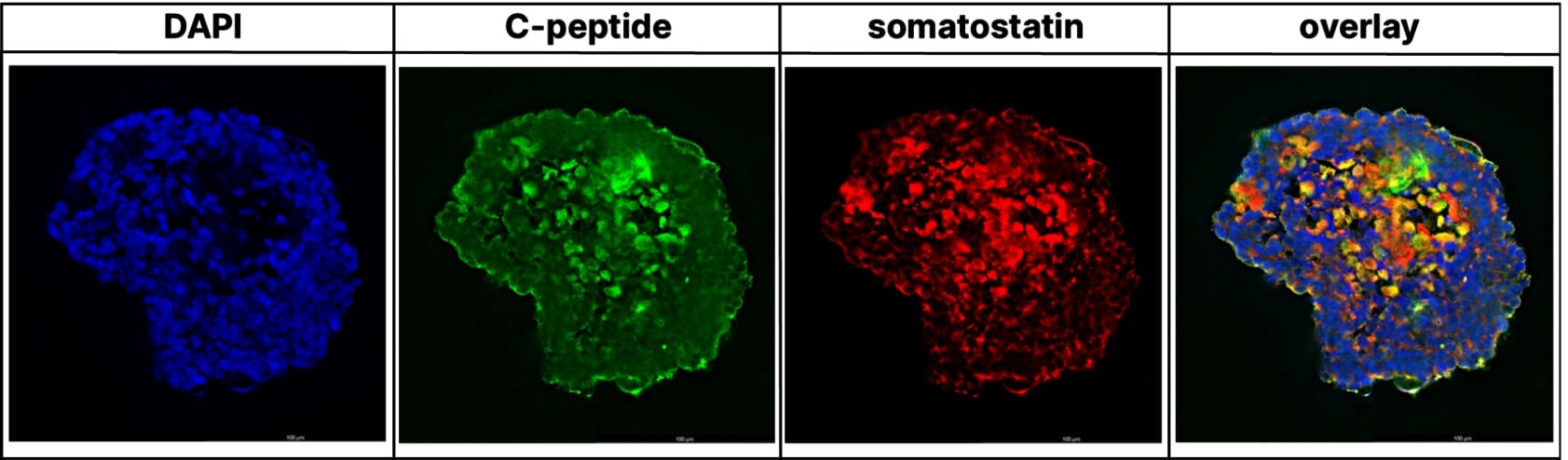
Immunofluorescent imaging shows expression of beta islet markers.
Immunofluorescent images of the beta islets generated using Recombinant Human KGF/FGF-7 GMP Protein (Catalog # BT-KGF-GMP). Beta islets differentiated from iPSCs were fixed, frozen and sectioned. Sections were stained with the anti-C-peptide antibody (Catalog # MAB14171) and the anti-somatostatin antibody (Catalog # MAB2358), followed by the secondary antibody staining (anti-mouse IgG NL493-conjugated antibody: Catalog # NL009; anti-rat IgG NL557-conjugated antibody: Catalog # NL013). A Leica THUNDER Imaging System was utilized for the imaging of C-peptide and somatostatin expression in the beta islets. GMP KGF successfully differentiates the iPSCs into functional beta islets capable of expressing these characteristic markers.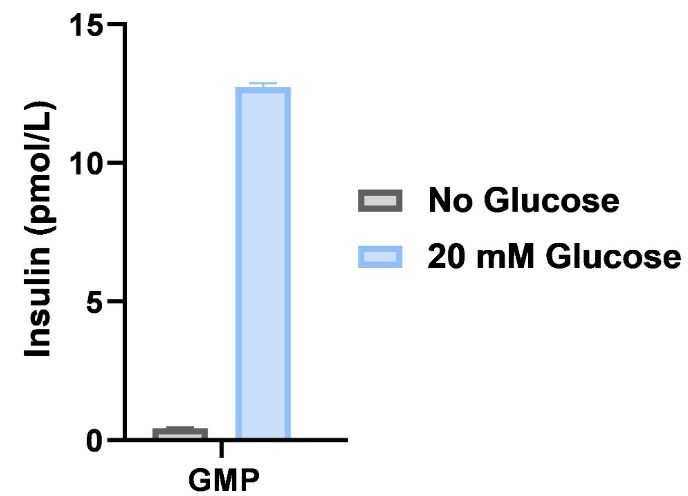
Beta islet cells derived using GMP KGF are functional.
The insulin secretion function of the iPSC-derived beta islets was tested in a glucose-stimulated insulin secretion assay using the Ella™ Automated ELISA platform, and the cell culture supernatant was analyzed with the Ella™ Automated ELISA platform and Simple Plex human insulin cartridge (Catalog # SPCKC-CS-008554). After the incubation of beta islets with 20 mM glucose for 1 hour at 37 °C, the beta islets generated using Recombinant Human KGF/FGF-7 GMP Protein (Catalog # BT-KGF-GMP) were shown to secrete insulin. The data is represented as the average of three technical replicates.Formulation, Preparation, and Storage
BT-KGF-GMP
| Formulation | Lyophilized from a 0.2 μm filtered solution in MOPS, Na2SO4 and EDTA with Trehalose. |
| Reconstitution | Reconstitute at 500 μg/mL in sterile water. |
| Shipping | The product is shipped with polar packs. Upon receipt, store it immediately at the temperature recommended below. |
| Stability & Storage | Use a manual defrost freezer and avoid repeated freeze-thaw cycles.
|
Calculators
Background: KGF/FGF-7
Long Name
Keratinocyte Growth Factor
Alternate Names
FGF-7, FGF7, HBGF-7, HBGF7
Gene Symbol
FGF7
UniProt
Additional KGF/FGF-7 Products
Product Documents for Recombinant Human KGF/FGF-7 GMP Protein, CF
Certificate of Analysis
To download a Certificate of Analysis, please enter a lot or batch number in the search box below.
Note: Certificate of Analysis not available for kit components.
Manufacturing Specifications
GMP ProteinsR&D Systems, a Bio-Techne Brand's GMP proteins are produced according to relevant sections of the following documents: USP Chapter 1043, Ancillary Materials for Cell, Gene and Tissue-Engineered Products and Eu. Ph. 5.2.12, Raw Materials of Biological Origin for the Production of Cell-based and Gene Therapy Medicinal Products.
R&D Systems' quality focus includes:
- Designed, manufactured and tested under an ISO 9001:2015 and ISO 13485:2016 certified quality system
- Documented and controlled manufacturing process
- Control of documentation and process changes by QA
- Personnel training programs
- Raw material inspection and vendor qualification/monitoring program
- Validated equipment, processes and test methods
- Equipment calibration and maintenance schedules using a Regulatory Asset Manager
- Facility/Utilities maintenance, contamination controls, safety and pest control programs
- Material review process for variances
- Robust product stability program following relevant ICH guidelines
- N-terminal amino acid analysis
- SDS-PAGE purity analysis
- Molecular weight analysis via mass spectrometry
- Endotoxin assessment per USP <85> and Ph. Eur. 2.6.14 guidelines
- Bioassay analysis
- Microbial testing per USP <71> and Ph. Eur. 2.6.1 guidelines
- Host cell protein assessment
- Host cell DNA assessment
- Mycoplasma assessment
Production records and facilities are available for examination by appropriate personnel on-site at R&D Systems in Minneapolis and St. Paul, Minnesota USA.
R&D Systems sells GMP grade products for preclinical or clinical ex vivo use. They are not for in vivo use. Please read the following End User Terms prior to using this product.
Animal-Free Manufacturing Conditions
Our dedicated controlled-access animal-free laboratories ensure that at no point in production are the products exposed to potential contamination by animal components or byproducts. Every stage of manufacturing is conducted in compliance with R&D Systems' stringent Standard Operating Procedures (SOPs). Production and purification procedures use equipment and media that are confirmed animal-free.
Production
- All molecular biology procedures use animal-free media and dedicated labware.
- Dedicated fermentors are utilized in committed animal-free areas.
- Protein purification columns are animal-free.
- Bulk proteins are filtered using animal-free filters.
- Purified proteins are stored in animal-free containers.
Product Specific Notices for Recombinant Human KGF/FGF-7 GMP Protein, CF
Full terms and conditions of sale can be found online in the Protein Sciences Segment T&Cs at: Terms & Conditions.
For preclinical, or clinical ex vivo use
Related Research Areas
Customer Reviews for Recombinant Human KGF/FGF-7 GMP Protein, CF
There are currently no reviews for this product. Be the first to review Recombinant Human KGF/FGF-7 GMP Protein, CF and earn rewards!
Have you used Recombinant Human KGF/FGF-7 GMP Protein, CF?
Submit a review and receive an Amazon gift card!
$25/€18/£15/$25CAN/¥2500 for a review with an image
$10/€7/£6/$10CAN/¥1110 for a review without an image
Submit a review
Loading...
Associated Pathways
