Key Product Details

Species Reactivity

Human

Applications

Immunohistochemistry

Label

Unconjugated

Antibody Source

Monoclonal Mouse IgG1 Clone # 171407
Loading...

Product Specifications

Immunogen

Mouse myeloma cell line NS0-derived recombinant human ACE/CD143
aa 30-1261
Accession # P12821

Specificity

Detects human ACE/CD143 in direct ELISAs.

Clonality

Monoclonal

Host

Mouse

Isotype

IgG1

Scientific Data Images for Human ACE/CD143 Antibody

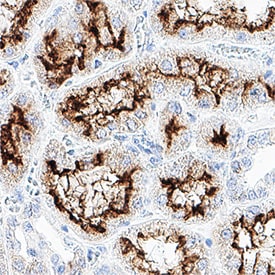
Detection of ACE/CD143 in Human Kidney.

ACE/CD143 was detected in immersion fixed paraffin-embedded sections of human kidney using Mouse Anti-Human ACE/CD143 Monoclonal Antibody (Catalog # MAB11513) at 5 µg/ml for 1 hour at room temperature followed by incubation with the HRP-conjugated Anti-Mouse IgG Secondary Antibody (Catalog # HAF007) or the Anti-Mouse IgG VisUCyte™ HRP Polymer Antibody (Catalog # VC001). Before incubation with the primary antibody, tissue was subjected to heat-induced epitope retrieval using VisUCyte Antigen Retrieval Reagent-Basic (Catalog # VCTS021). Tissue was stained using DAB (brown) and counterstained with hematoxylin (blue). Specific staining was localized to the cytoplasm of tubules. View our protocol for Chromogenic IHC Staining of Paraffin-embedded Tissue Sections.

Applications for Human ACE/CD143 Antibody

Application
Recommended Usage

Immunohistochemistry

3-25 µg/mL
Sample: Immersion fixed paraffin-embedded sections of human kidney

Formulation, Preparation, and Storage

Purification

Protein A or G purified from hybridoma culture supernatant

Reconstitution

Reconstitute at 0.5 mg/mL in sterile PBS. For liquid material, refer to CoA for concentration.


Loading...

Formulation

Lyophilized from a 0.2 μm filtered solution in PBS with Trehalose. *Small pack size (SP) is supplied either lyophilized or as a 0.2 µm filtered solution in PBS.

Shipping

Lyophilized product is shipped at ambient temperature. Liquid small pack size (-SP) is shipped with polar packs. Upon receipt, store immediately at the temperature recommended below.

Stability & Storage

Use a manual defrost freezer and avoid repeated freeze-thaw cycles.
  • 12 months from date of receipt, -20 to -70 °C as supplied.
  • 1 month, 2 to 8 °C under sterile conditions after reconstitution.
  • 6 months, -20 to -70 °C under sterile conditions after reconstitution.

Calculators

The reconstitution calculator allows you to quickly calculate the volume of a reagent to reconstitute your vial. Simply enter the mass of reagent and the target concentration and the calculator will determine the rest.

=
÷

Background: ACE/CD143

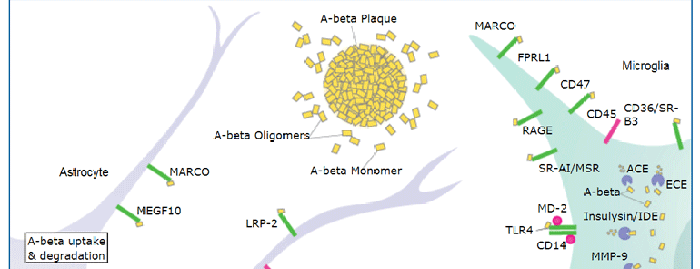
ACE (also known as peptidyl-dipetidase A) is a zinc metallopeptidase important for blood pressure control and water and salt metabolism (2). It cleaves the C-terminal dipeptide from angiotensin I to produce the potent vasopressor octapeptide angiotensin II and inactivates bradykinin by the sequential removal of two C-terminal dipeptides. In addition to the two physiological substrates, ACE cleaves C-terminal dipeptides from various oligopeptides with a free C-terminus. Because of its location and specificity, ACE plays additional roles in immunity, reproduction and neuropeptide regulation. For example, ACE degrades Alzheimer amyloid beta -peptide (A beta ), retards A beta aggregation, deposition, fibril formation, and inhibits cytotoxicity (3).

ACE is a type I membrane protein and exists in two isoforms (2). Somatic ACE, found in endothelial, epithelial and neuronal cells, comprises two highly similar domains called N- and C-domains, each of which contains the HExxH consensus sequence for zinc binding. Germinal ACE, found exclusively in the testes, comprises a single catalytically active domain identical to the C-domain of somatic ACE except for an N-terminal 67 residue germinal ACE-specific sequence. Physiological functions of the two tissue-specific isozymes are not interchangeable (4). For example, sperm-specific expression of the germinal ACE, not the somatic ACE, in ACE knockout male mice restored fertility.

Soluble ACE is present in many biological fluids, such as serum, seminal fluid, amniotic fluid and cerebrospinal fluid (2). The soluble ACE is derived from the membrane forms by actions of secretases or sheddases. The identities of the secretases have not been revealed, although they belong to the family of zinc metallopeptidases (5, 6).

References

  1. Soubrier, et al. (1988) Proc. Natl. Acad. Sci. USA 85:9386.
  2. Corvol, P. and T.A. Williams (1998) in Handbook of Proteolytic Enzymes. Barrett, A.J. et al. (eds): San Diego, Academic Press, p. 1066.
  3. Hu, et al. (2001) J. Biol. Chem. 276:47863.
  4. Kessler, et al. (2000) J. Biol. Chem. 275:26259.
  5. Eyries, et al. (2001) J. Biol. Chem. 276:5525.
  6. Alfalah, et al. (2001) J. Biol. Chem. 276:21105.

Long Name

Angiotensin I Converting Enzyme

Alternate Names

CD143, DCP1, Kininase II

Entrez Gene IDs

1636 (Human); 11421 (Mouse)

Gene Symbol

ACE

UniProt

Additional ACE/CD143 Products

Product Documents for Human ACE/CD143 Antibody

Certificate of Analysis

To download a Certificate of Analysis, please enter a lot or batch number in the search box below.

Note: Certificate of Analysis not available for kit components.

Product Specific Notices for Human ACE/CD143 Antibody

For research use only

Customer Reviews for Human ACE/CD143 Antibody

There are currently no reviews for this product. Be the first to review Human ACE/CD143 Antibody and earn rewards!

Have you used Human ACE/CD143 Antibody?

Submit a review and receive an Amazon gift card!

$25/€18/£15/$25CAN/¥2500 Yen for a review with an image

$10/€7/£6/$10CAN/¥1110 Yen for a review without an image

Submit a review
Amazon Gift Card

Protocols

Find general support by application which include: protocols, troubleshooting, illustrated assays, videos and webinars.

FAQs

No product specific FAQs exist for this product.

View all FAQs for Antibodies