
MIP-3 beta, also known as ELC (EBI1-Ligand Chemokine), is one of many novel beta chemokines identified through bioinformatics. MIP-3 beta cDNA encodes a 98 amino acid (aa) residue precursor protein with a predicted 21 aa residue signal peptide that is cleaved to form the 77 aa residue mature secreted protein. MIP-3 beta is distantly related to other beta chemokines (20-30% aa sequence identity) and the gene for MIP-3 beta has been mapped to chromosome 9p13 rather than chromosome 17 where the genes for many human beta chemokines are clustered. MIP-3 beta has been shown to be constitutively expressed in various lymphoid tissues (including thymus, lymph nodes, appendix and spleen). The expression of MIP-3 beta is down-regulated by the anti-inflammatory cytokine IL-10. MIP-3 beta has been shown to be a unique functional ligand for CCR7 (previously referred to as the Epstein-Barr virus-induced gene 1 (EBI1) orphan receptor), a chemokine receptor that is expressed in various lymphoid tissues and activated B and T lymphocytes. EBI1 is strongly up-regulated in B cells infected with Epstein-Barr virus and T cells infected with herpesvirus 6 or 7.
Human CCL19/MIP-3 beta Antibody (948918)
R&D Systems | Catalog # MAB3611

Scientific images may be resized, cropped, or adjusted for brightness or contrast for presentation purposes. These updates are limited to presentation and do not affect the underlying scientific interpretation of the data. Where available, additional source data may be provided upon request.
Key Product Details
Species Reactivity
Applications
Label
Antibody Source
Product Specifications
Immunogen
Gly22-Ser98
Accession # Q99731
Specificity
Clonality
Host
Isotype
Endotoxin Level
Scientific Data Images for Human CCL19/MIP-3 beta Antibody (948918)
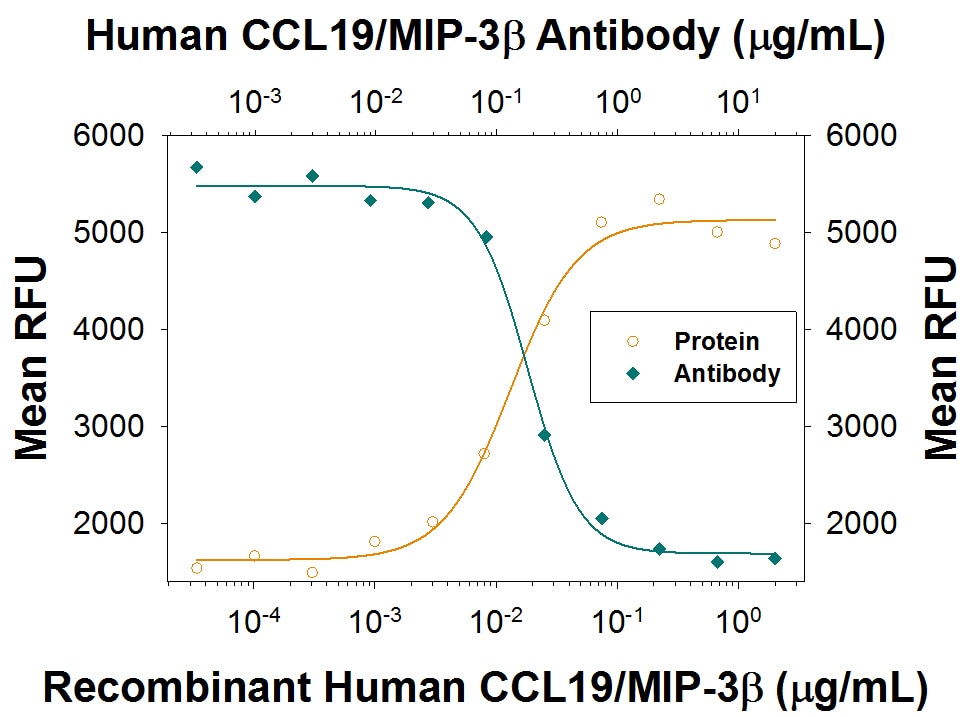
Chemotaxis Induced by CCL19/MIP-3 beta and Neutrali-zation by Human CCL19/MIP-3 beta Antibody.
Recombinant Human CCL19/MIP-3 beta (Catalog # 361-MI) chemoattracts the BaF3 mouse pro-B cell line transfected with human CCR7 in a dose-dependent manner (orange line). The amount of cells that migrated through to the lower chemotaxis chamber was measured by Resazurin (Catalog # AR002). Chemotaxis elicited by Recombinant Human CCL19/MIP-3 beta (50 ng/mL) is neutralized (green line) by increasing concentrations of Mouse Anti-Human CCL19/MIP-3 beta Monoclonal Antibody (Catalog # MAB3611). The ND50 is typically 0.1-0.5 µg/mL.Applications for Human CCL19/MIP-3 beta Antibody (948918)
Neutralization
Formulation, Preparation, and Storage
Purification
Reconstitution
Reconstitute at 0.5 mg/mL in sterile PBS. For liquid material, refer to CoA for concentration.
Formulation
Shipping
Stability & Storage
- 12 months from date of receipt, -20 to -70 °C as supplied.
- 1 month, 2 to 8 °C under sterile conditions after reconstitution.
- 6 months, -20 to -70 °C under sterile conditions after reconstitution.
Calculators
Background: CCL19/MIP-3 beta
Alternate Names
Gene Symbol
UniProt
Additional CCL19/MIP-3 beta Products
Product Documents for Human CCL19/MIP-3 beta Antibody (948918)
Certificate of Analysis
To download a Certificate of Analysis, please enter a lot or batch number in the search box below.
Note: Certificate of Analysis not available for kit components.
Product Specific Notices for Human CCL19/MIP-3 beta Antibody (948918)
For research use only
Customer Reviews for Human CCL19/MIP-3 beta Antibody (948918)
There are currently no reviews for this product. Be the first to review Human CCL19/MIP-3 beta Antibody (948918) and earn rewards!
Have you used Human CCL19/MIP-3 beta Antibody (948918)?
Submit a review and receive an Amazon gift card!
$25/€18/£15/$25CAN/¥2500 for a review with an image
$10/€7/£6/$10CAN/¥1110 for a review without an image
Submit a review
Associated Pathways
