
Human CCL28 (CC chemokine ligand 28) is a 127 amino acid (aa) precursor protein with a putative 22 aa signal peptide that is cleaved to produce the 105 aa residue mature protein. Mature human and mouse CCL28 share 83% aa sequence identity. Among CC chemokines, CCL28 shares the most homology with CCL27/CTACK. The mouse CCL28 gene has been mapped to the distal region of chromosome 13. Human and mouse CCL28 RNA expression is highest in epithelial cells of normal and pathologic colon. Human CCL28 RNA is also present in normal and asthmatic lung tissues. CCR10 (GPR2 orphan receptor) is the receptor for both CCL27/CTACK and CCL28.
Human CCL28 Antibody (62705)
R&D Systems | Catalog # MAB717


Scientific images may be resized, cropped, or adjusted for brightness or contrast for presentation purposes. These updates are limited to presentation and do not affect the underlying scientific interpretation of the data. Where available, additional source data may be provided upon request.
Key Product Details
Species Reactivity
Validated:
Human
Cited:
Human, Mouse
Applications
Validated:
Western Blot, Neutralization
Cited:
Immunohistochemistry-Paraffin, Immunohistochemistry-Frozen, Western Blot, Neutralization, ELISA Development, Functional Assay
Label
Unconjugated
Antibody Source
Monoclonal Mouse IgG1 Clone # 62705
Loading...
Product Specifications
Immunogen
E. coli-derived recombinant human CCL28
Ile23-Tyr127
Accession # Q9NRJ3
Ile23-Tyr127
Accession # Q9NRJ3
Specificity
Detects human CCL28 in direct ELISAs and Western blots. In direct ELISAs, no cross-reactivity with recombinant human CCL1, 2, 3, 4, 5, 7, 8, 11,
12, 13, 14, 15, 16, 17, 18, 19, 20, 21, 22, 23, 24, 25, recombinant mouse CCL1,
2, 3, 4, 5, 6, 7, 9, 11, 19, 21, 22, 25, or recombinant rat CCL20 is observed.
Clonality
Monoclonal
Host
Mouse
Isotype
IgG1
Endotoxin Level
<0.10 EU per 1 μg of the antibody by the LAL method.
Scientific Data Images for Human CCL28 Antibody (62705)
Chemotaxis Induced by CCL28 and Neutralization by Human CCL28 Antibody.
Recombinant Human CCL28 (Catalog # 717-VC) chemo-attracts the BaF3 mouse pro-B cell line transfected with human CCR10 in a dose-dependent manner (orange line). The amount of cells that migrated through to the lower chemotaxis chamber was measured by Resazurin. Chemotaxis elicited by Recombinant Human CCL28 (4 µg/mL) is neutralized (green line) by increasing concentrations of Mouse Anti-Human CCL28 Monoclonal Antibody (Catalog # MAB717). The ND50 is typically 15-45 µg/mL.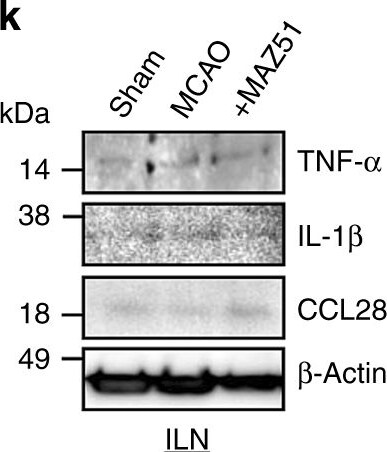
Detection of CCL28 by Western Blot
Cervical lymphatic inflammation through VEGFR3 tyrosine kinase in mice after stroke: a Male C57BL6 mice were subjected to transient focal ischemia and, immediately after reperfusion the vehicle (PBS 10 µL) or MAZ51 (3 ng/10 µL) were injected into the nasal cavity. b MAZ51 treatment suppressed tyrosine phosphorylation in superficial CLN lymphatic endothelium at 72 h after focal ischemia (Sham; n = 4, MCAO; n = 9, MCAO + MAZ51; n = 8 biologically independent animals). *P < 0.05, one-way ANOVA followed by Fisher’s LSD test. c FACS analysis demonstrated that MAZ51 treatment significantly decreased pro-inflammatory TNF-alpha positive macrophages in superficial CLNs; no clear changes were noticed in TGF-beta positive macrophages. *P < 0.05, one-way ANOVA followed by Fisher’s LSD test. d–f. Immunostaining revealed that CD169 positive macrophages increased TNF-alpha, while MAZ51 treatment decreased pro-inflammatory macrophages. Scale: 100 nm. g–h Confocal microscopy analysis demonstrated that TNF-alpha was highly co-localized with CD169 positive macrophages in the subcapsular sinus of superficial CLNs. MAZ51 treatment decreased the co-localization. TNF-alpha expression was not observed in ILN macrophages. Scale: 100 nm. i–l Western blot confirmed that TNF-alpha, IL-1 beta and CCL28 were significantly increased in post-stroke superficial CLNs. MAZ51 treatment reduced cytokine/chemokine expression (n = 4 biologically independent animals). ILNs weakly responded to focal cerebral ischemia as to TNF-alpha, IL-1 beta or CCL28 expression (n = 3 biologically independent animals). *P < 0.05, **P < 0.01, one-way ANOVA followed by Fisher’s LSD test. All values are mean +/− SD. Image collected and cropped by CiteAb from the following open publication (https://pubmed.ncbi.nlm.nih.gov/31757960), licensed under a CC-BY license. Not internally tested by R&D Systems.Applications for Human CCL28 Antibody (62705)
Application
Recommended Usage
Western Blot
1 µg/mL
Sample: Recombinant Human CCL28 (Catalog # 717-VC)
Sample: Recombinant Human CCL28 (Catalog # 717-VC)
Neutralization
Measured by its ability to neutralize CCL28-induced chemotaxis in the BaF3 mouse pro‑B cell line transfected with human CCR10. The Neutralization Dose (ND50) is typically 15-45 µg/mL in the presence of 4 µg/mL Recombinant Human CCL28.
Formulation, Preparation, and Storage
Purification
Protein A or G purified from ascites
Reconstitution
Reconstitute at 0.5 mg/mL in sterile PBS. For liquid material, refer to CoA for concentration.
Loading...
Formulation
Lyophilized from a 0.2 μm filtered solution in PBS with Trehalose. *Small pack size (SP) is supplied either lyophilized or as a 0.2 µm filtered solution in PBS.
Shipping
Lyophilized product is shipped at ambient temperature. Liquid small pack size (-SP) is shipped with polar packs. Upon receipt, store immediately at the temperature recommended below.
Stability & Storage
Use a manual defrost freezer and avoid repeated freeze-thaw cycles.
- 12 months from date of receipt, -20 to -70 °C as supplied.
- 1 month, 2 to 8 °C under sterile conditions after reconstitution.
- 6 months, -20 to -70 °C under sterile conditions after reconstitution.
Calculators
Background: CCL28
References
- Wang, W. et al. (2000) J. Biol. Chem. 275:22313.
Alternate Names
CCL28, MEC, VIC
Gene Symbol
CCL28
UniProt
Additional CCL28 Products
Product Documents for Human CCL28 Antibody (62705)
Certificate of Analysis
To download a Certificate of Analysis, please enter a lot or batch number in the search box below.
Note: Certificate of Analysis not available for kit components.
Product Specific Notices for Human CCL28 Antibody (62705)
For research use only
Related Research Areas
Citations for Human CCL28 Antibody (62705)
 Powered by Bioz
Customer Reviews for Human CCL28 Antibody (62705)
There are currently no reviews for this product. Be the first to review Human CCL28 Antibody (62705) and earn rewards!
Have you used Human CCL28 Antibody (62705)?
Submit a review and receive an Amazon gift card!
$25/€18/£15/$25CAN/¥2500 for a review with an image
$10/€7/£6/$10CAN/¥1110 for a review without an image
Submit a review
Protocols
Find general support by application which include: protocols, troubleshooting, illustrated assays, videos and webinars.
- Cellular Response to Hypoxia Protocols
- R&D Systems Quality Control Western Blot Protocol
- Troubleshooting Guide: Western Blot Figures
- Western Blot Conditions
- Western Blot Protocol
- Western Blot Protocol for Cell Lysates
- Western Blot Troubleshooting
- Western Blot Troubleshooting Guide
- View all Protocols, Troubleshooting, Illustrated assays and Webinars
Loading...
Associated Pathways
