
Human ChemR23 Antibody (84939)
R&D Systems | Catalog # MAB362

Scientific images may be resized, cropped, or adjusted for brightness or contrast for presentation purposes. These updates are limited to presentation and do not affect the underlying scientific interpretation of the data. Where available, additional source data may be provided upon request.
Key Product Details
Species Reactivity
Validated:
Cited:
Applications
Validated:
Cited:
Label
Antibody Source
Product Specifications
Immunogen
Met1-Leu371
Accession # NP_004063
Specificity
Clonality
Host
Isotype
Scientific Data Images for Human ChemR23 Antibody (84939)
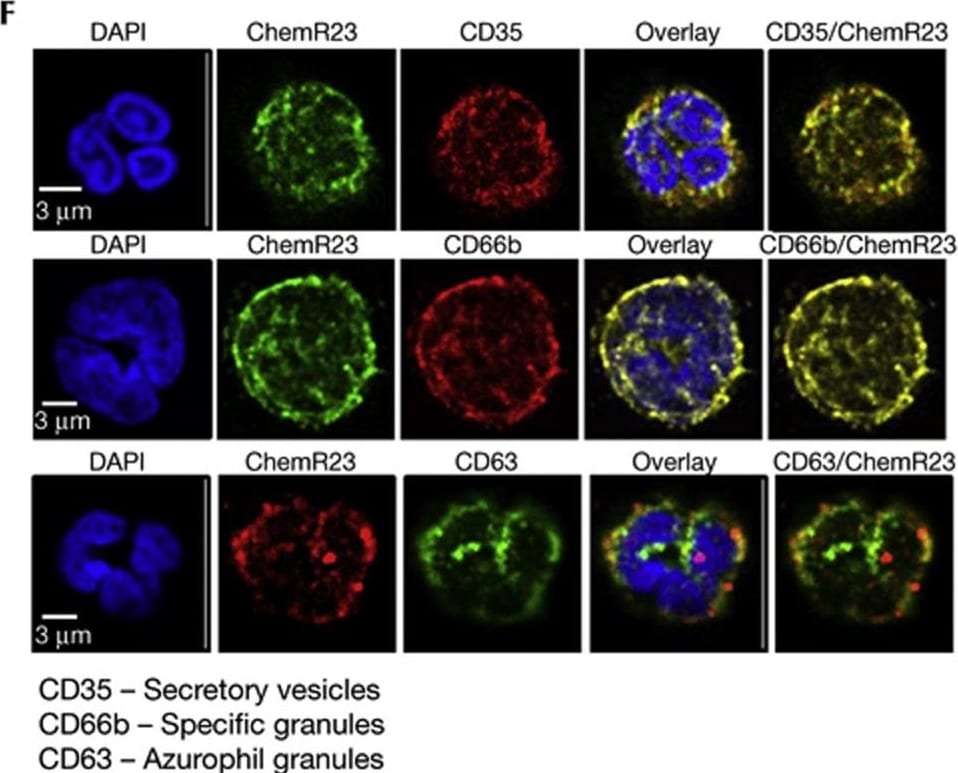
Detection of ChemR23/CMKLR1 by Immunocytochemistry/ Immunofluorescence
Non-genomic modulation of ChemR23 expression on neutrophils (A,B) ChemR23 expression on human leukocytes was determined by flow cytometry on vehicle and TNF alpha (10 ng/ml; 20 min)-stimulated cells. Representative histograms shown in A. (C) Neutrophils were treated with vehicle, pro-inflammatory (TNF alpha ; fMLF, 1 μM; IL-8, 100 ng/ml) or anti-inflammatory mediators (annexin A1, 10 nM; alpha MSH, 10 nM; C15, 10 pM) followed by staining for ChemR23. ChemR23 expression was also assessed on isolated human neutrophils before and after flow over activated endothelial cells. (D) ChemR23 expression by wild-type but not ChemR23−/− murine neutrophils. (E) Permeabilized human neutrophils were stained with anti-ChemR23 (with goat-anti-mouse Alexa 488 secondary) and wheat germ agglutinin (WGA-Alexa 647) to visualize the cell membrane. Cells were analysed by confocal microscopy. (F) Human neutrophils were stained for ChemR23 and markers of secretory vesicles (CD35), specific granules (CD66b) and azurophil granules (CD63). (G) Neutrophils were loaded with Fura2-AM and calcium flux responses elicited by control (ionomycin), vehicle, ChemR23 inhibitor (CCX2005, 100 nM), C15 (10 pM), scrambled C15 (C15-S; 10 pM) or chemerin (1 nM). Responses are displayed as delta F340/F380. Graphs show mean values±s.e.m. from three to six independent experiments. *P<0.05 relative to vehicle-treated or pre-flow cells. alpha MSH, alpha-melanocyte-stimulating hormone; IL-8, interleukin-8; TNF alpha, tumour necrosis factor alpha. Image collected and cropped by CiteAb from the following open publication (https://pubmed.ncbi.nlm.nih.gov/23999103), licensed under a CC-BY license. Not internally tested by R&D Systems.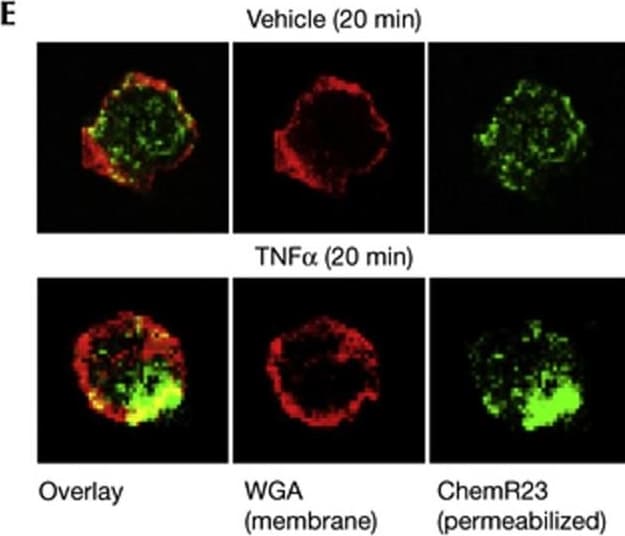
Detection of ChemR23/CMKLR1 by Immunocytochemistry/ Immunofluorescence
Non-genomic modulation of ChemR23 expression on neutrophils (A,B) ChemR23 expression on human leukocytes was determined by flow cytometry on vehicle and TNF alpha (10 ng/ml; 20 min)-stimulated cells. Representative histograms shown in A. (C) Neutrophils were treated with vehicle, pro-inflammatory (TNF alpha ; fMLF, 1 μM; IL-8, 100 ng/ml) or anti-inflammatory mediators (annexin A1, 10 nM; alpha MSH, 10 nM; C15, 10 pM) followed by staining for ChemR23. ChemR23 expression was also assessed on isolated human neutrophils before and after flow over activated endothelial cells. (D) ChemR23 expression by wild-type but not ChemR23−/− murine neutrophils. (E) Permeabilized human neutrophils were stained with anti-ChemR23 (with goat-anti-mouse Alexa 488 secondary) and wheat germ agglutinin (WGA-Alexa 647) to visualize the cell membrane. Cells were analysed by confocal microscopy. (F) Human neutrophils were stained for ChemR23 and markers of secretory vesicles (CD35), specific granules (CD66b) and azurophil granules (CD63). (G) Neutrophils were loaded with Fura2-AM and calcium flux responses elicited by control (ionomycin), vehicle, ChemR23 inhibitor (CCX2005, 100 nM), C15 (10 pM), scrambled C15 (C15-S; 10 pM) or chemerin (1 nM). Responses are displayed as delta F340/F380. Graphs show mean values±s.e.m. from three to six independent experiments. *P<0.05 relative to vehicle-treated or pre-flow cells. alpha MSH, alpha-melanocyte-stimulating hormone; IL-8, interleukin-8; TNF alpha, tumour necrosis factor alpha. Image collected and cropped by CiteAb from the following open publication (https://pubmed.ncbi.nlm.nih.gov/23999103), licensed under a CC-BY license. Not internally tested by R&D Systems.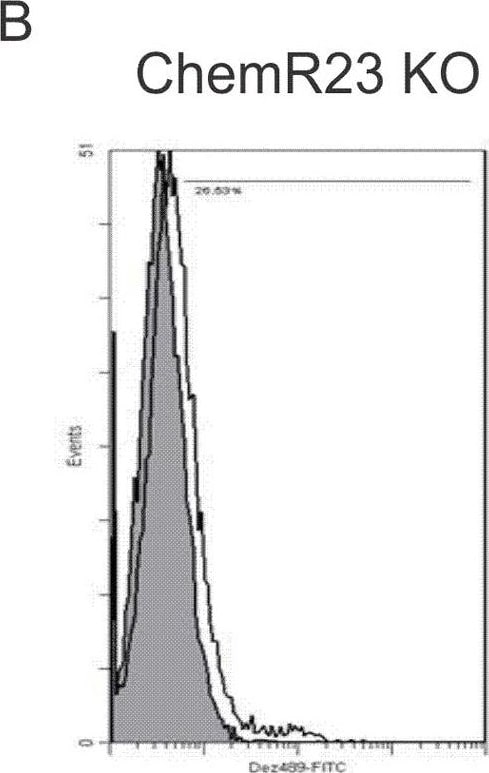
Detection of ChemR23/CMKLR1 by Flow Cytometry
Competition binding assays on BMDCs.[A, B] FACS analysis showing the cell surface expression of mChemR23/Dez on BMDCs generated from wild-type or ChemR23−/− mice. Cells were incubated with an anti-mChemR23 antibody (open histogram) or a control isotype (filled histogram). [C, D] Competition binding assays were performed on BMDCs generated from wild-type (C) or ChemR23−/− mice (D). Purified cells were incubated with 0.2 nM 125I-CXCL12 as tracer, and CXCL12 (300 nM), chemerin (300 nM) or a monoclonal anti-CXCR4 antibody (10 µg/ml) as competitors. After one hour incubation, unbound tracer was separated by filtration and filters washed twice before counting. The data were normalized for non-specific binding (0%) and specific binding in the absence of competitor (100%). Statistical significance as compared to the 100% values was tested by two-way analysis of variance followed by Tukey's test (***, P<0.001; **, P<0.01). All data points were performed in triplicate and the displayed data are the mean of five experiments performed with three independent cell preparations (error bars indicate S.E.M.). Image collected and cropped by CiteAb from the following open publication (https://pubmed.ncbi.nlm.nih.gov/23469143), licensed under a CC-BY license. Not internally tested by R&D Systems.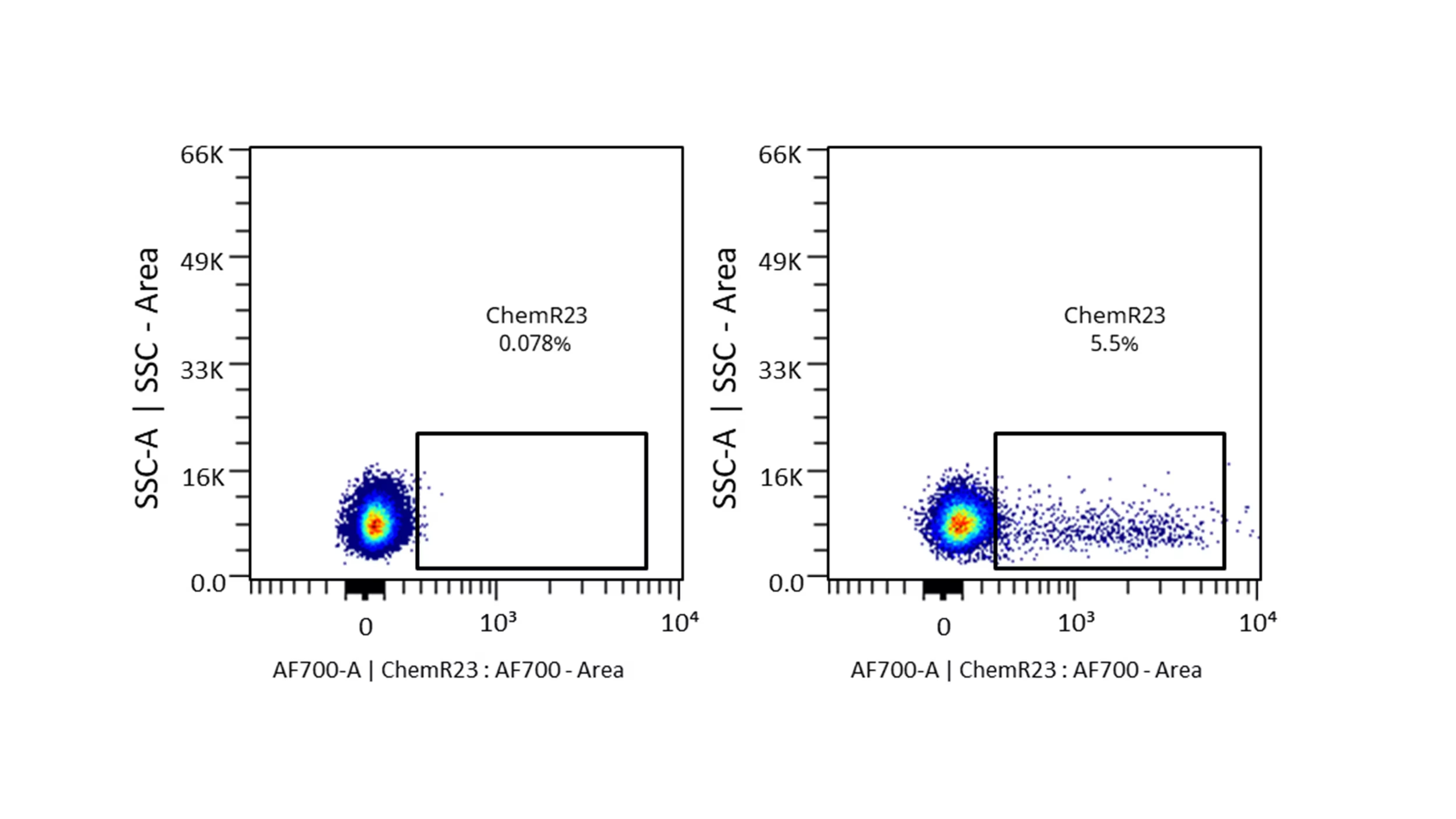
Detection of ChemR23/CMKLR1 by Flow Cytometry.
100.000 human natural killer cells were stained for 20 min at room temperature. Image from a verified customer review. The customer used the Alexa Fluor® 700-conjugated version of MAB362, which is listed under FAB362N.Applications for Human ChemR23 Antibody (84939)
CyTOF-ready
Flow Cytometry
Sample: Human peripheral blood monocytes
Flow Cytometry Panel Builder
Bio-Techne Knows Flow Cytometry
Save time and reduce costly mistakes by quickly finding compatible reagents using the Panel Builder Tool.
Advanced Features
- Spectra Viewer - Custom analysis of spectra from multiple fluorochromes
- Spillover Popups - Visualize the spectra of individual fluorochromes
- Antigen Density Selector - Match fluorochrome brightness with antigen density

Formulation, Preparation, and Storage
Purification
Reconstitution
Reconstitute at 0.5 mg/mL in sterile PBS. For liquid material, refer to CoA for concentration.
Formulation
Shipping
Stability & Storage
- 12 months from date of receipt, -20 to -70 °C as supplied.
- 1 month, 2 to 8 °C under sterile conditions after reconstitution.
- 6 months, -20 to -70 °C under sterile conditions after reconstitution.
Calculators
Background: ChemR23
References
- Samson, M. et al. (1998) Eur. J. Immunol. 28:1689.
Long Name
Alternate Names
Gene Symbol
UniProt
Additional ChemR23 Products
Product Documents for Human ChemR23 Antibody (84939)
Certificate of Analysis
To download a Certificate of Analysis, please enter a lot or batch number in the search box below.
Note: Certificate of Analysis not available for kit components.
Product Specific Notices for Human ChemR23 Antibody (84939)
For research use only
Related Research Areas
Citations for Human ChemR23 Antibody (84939)
 Powered by Bioz
Customer Reviews for Human ChemR23 Antibody (84939)
There are currently no reviews for this product. Be the first to review Human ChemR23 Antibody (84939) and earn rewards!
Have you used Human ChemR23 Antibody (84939)?
Submit a review and receive an Amazon gift card!
$25/€18/£15/$25CAN/¥2500 for a review with an image
$10/€7/£6/$10CAN/¥1110 for a review without an image
Submit a review
Protocols
Find general support by application which include: protocols, troubleshooting, illustrated assays, videos and webinars.
- 7-Amino Actinomycin D (7-AAD) Cell Viability Flow Cytometry Protocol
- Extracellular Membrane Flow Cytometry Protocol
- Flow Cytometry Protocol for Cell Surface Markers
- Flow Cytometry Protocol for Staining Membrane Associated Proteins
- Flow Cytometry Staining Protocols
- Flow Cytometry Troubleshooting Guide
- Intracellular Flow Cytometry Protocol Using Alcohol (Methanol)
- Intracellular Flow Cytometry Protocol Using Detergents
- Intracellular Nuclear Staining Flow Cytometry Protocol Using Detergents
- Intracellular Staining Flow Cytometry Protocol Using Alcohol Permeabilization
- Intracellular Staining Flow Cytometry Protocol Using Detergents to Permeabilize Cells
- Propidium Iodide Cell Viability Flow Cytometry Protocol
- Protocol for Liperfluo
- Protocol for the Characterization of Human Th22 Cells
- Protocol for the Characterization of Human Th9 Cells
- Protocol: Annexin V and PI Staining by Flow Cytometry
- Protocol: Annexin V and PI Staining for Apoptosis by Flow Cytometry
- Troubleshooting Guide: Fluorokine Flow Cytometry Kits
- View all Protocols, Troubleshooting, Illustrated assays and Webinars