
Human CMG-2/ANTXR2 Antibody
R&D Systems | Catalog # AF2940


Key Product Details
Validated by
Species Reactivity
Validated:
Cited:
Applications
Validated:
Cited:
Label
Antibody Source
Product Specifications
Immunogen
Gln34-Asn317
Accession # P58335
Specificity
Clonality
Host
Isotype
Scientific Data Images for Human CMG-2/ANTXR2 Antibody
Detection of CMG‑2/ANTXR2 in Human Monocytes by Flow Cytometry.
Human whole blood monocytes were stained with Human CMG-2/ANTXR2 Antigen Affinity-purified Polyclonal Antibody (Catalog # AF2940, filled histogram) or control antibody (Catalog # AB-108-C, open histogram), followed by Phycoerythrin-conjugated Anti-Goat IgG Secondary Antibody (Catalog # F0107).
Detection of Human CMG-2/ANTXR2 by Western Blot
Number and localization of glycan sidechains determine trafficking efficiency of TEM8 and CMG2.A) Endoglycosidase H (EndoH) treatment on TEM8 and CMG2 single mutants. HeLa cells were transfected for 48h with the respective cDNAs. 40 μg of cell extracts were treated or not with EndoH as described before. Samples were analyzed by SDS-PAGE and Western Blotting. B) Quantification of surface biotinylation experiments to determine amount of TEM8 at the cell surface. All mutants were corrected for their expression levels and then normalized to WT, which was set at 100%. Errors represent standard deviation. Statistics were calculated using an unpaired t-test. n ≥ 3. * p≤0.05, ** p≤0.01, *** p≤0.001 C) Representative Western Blots of surface biotinylation. HeLa cells were transfected 48h with the respective cDNAs. Proteins at the cell surface were labeled with biotin, immunoprecipitated with streptavidin beads and blotted against TEM8-HA. D) Quantification of surface biotinylation experiments to determine amount of CMG2 at the cell surface. All mutants were corrected for their expression levels and then normalized to WT, which was set at 100%. Errors represent standard deviation. Statistics were calculated using an unpaired t-test. n ≥ 3. * p≤0.05, ** p≤0.01, *** p≤0.001 E) Representative Western Blots of surface biotinylation. HeLa cells were transfected 48h with the respective cDNAs. Proteins at the cell surface were labeled with biotin, immunoprecipitated with streptavidin beads and blotted against CMG2-V5. Image collected and cropped by CiteAb from the following publication (https://pubmed.ncbi.nlm.nih.gov/25781883), licensed under a CC-BY license. Not internally tested by R&D Systems.
Detection of Human CMG-2/ANTXR2 by Western Blot
Number and localization of glycan sidechains determine trafficking efficiency of TEM8 and CMG2.A) Endoglycosidase H (EndoH) treatment on TEM8 and CMG2 single mutants. HeLa cells were transfected for 48h with the respective cDNAs. 40 μg of cell extracts were treated or not with EndoH as described before. Samples were analyzed by SDS-PAGE and Western Blotting. B) Quantification of surface biotinylation experiments to determine amount of TEM8 at the cell surface. All mutants were corrected for their expression levels and then normalized to WT, which was set at 100%. Errors represent standard deviation. Statistics were calculated using an unpaired t-test. n ≥ 3. * p≤0.05, ** p≤0.01, *** p≤0.001 C) Representative Western Blots of surface biotinylation. HeLa cells were transfected 48h with the respective cDNAs. Proteins at the cell surface were labeled with biotin, immunoprecipitated with streptavidin beads and blotted against TEM8-HA. D) Quantification of surface biotinylation experiments to determine amount of CMG2 at the cell surface. All mutants were corrected for their expression levels and then normalized to WT, which was set at 100%. Errors represent standard deviation. Statistics were calculated using an unpaired t-test. n ≥ 3. * p≤0.05, ** p≤0.01, *** p≤0.001 E) Representative Western Blots of surface biotinylation. HeLa cells were transfected 48h with the respective cDNAs. Proteins at the cell surface were labeled with biotin, immunoprecipitated with streptavidin beads and blotted against CMG2-V5. Image collected and cropped by CiteAb from the following publication (https://pubmed.ncbi.nlm.nih.gov/25781883), licensed under a CC-BY license. Not internally tested by R&D Systems.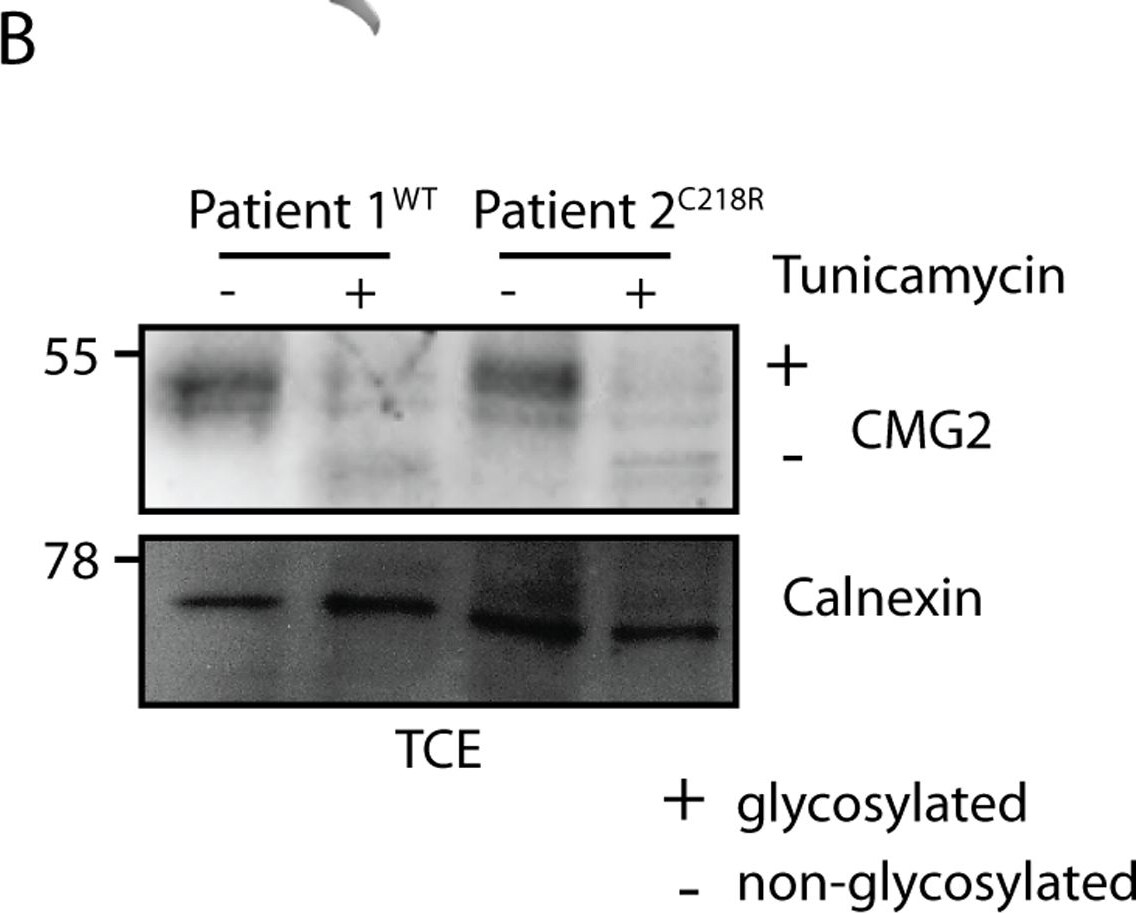
Detection of Human CMG-2/ANTXR2 by Immunoprecipitation
Glycosylation acts as a buffer for CMG2 ectodomain mutations.A) Graphic showing the disulfide bridge C39-C218 (blue) present in CMG2 WT B) Fibroblast cells were treated or not with tunicamycin for 16h and TCE were analyzed by SDS-PAGE and Western Blot. Representative Western Blot with control fibroblasts and patient fibroblasts. Calnexin serves as a loading control. C) Quantification of total protein levels. CMG2 levels are normalized to WT protein level without tunicamycin treatment, which was set to 100%. Statistics were calculated using an unpaired t-test. Errors represent standard deviation. n ≥ 3. * p≤0.05 Image collected and cropped by CiteAb from the following publication (https://pubmed.ncbi.nlm.nih.gov/25781883), licensed under a CC-BY license. Not internally tested by R&D Systems.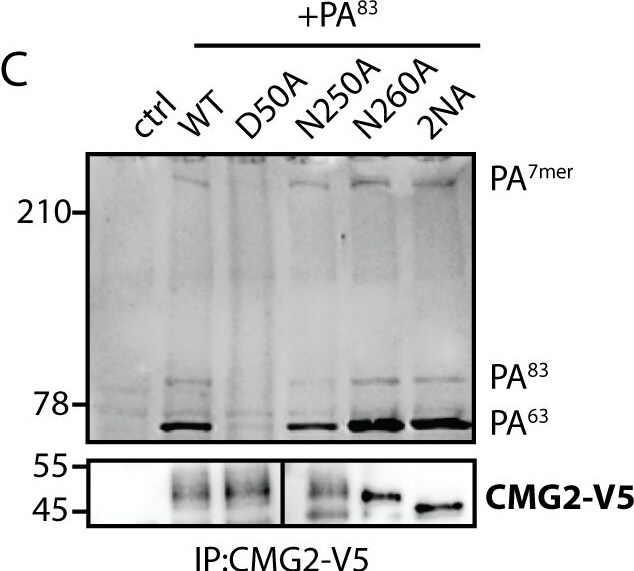
Detection of Human CMG-2/ANTXR2 by Immunoprecipitation
Loss of glycosylation affects binding of Anthrax toxin to TEM8 but not to CMG2.A and C) HeLa cells were transfected for 48h with the respective cDNAs. Cells were treated for 1h at 4°C with 500 ng/ml PA83 and shifted to 37°C for 10 min to induce cleavage and heptamerization. Immunoprecipitates against TEM8-HA/CMG2-V5 were analyzed by SDS-PAGE and Western Blotting against PA and TEM8-HA/CMG2-V5. Control cells are non-transfected. D50A is a binding deficient mutant that serves as a negative control. B and D) HeLa cells were transfected for 48h with the respective cDNAs. Cells were lysed and incubated for 1h at 4°C with 1 μg/ml PA83. Immunoprecipitates against TEM8-HA/CMG2-V5 were analyzed by SDS-PAGE and Western Blotting against PA and TEM8-HA/CMG2-V5. Control cells are non-transfected. D50A is a binding deficient mutant that serves as a negative control. Image collected and cropped by CiteAb from the following publication (https://pubmed.ncbi.nlm.nih.gov/25781883), licensed under a CC-BY license. Not internally tested by R&D Systems.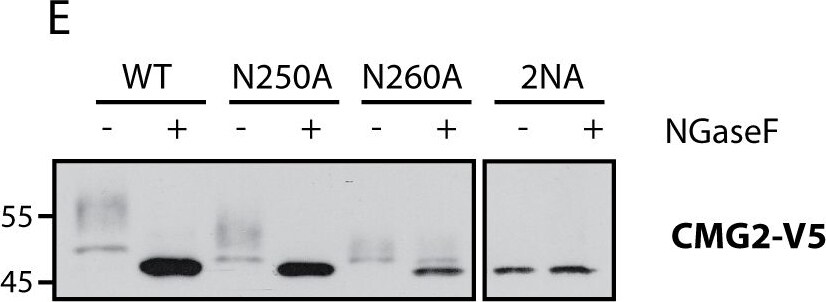
Detection of Human CMG-2/ANTXR2 by Immunoprecipitation
CMG2 and TEM8 can undergo N-glycosylation on all predicted sites.A) Graphics depicting glycosylation sites on TEM8 and CMG2. Sites in red are unique to the respective proteins, N260 in CMG2 (yellow) corresponds to N262 in TEM8. B) Expression of TEM8 glycosylation mutants in HeLa cells. Cells were transfected for 48h with the respective cDNAs. Expression was analyzed by SDS-PAGE and Western Blotting. C) Expression of all CMG2 glycosylation mutants in HeLa cells. Cells were transfected for 48h with the respective cDNAs. Expression was analyzed by SDS-PAGE and Western Blotting. D) Endoglycosidase F (NGaseF) treatment on TEM8 glycosylation mutants. 40 μg of cell extracts were treated or not with NGaseF and analyzed by SDS-PAGE and Western Blotting. E) Endoglycosidase F (NGaseF) treatment on CMG2 glycosylation mutants. 40 μg of cell extracts were treated or not with NGaseF and analyzed by SDS-PAGE and Western Blotting. Image collected and cropped by CiteAb from the following publication (https://pubmed.ncbi.nlm.nih.gov/25781883), licensed under a CC-BY license. Not internally tested by R&D Systems.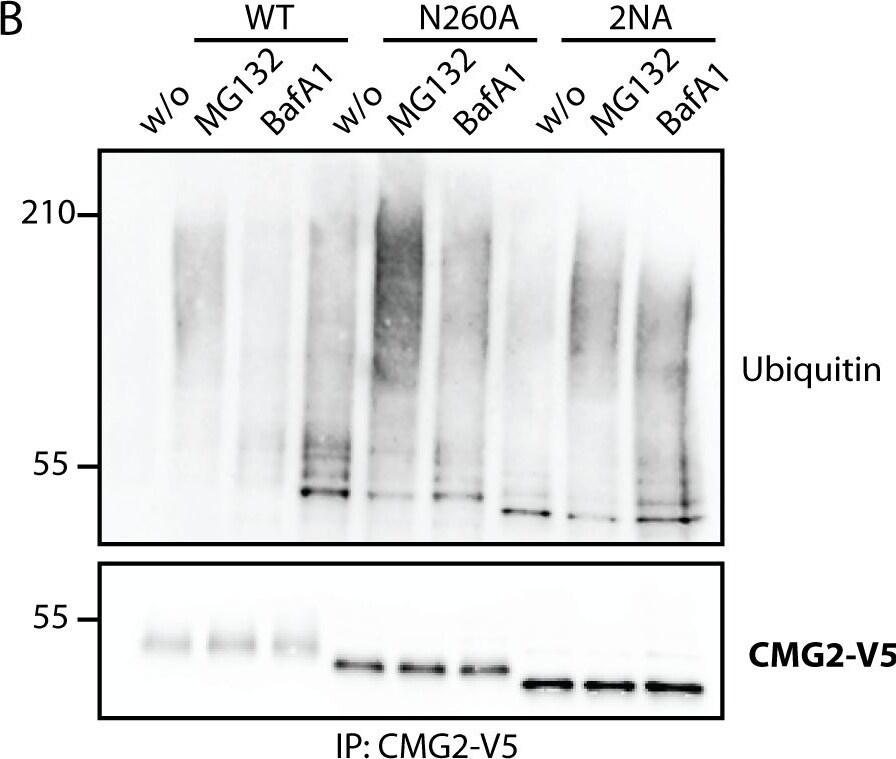
Detection of Human CMG-2/ANTXR2 by Western Blot
Non-glycosylated TEM8 is an ER quality control and ERAD substrate.A) HeLa cells were transfected for 48h with the respective cDNAs. Cells were treated or not with MG132, an inhibitor of the proteasome or Bafilomycin A1, a drug preventing endosomal acidification and thus lysosomal degradation. Immunoprecipitates against TEM8-HA were analyzed by SDS-PAGE and Western Blotting against Ubiquitin and TEM8-HA. B) HEK cells stably expressing CMG2 under the control of a tetracycline inducible promotor were induced for 24h with 0.1μg/ml doxycycline. Cells were treated or not with MG132 or Bafilomycin A1. Immunoprecipitates against CMG2-V5 were analyzed by SDS-PAGE and Western Blotting against Ubiquitin and CMG2-V5. C) HeLa cells were treated or not with tunicamycin, an antibiotic blocking the co-translational transfer of glycan sidechains in the ER by blocking the oligosaccharyltransferase (OST) for 16h. Surface proteins were labeled with biotin and immunoprecipitates against streptavidin were analysed for TEM8 or Calnexin as a negative control. D) RpeI cells were treated or not with tunicamycin for 16h. Surface proteins were labeled with biotin and immunoprecipitates against streptavidin were analysed for CMG2 or Calnexin as a negative control. Image collected and cropped by CiteAb from the following publication (https://pubmed.ncbi.nlm.nih.gov/25781883), licensed under a CC-BY license. Not internally tested by R&D Systems.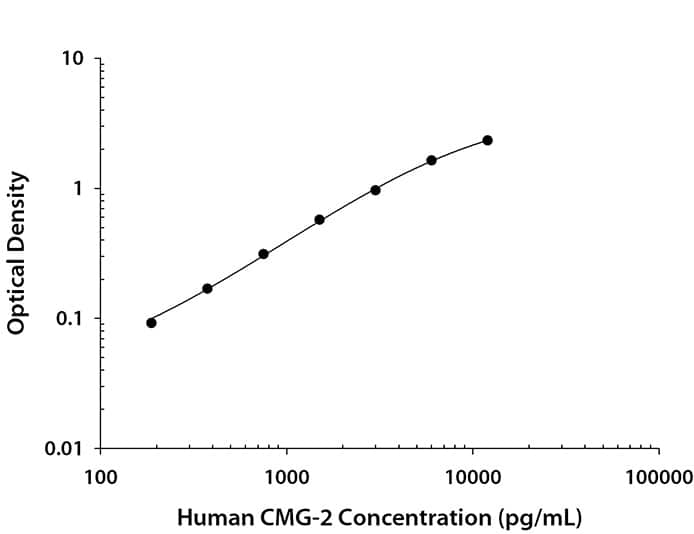
Human CMG-2 DuoSet ELISA Standard Curve
Recombinant Human CMG‑2/ANTXR2 (Catalog # 2940-CM) was serially diluted and captured by Mouse Anti-Human CMG‑2/ANTXR2 Monoclonal Antibody (Catalog # MAB29401) coated on a Clear Polystyrene Microplate (Catalog # DY990). Goat Anti-Human CMG‑2/ANTXR2 Antigen Affinity-purified Polyclonal Antibody (Catalog # AF2940) was biotinylated and incubated with the protein captured on the plate. Detection of the standard curve was achieved by incubating Streptavidin-HRP (Catalog # DY998)Applications for Human CMG-2/ANTXR2 Antibody
CyTOF-ready
ELISA
This antibody functions as an ELISA detection antibody when paired with Mouse Anti-Human CMG‑2/ANTXR2 Monoclonal Antibody (Catalog # MAB29401).
This product is intended for assay development on various assay platforms requiring antibody pairs.
Flow Cytometry
Sample: Human whole blood monocytes
Western Blot
Sample: Recombinant Human CMG‑2/ANTXR2 (Catalog # 2940-CM)
Flow Cytometry Panel Builder
Bio-Techne Knows Flow Cytometry
Save time and reduce costly mistakes by quickly finding compatible reagents using the Panel Builder Tool.
Advanced Features
- Spectra Viewer - Custom analysis of spectra from multiple fluorochromes
- Spillover Popups - Visualize the spectra of individual fluorochromes
- Antigen Density Selector - Match fluorochrome brightness with antigen density

Formulation, Preparation, and Storage
Purification
Reconstitution
Reconstitute at 0.2 mg/mL in sterile PBS. For liquid material, refer to CoA for concentration.
Formulation
Shipping
Stability & Storage
- 12 months from date of receipt, -20 to -70 °C as supplied.
- 1 month, 2 to 8 °C under sterile conditions after reconstitution.
- 6 months, -20 to -70 °C under sterile conditions after reconstitution.
Calculators
Background: CMG-2/ANTXR2
References
- Scobie, H.M. and J.A.T. Young (2005) Curr. Opin. Microbiol. 8:106.
- Scobie, H.M. et al. (2003) Proc. Natl. Acad. Sci. USA 100:5170.
- Bell, S.E. et al. (2001) J. Cell Sci. 114:2755.
- Lacy, D.B. et al. (2004) Proc. Natl. Acad. Sci. USA 101:6367.
- Santelli, E. et al. (2004) Nature 430:905.
- Dowling, O. et al. (2003) Am. J. Hum. Genet. 73:957.
- Wigelsworth, D.J. et al. (2004) J. Biol. Chem. 279:23349.
- Go, M.Y. et al. (2006) J. Mol. Biol. 360:145.
- Abrami, L. et al. (2006) J. Cell Biol. 172:309.
- Wei, W. et al. (2006) Cell 124:1141.
- Lacy, D.B. et al. (2004) Proc. Natl. Acad. Sci. USA 101:13147.
Long Name
Alternate Names
Gene Symbol
UniProt
Additional CMG-2/ANTXR2 Products
Product Documents for Human CMG-2/ANTXR2 Antibody
Certificate of Analysis
To download a Certificate of Analysis, please enter a lot or batch number in the search box below.
Note: Certificate of Analysis not available for kit components.
Product Specific Notices for Human CMG-2/ANTXR2 Antibody
For research use only
Related Research Areas
Citations for Human CMG-2/ANTXR2 Antibody
 Powered by Bioz
Customer Reviews for Human CMG-2/ANTXR2 Antibody
There are currently no reviews for this product. Be the first to review Human CMG-2/ANTXR2 Antibody and earn rewards!
Have you used Human CMG-2/ANTXR2 Antibody?
Submit a review and receive an Amazon gift card!
$25/€18/£15/$25CAN/¥2500 for a review with an image
$10/€7/£6/$10CAN/¥1110 for a review without an image
Submit a review
Protocols
Find general support by application which include: protocols, troubleshooting, illustrated assays, videos and webinars.
- 7-Amino Actinomycin D (7-AAD) Cell Viability Flow Cytometry Protocol
- Cellular Response to Hypoxia Protocols
- ELISA Sample Preparation & Collection Guide
- ELISA Troubleshooting Guide
- Extracellular Membrane Flow Cytometry Protocol
- Flow Cytometry Protocol for Cell Surface Markers
- Flow Cytometry Protocol for Staining Membrane Associated Proteins
- Flow Cytometry Staining Protocols
- Flow Cytometry Troubleshooting Guide
- How to Run an R&D Systems DuoSet ELISA
- How to Run an R&D Systems Quantikine ELISA
- How to Run an R&D Systems Quantikine™ QuicKit™ ELISA
- Intracellular Flow Cytometry Protocol Using Alcohol (Methanol)
- Intracellular Flow Cytometry Protocol Using Detergents
- Intracellular Nuclear Staining Flow Cytometry Protocol Using Detergents
- Intracellular Staining Flow Cytometry Protocol Using Alcohol Permeabilization
- Intracellular Staining Flow Cytometry Protocol Using Detergents to Permeabilize Cells
- Propidium Iodide Cell Viability Flow Cytometry Protocol
- Protocol for Liperfluo
- Protocol for the Characterization of Human Th22 Cells
- Protocol for the Characterization of Human Th9 Cells
- Protocol: Annexin V and PI Staining by Flow Cytometry
- Protocol: Annexin V and PI Staining for Apoptosis by Flow Cytometry
- Quantikine HS ELISA Kit Assay Principle, Alkaline Phosphatase
- Quantikine HS ELISA Kit Principle, Streptavidin-HRP Polymer
- R&D Systems Quality Control Western Blot Protocol
- Sandwich ELISA (Colorimetric) – Biotin/Streptavidin Detection Protocol
- Sandwich ELISA (Colorimetric) – Direct Detection Protocol
- Troubleshooting Guide: ELISA
- Troubleshooting Guide: Fluorokine Flow Cytometry Kits
- Troubleshooting Guide: Western Blot Figures
- Western Blot Conditions
- Western Blot Protocol
- Western Blot Protocol for Cell Lysates
- Western Blot Troubleshooting
- Western Blot Troubleshooting Guide
- View all Protocols, Troubleshooting, Illustrated assays and Webinars