
CRTAM (Class I-restricted T cell-associated molecule) is a nectin family member of the immunoglobulin superfamily that is expressed by activated CD8+ and NK T cells (1‑4). NK activation receptor engagement, but not cytokines, also induce NK CRTAM expression (4, 5). CRTAM is found in spleen, thymus, small intestine, peripheral blood, and surprisingly, in brain where it is highly expressed by Purkinje cells of the cerebellum (1, 2). Human CRTAM is a 393 amino acid (aa), 80 kDa type I transmembrane glycoprotein with a 17 aa signal sequence, a 269 aa extracellular domain (ECD), a 21 aa transmembrane segment, and an 84 aa cytoplasmic domain. The ECD has one V-type and one C1-type Ig-like domain, while the cytoplasmic region shows a potential class I PDZ domain (1‑5). Human CRTAM ECD shows 70%, 43%, and 63% aa identity with mouse, rat, and canine CRTAM ECD, respectively, but 73‑78% aa identity within the Ig-like domains. The V-type Ig-like domain mediates interaction with the corresponding domain on another nectin family member, IGSF4 (also called TSLC-1, Necl-2, Syncam or SgIGSF) (4, 5). CRTAM is a homodimer on the cell surface but does not show homotypic binding in trans (3‑5). The high affinity of CRTAM/IGSF4 adhesion allows CRTAM to disrupt IGSF4 homotypic interactions (3‑5). IGSF4 and T cell receptor co-engagement of CRTAM-expressing CD8+ cells induces increased IFN-gamma or IL-22 production (3, 4). A role in cancer surveillance through NK cell-mediated rejection of IGSF4-expressing tumors has been proposed (3‑5). IGSF4 is expressed broadly, including on epithelia, neurons, a subset of tonsillar B cells (4, 5), and a rare splenic T zone-restricted BCDA3+ dendritic cell population which interacts with CRTAM (3).
Human CRTAM Antibody (210206)
R&D Systems | Catalog # MAB1695

Scientific images may be resized, cropped, or adjusted for brightness or contrast for presentation purposes. These updates are limited to presentation and do not affect the underlying scientific interpretation of the data. Where available, additional source data may be provided upon request.
Key Product Details
Species Reactivity
Validated:
Cited:
Applications
Validated:
Cited:
Label
Antibody Source
Product Specifications
Immunogen
Ser18-Ser286
Accession # O95727
Specificity
Clonality
Host
Isotype
Scientific Data Images for Human CRTAM Antibody (210206)
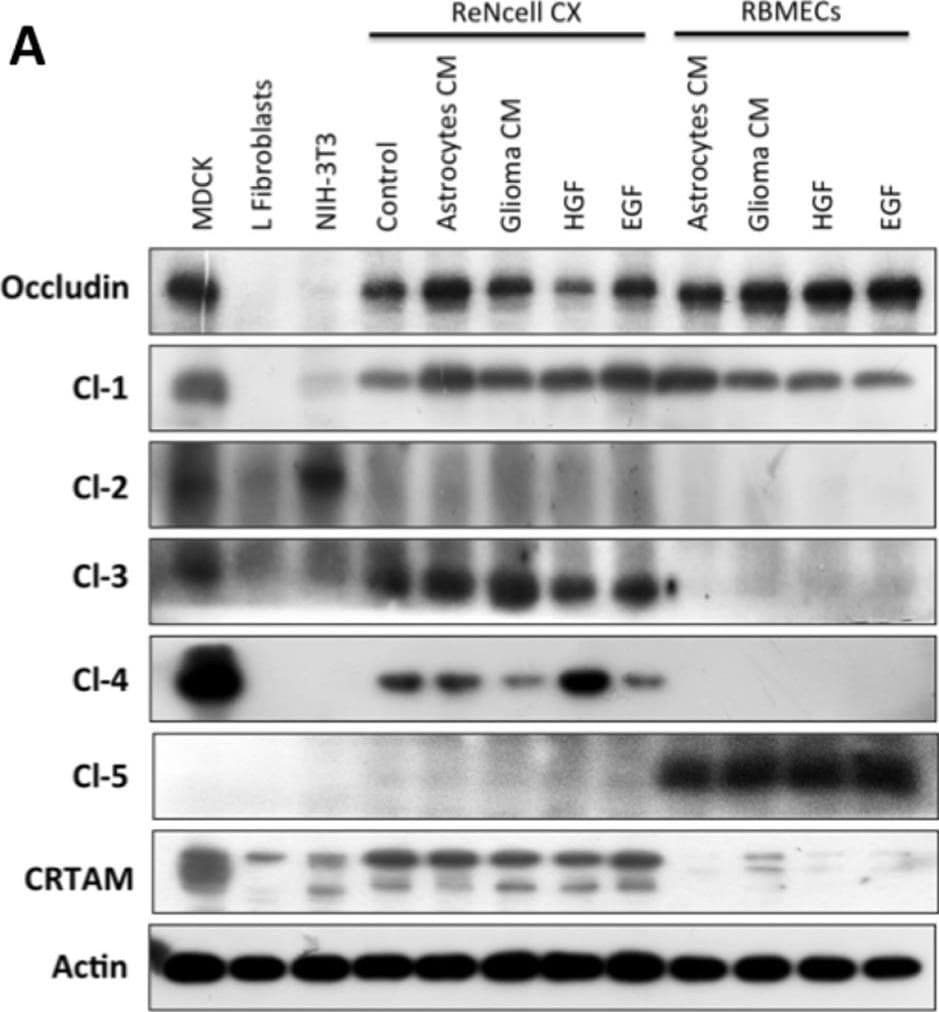
Detection of CRTAM by Western Blot
Expression of TJ proteins in transmigrating cells favors their passage across RBMECs.A) Analysis by Western blots of the expression of occludin, claudins 1 to 5 and CRTAM in NIH-3T3and L-fibroblasts, ReNcells CX and RBMECs. B) The transmigration of NIH-3T3 and L-fibroblasts acrossRBMECs is independent of the CM present in the basal compartment, but is significantly higher inNIH-3T3 fibroblasts that express claudin-2 than in L-fibroblast that do not express TJ proteins.N = 3, F(1,6) = 232.22, ***P<0.001; F(2,8) = 0.0895, ns = not significant; as assessed by two-wayANOVA followed by Bonferroni's post hoc test. C) Exogenous expression of occludin in L-fibroblastsenhances their transmigration across RBMECs monolayers. N = 9, t = 6.411, df = 8; ***P<0.001 asassessed by Student's t-test. D) Competing CRTAM mediated adhesion with soluble human CRTAM(CRTAM-Fc) added to the upper compartment of a Millicell insert, reduces transmigration of ReNcellsCX. N = 4, F(2,6) = 73.86; ***P<0.001, ns = not significant; as assessed by one-way ANOVAfollowed by Bonferroni's post hoc test. Image collected and cropped by CiteAb from the following open publication (https://pubmed.ncbi.nlm.nih.gov/23637756), licensed under a CC-BY license. Not internally tested by R&D Systems.Applications for Human CRTAM Antibody (210206)
Western Blot
Sample: Recombinant Human CRTAM Fc Chimera (Catalog # 1695-CR)
Formulation, Preparation, and Storage
Purification
Reconstitution
Reconstitute at 0.5 mg/mL in sterile PBS. For liquid material, refer to CoA for concentration.
Formulation
Shipping
Stability & Storage
- 12 months from date of receipt, -20 to -70 °C as supplied.
- 1 month, 2 to 8 °C under sterile conditions after reconstitution.
- 6 months, -20 to -70 °C under sterile conditions after reconstitution.
Calculators
Background: CRTAM
References
- Kennedy, J. et al. (2000) J. Leukoc. Biol. 67:725.
- Patino-Lopez, G. et al. (2006) J. Neuroimmunol. 171:145.
- Galibert, L. et al. (2005) J. Biol. Chem. 280:21955.
- Boles, K. S. et al. (2005) Blood 106:779.
- Arase, N. et al. (2005) Int. Immunol. 17:1227.
Long Name
Alternate Names
Gene Symbol
UniProt
Additional CRTAM Products
Product Documents for Human CRTAM Antibody (210206)
Certificate of Analysis
To download a Certificate of Analysis, please enter a lot or batch number in the search box below.
Note: Certificate of Analysis not available for kit components.
Product Specific Notices for Human CRTAM Antibody (210206)
For research use only
Related Research Areas
Citations for Human CRTAM Antibody (210206)
 Powered by Bioz
Customer Reviews for Human CRTAM Antibody (210206)
There are currently no reviews for this product. Be the first to review Human CRTAM Antibody (210206) and earn rewards!
Have you used Human CRTAM Antibody (210206)?
Submit a review and receive an Amazon gift card!
$25/€18/£15/$25CAN/¥2500 for a review with an image
$10/€7/£6/$10CAN/¥1110 for a review without an image
Submit a review
Protocols
Find general support by application which include: protocols, troubleshooting, illustrated assays, videos and webinars.
- Cellular Response to Hypoxia Protocols
- R&D Systems Quality Control Western Blot Protocol
- Troubleshooting Guide: Western Blot Figures
- Western Blot Conditions
- Western Blot Protocol
- Western Blot Protocol for Cell Lysates
- Western Blot Troubleshooting
- Western Blot Troubleshooting Guide
- View all Protocols, Troubleshooting, Illustrated assays and Webinars