
Human decoy receptor 3 (DcR3), also called TNFRSF6B, TR6 and M68, is a member of the TNF receptor superfamily. The cDNA of DcR3 encodes a 300 amino acid (aa) polypeptide with a putative 23 aa signal peptide. Like osteoprotegerin (OPG), DcR3 lacks a transmembrane sequence and is a secreted protein. DcR3 shares sequence identity with OPG (31%), TNFRII (29%) and Fas (17%). It was found to be expressed in a variety of different tissues and at high levels in many malignant tumors. Among TNF family members, DcR3 was shown to bind with Fas ligand (FasL) and LIGHT and inhibit FasL- and LIGHT-induced apoptosis. Thus, in addition to DcR1, DcR2 and OPG, DcR3 is another TNFR family molecule which modulates ligands that induce apoptosis. Overexpression of DcR3 might be a mechanism by which certain tumors escape immune-cytotoxic attack.
Human DcR3/TNFRSF6B Antibody (229812)
R&D Systems | Catalog # MAB2135

Scientific images may be resized, cropped, or adjusted for brightness or contrast for presentation purposes. These updates are limited to presentation and do not affect the underlying scientific interpretation of the data. Where available, additional source data may be provided upon request.
Key Product Details
Species Reactivity
Validated:
Cited:
Applications
Validated:
Cited:
Label
Antibody Source
Product Specifications
Immunogen
Val24-His300
Accession # O95407
Specificity
Clonality
Host
Isotype
Endotoxin Level
Scientific Data Images for Human DcR3/TNFRSF6B Antibody (229812)
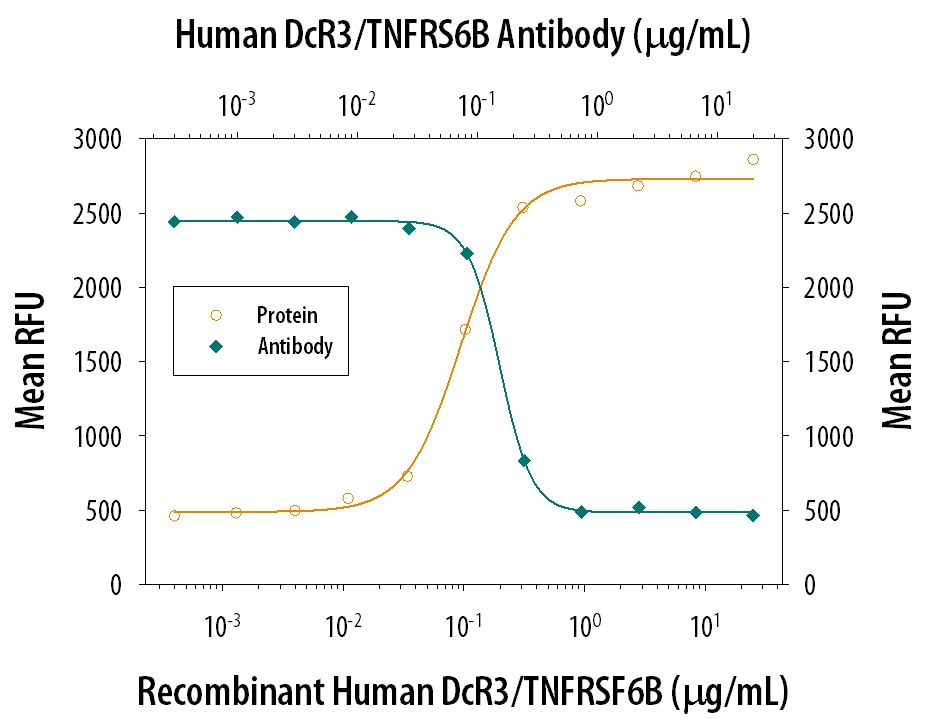
DcR3/TNFRSF6B Inhibition of Fas Ligand/TNFSF6-induced Apoptosis and Neutralization by Human DcR3/TNFRSF6B Antibody.
In the presence of a cross-linking antibody, Mouse polyHistidine Monoclonal Antibody (10 µg/mL, Catalog # MAB050), Recombinant Human DcR3/TNFRSF6B Fc Chimera (Catalog # 142-DC) inhibits Recombinant Human Fas Ligand/TNFSF6 (Catalog # 126-FL) induced apoptosis in the Jurkat human acute T cell leukemia cell line in a dose-dependent manner (orange line). Under these conditions, inhibition of Recombinant Human Fas Ligand/TNFSF6 (20 ng/mL) activity elicited by Recombinant Human DcR3/TNFRSF6B Fc Chimera (1 µg/mL) is neutralized (green line) by increasing concentrations of Mouse Anti-Human DcR3/TNFRSF6B Monoclonal Antibody (Catalog # MAB2135). The ND50 is typically 0.1-0.4 µg/mL.
Human DcR3 / TNFRSF6B ELISA Standard Curve
Recombinant Human DcR3/TNFRSF6B Fc Chimera (Catalog # 142-DC) was serially diluted and captured by Mouse Anti-Human DcR3/TNFRSF6B Monoclonal Antibody (Catalog # MAB21351) coated on a Clear Polystyrene Microplate (Catalog # DY990). Mouse Anti-Human DcR3/TNFRSF6B Monoclonal Antibody (Catalog # MAB2135) was biotinylated and incubated with the protein captured on the plate. Detection of the standard curve was achieved by incubating Streptavidin-HRP (Catalog # DY998)Applications for Human DcR3/TNFRSF6B Antibody (229812)
Western Blot
Sample: Recombinant Human DcR3/TNFRSF6B Fc Chimera (Catalog # 142-DC)
under non-reducing conditions only
Neutralization
Reviewed Applications
Read 1 review rated 5 using MAB2135 in the following applications:
Formulation, Preparation, and Storage
Purification
Reconstitution
Reconstitute at 0.5 mg/mL in sterile PBS. For liquid material, refer to CoA for concentration.
Formulation
Shipping
Stability & Storage
- 12 months from date of receipt, -20 to -70 °C as supplied.
- 1 month, 2 to 8 °C under sterile conditions after reconstitution.
- 6 months, -20 to -70 °C under sterile conditions after reconstitution.
Calculators
Background: DcR3/TNFRSF6B
References
- Pitti, R.M. et al. (1998) Nature 396:699.
- Yu, K-Y. et al. (1999) J. Biochem. Chem. 274:13733.
- Bai, C. et al. (2000) Proc. Natl. Acad. Sci. USA. 97:1230.
Long Name
Alternate Names
Gene Symbol
UniProt
Additional DcR3/TNFRSF6B Products
Product Documents for Human DcR3/TNFRSF6B Antibody (229812)
Certificate of Analysis
To download a Certificate of Analysis, please enter a lot or batch number in the search box below.
Note: Certificate of Analysis not available for kit components.
Product Specific Notices for Human DcR3/TNFRSF6B Antibody (229812)
For research use only
Related Research Areas
Citations for Human DcR3/TNFRSF6B Antibody (229812)
 Powered by Bioz
Customer Reviews for Human DcR3/TNFRSF6B Antibody (229812) (1)
Have you used Human DcR3/TNFRSF6B Antibody (229812)?
Submit a review and receive an Amazon gift card!
$25/€18/£15/$25CAN/¥2500 for a review with an image
$10/€7/£6/$10CAN/¥1110 for a review without an image
Submit a review
-
Application: ELISASample Tested: Cell culture supernatantSpecies: HumanVerified Customer | Posted 09/23/2016
There are no reviews that match your criteria.
Protocols
Find general support by application which include: protocols, troubleshooting, illustrated assays, videos and webinars.
- Cellular Response to Hypoxia Protocols
- R&D Systems Quality Control Western Blot Protocol
- Troubleshooting Guide: Western Blot Figures
- Western Blot Conditions
- Western Blot Protocol
- Western Blot Protocol for Cell Lysates
- Western Blot Troubleshooting
- Western Blot Troubleshooting Guide
- View all Protocols, Troubleshooting, Illustrated assays and Webinars
Associated Pathways
