
Desmoglein-2 is one of three members of the desmoglein subfamily of calcium-dependent cadherin cell adhesion molecules. Together with desmocollins, another subfamily within the cadherin superfamily, the desmoglein isoforms form the adhesive components of desmosomes, the cell-cell adhesive structures that are found in epithelial cells. Human Desmoglein-2 is a type I transmembrane glycoprotein of 1117 amino acid (aa) residues with a 23 aa signal peptide and a 25 aa propeptide. It differs from other classic cadherins by having four instead of five cadherin repeat domains in its extracellular region, and a much larger cytoplasmic region containing five desmoglein repeat domains which share homology with the cadherin repeats. Instead of having the HAV adhesion motif found in type I cadherins, desmogleins have R/YAL as the adhesion motif on its amino-terminal cadherin repeat. The cytoplasmic tails of desmogleins interact with desmoplakins, plakoglobin and plakophilins. In turn, these proteins link the desmogleins with the intermediate filaments. Desmoglein-2 has been shown to be important in establishing cell-cell adhesion and function in epithelial cells. Desmoglein-2 was originally identified in colon carcinoma and colon, and was named HDGC (human desmoglein colon).
Human Desmoglein-2 Antibody
R&D Systems | Catalog # AF947

Scientific images may be resized, cropped, or adjusted for brightness or contrast for presentation purposes. These updates are limited to presentation and do not affect the underlying scientific interpretation of the data. Where available, additional source data may be provided upon request.
Key Product Details
Species Reactivity
Validated:
Cited:
Applications
Validated:
Cited:
Label
Antibody Source
Product Specifications
Immunogen
Met1-Gly608
Accession # CAA81226
Specificity
Clonality
Host
Isotype
Scientific Data Images for Human Desmoglein-2 Antibody
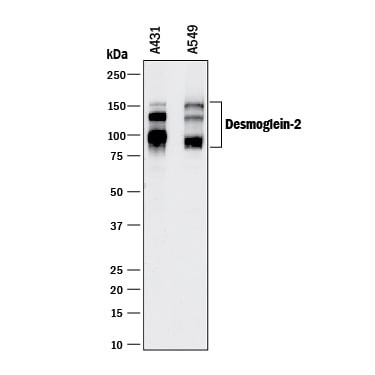
Detection of Human Desmoglein‑2 by Western Blot.
Western blot shows lysates of A431 human epithelial carcinoma cell line and A549 human lung carcinoma cell line. PVDF membrane was probed with 0.25 µg/mL of Goat Anti-Human Desmoglein-2 Antigen Affinity-purified Polyclonal Antibody (Catalog # AF947) followed by HRP-conjugated Anti-Goat IgG Secondary Antibody (Catalog # HAF017). Specific bands were detected for Desmoglein-2 at approximately 90-160 kDa (as indicated). This experiment was conducted under reducing conditions and using Immunoblot Buffer Group 1.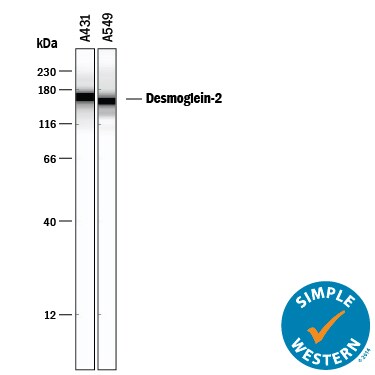
Detection of Human Desmoglein‑2 by Simple WesternTM.
Simple Western lane view shows lysates of A431 human epithelial carcinoma cell line and A549 human lung carcinoma cell line, loaded at 0.2 mg/mL. A specific band was detected for Desmoglein-2 at approximately 159-164 kDa (as indicated) using 5 µg/mL of Goat Anti-Human Desmoglein-2 Antigen Affinity-purified Polyclonal Antibody (Catalog # AF947) followed by 1:50 dilution of HRP-conjugated Anti-Goat IgG Secondary Antibody (Catalog # HAF109). This experiment was conducted under reducing conditions and using the 12-230 kDa separation system.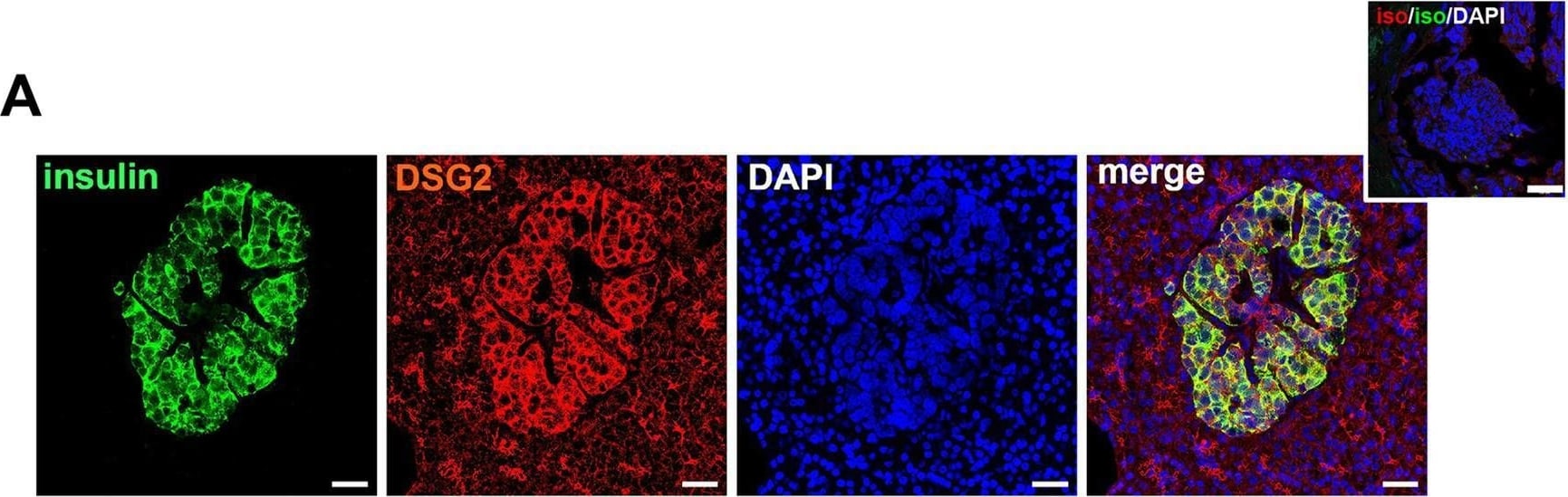
Detection of Desmoglein-2 by Immunohistochemistry
DSG2 protein and gene expression by human islets. A Immunofluorescence confocal microscopy of human pancreas from a healthy body donor stained for insulin (green), DSG2 (red), and nuclei (blue). Scale bar = 20 μm. Insert top right is representative of isotype control stains. B Surface expression of DSG2 by flow cytometric analysis on freshly isolated human islet cells from healthy donors labelled with Newport Green (NPG) dye identifying beta -cells, isotype control (dotted line), and DSG2 (solid line); with all single cells gated from a live population (7-AAD). C Immunofluorescence microscopy of partly digested human islets from a healthy donor stained for beta -cells by labelling for insulin (green), DSG2 (red), and nuclei (blue). Scale bar = 10 μm. Insert top right is representative of isotype control stains. D Microarray gene expression of insulin (INS, green), desmoglein's (DSG1-4, red), and desmocollins (DSC1-3, purple) in isolated islet preparations from 9 healthy human body donors. Data represented as the average log2 expression ± SEM with a threshold cut off of 5. E Complete RNA sequencing data from 188 human islets expressed as log2 FPKM (Fragments Per Kilobase Million, value of 1 noted in blue line) with ranked expression of DSG2 (red line) compared to insulin (INS, grey line) and potassium channel (KCNJ1, grey line). Image collected and cropped by CiteAb from the following open publication (https://pubmed.ncbi.nlm.nih.gov/36309486), licensed under a CC-BY license. Not internally tested by R&D Systems.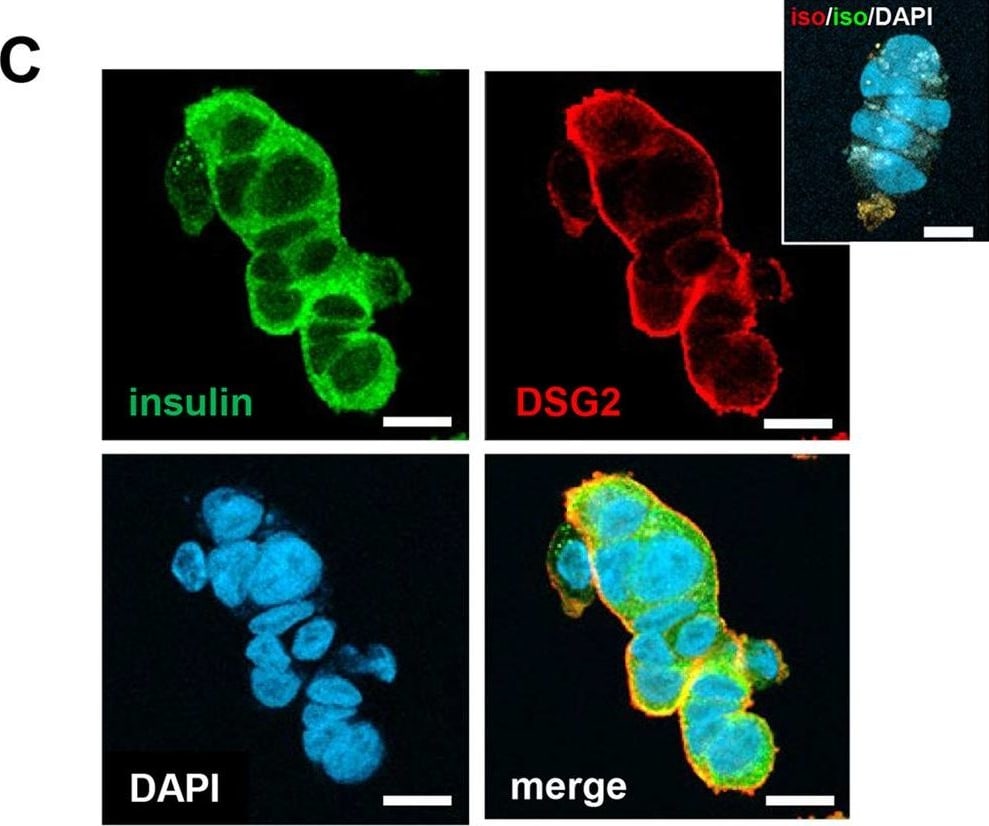
Detection of Desmoglein-2 by Immunocytochemistry/ Immunofluorescence
DSG2 protein and gene expression by human islets. A Immunofluorescence confocal microscopy of human pancreas from a healthy body donor stained for insulin (green), DSG2 (red), and nuclei (blue). Scale bar = 20 μm. Insert top right is representative of isotype control stains. B Surface expression of DSG2 by flow cytometric analysis on freshly isolated human islet cells from healthy donors labelled with Newport Green (NPG) dye identifying beta -cells, isotype control (dotted line), and DSG2 (solid line); with all single cells gated from a live population (7-AAD). C Immunofluorescence microscopy of partly digested human islets from a healthy donor stained for beta -cells by labelling for insulin (green), DSG2 (red), and nuclei (blue). Scale bar = 10 μm. Insert top right is representative of isotype control stains. D Microarray gene expression of insulin (INS, green), desmoglein's (DSG1-4, red), and desmocollins (DSC1-3, purple) in isolated islet preparations from 9 healthy human body donors. Data represented as the average log2 expression ± SEM with a threshold cut off of 5. E Complete RNA sequencing data from 188 human islets expressed as log2 FPKM (Fragments Per Kilobase Million, value of 1 noted in blue line) with ranked expression of DSG2 (red line) compared to insulin (INS, grey line) and potassium channel (KCNJ1, grey line). Image collected and cropped by CiteAb from the following open publication (https://pubmed.ncbi.nlm.nih.gov/36309486), licensed under a CC-BY license. Not internally tested by R&D Systems.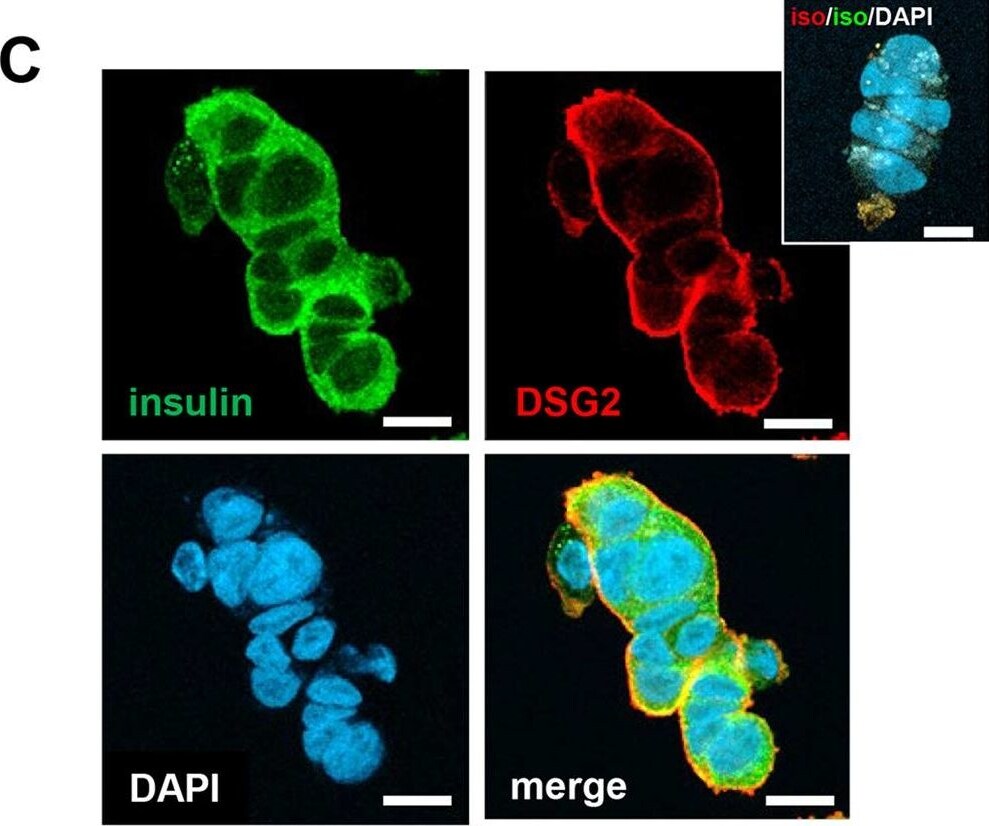
Detection of Desmoglein-2 by Immunocytochemistry/ Immunofluorescence
DSG2 protein and gene expression by human islets. A Immunofluorescence confocal microscopy of human pancreas from a healthy body donor stained for insulin (green), DSG2 (red), and nuclei (blue). Scale bar = 20 μm. Insert top right is representative of isotype control stains. B Surface expression of DSG2 by flow cytometric analysis on freshly isolated human islet cells from healthy donors labelled with Newport Green (NPG) dye identifying beta -cells, isotype control (dotted line), and DSG2 (solid line); with all single cells gated from a live population (7-AAD). C Immunofluorescence microscopy of partly digested human islets from a healthy donor stained for beta -cells by labelling for insulin (green), DSG2 (red), and nuclei (blue). Scale bar = 10 μm. Insert top right is representative of isotype control stains. D Microarray gene expression of insulin (INS, green), desmoglein's (DSG1-4, red), and desmocollins (DSC1-3, purple) in isolated islet preparations from 9 healthy human body donors. Data represented as the average log2 expression ± SEM with a threshold cut off of 5. E Complete RNA sequencing data from 188 human islets expressed as log2 FPKM (Fragments Per Kilobase Million, value of 1 noted in blue line) with ranked expression of DSG2 (red line) compared to insulin (INS, grey line) and potassium channel (KCNJ1, grey line). Image collected and cropped by CiteAb from the following open publication (https://pubmed.ncbi.nlm.nih.gov/36309486), licensed under a CC-BY license. Not internally tested by R&D Systems.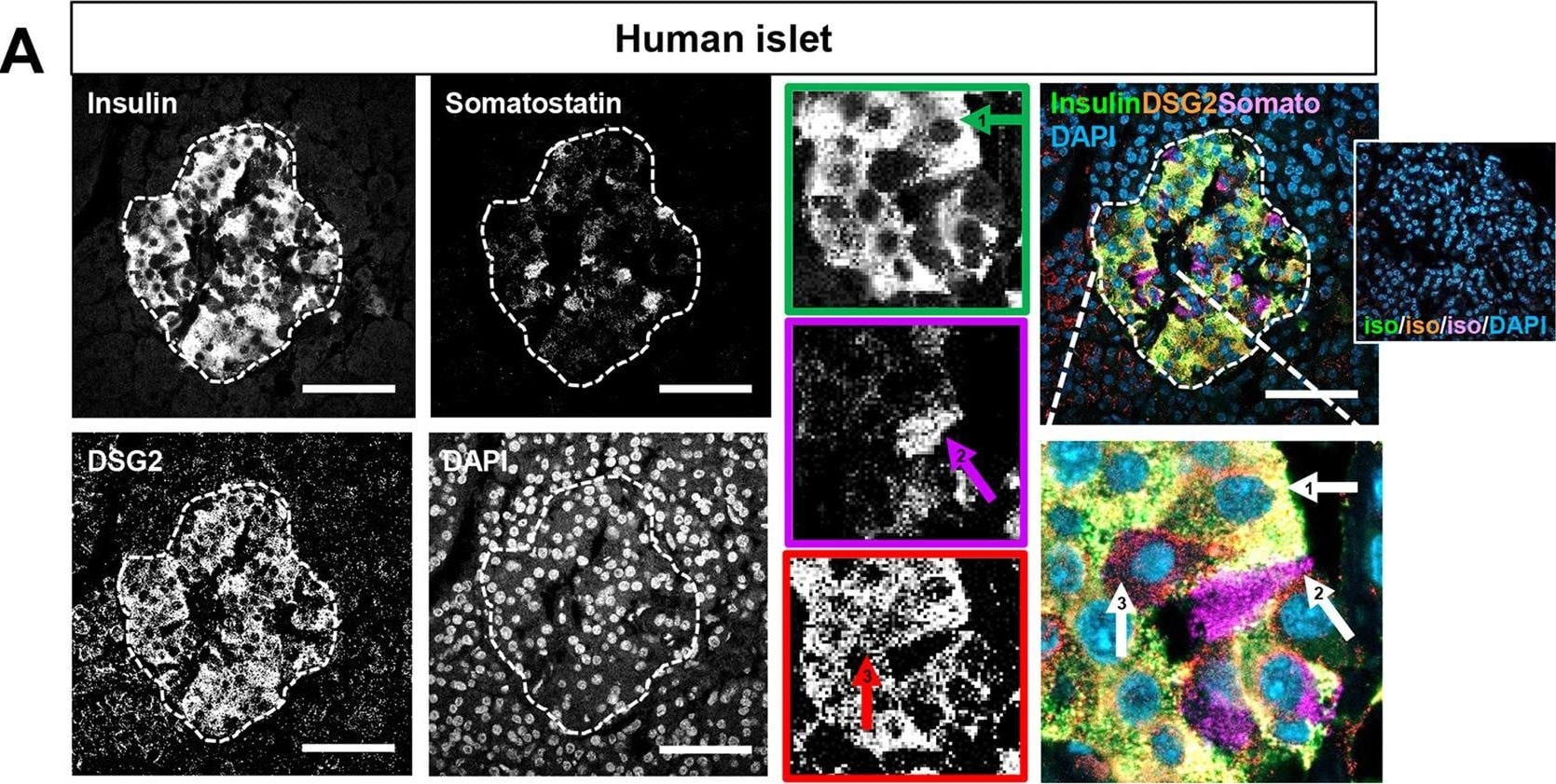
Detection of Desmoglein-2 by Immunohistochemistry
DSG2 expression by select cell types in the islets of humans and mice. Immunofluorescence confocal microscopy of A human and B mouse islets stained for insulin (green), DSG2 (red), somatostatin (magenta), and nuclei (DAPI, blue). Insets with arrow labelled ‘1’ indicating insulin-positive cells, arrow labelled ‘2’ indicating somatostatin positive cells, and cells with neither insulin nor somatostatin staining indicated with arrow labelled ‘3’. Scale bar = 50 μm. Insert top right is representative of isotype control stains. C Mouse pancreata were isolated from wildtype (WT, black circles) and Dsg2lo/lo (blue squares) mice and Dsg2 gene expression determined via qRT-PCR. Data are expressed as mean ± SEM relative to housekeeper gene (Hprt1), n = 4 mice per group, *p < 0.05 vs WT. D Immunofluorescence confocal microscopy of pancreas sections from WT and Dsg2lo/lo mice stained for insulin (green), DSG2 (red), and nuclei (blue). Red arrow indicating blood vessels. Scale bar = 50 μm. Image collected and cropped by CiteAb from the following open publication (https://pubmed.ncbi.nlm.nih.gov/36309486), licensed under a CC-BY license. Not internally tested by R&D Systems.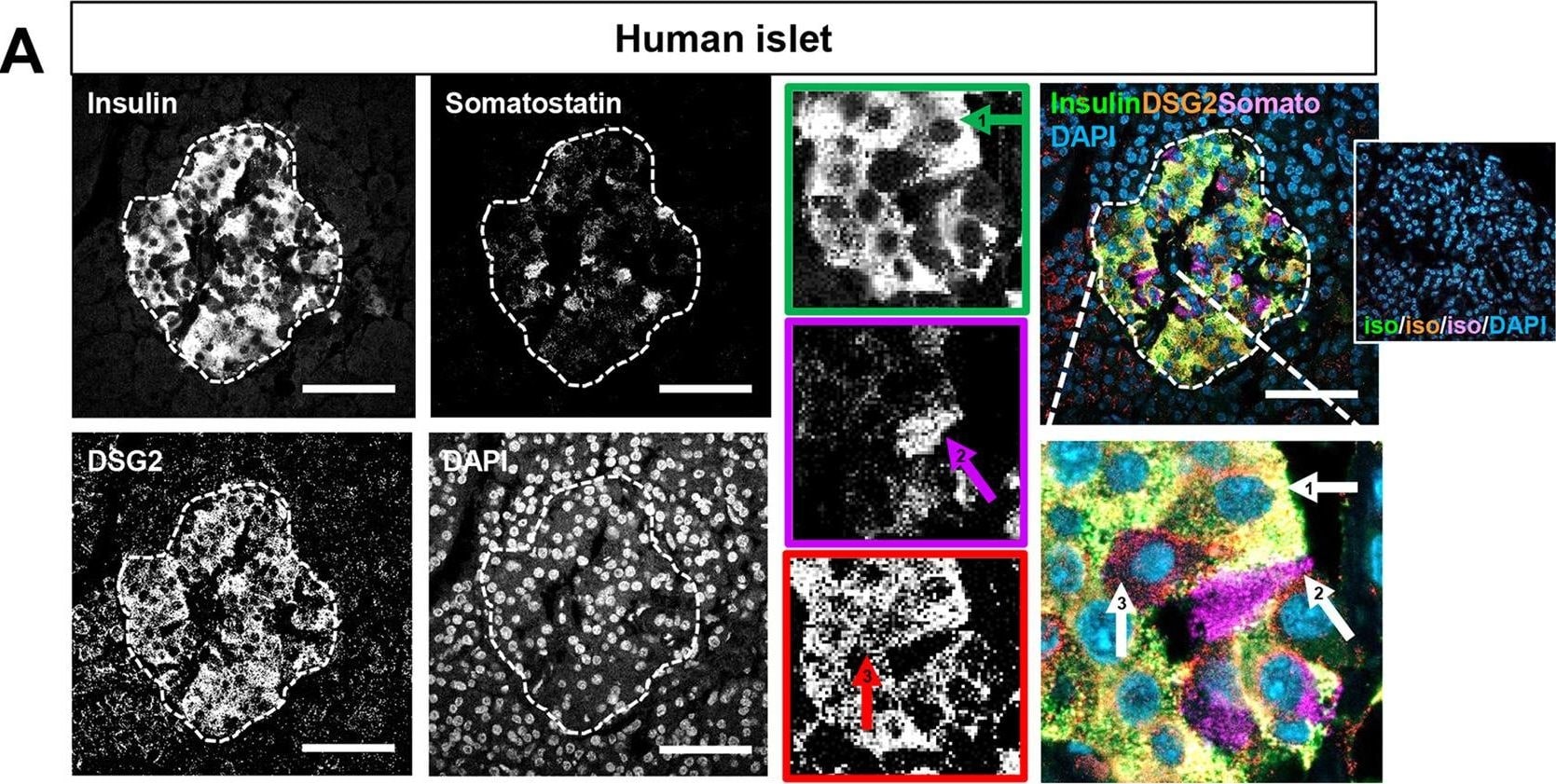
Detection of Desmoglein-2 by Immunohistochemistry
DSG2 expression by select cell types in the islets of humans and mice. Immunofluorescence confocal microscopy of A human and B mouse islets stained for insulin (green), DSG2 (red), somatostatin (magenta), and nuclei (DAPI, blue). Insets with arrow labelled ‘1’ indicating insulin-positive cells, arrow labelled ‘2’ indicating somatostatin positive cells, and cells with neither insulin nor somatostatin staining indicated with arrow labelled ‘3’. Scale bar = 50 μm. Insert top right is representative of isotype control stains. C Mouse pancreata were isolated from wildtype (WT, black circles) and Dsg2lo/lo (blue squares) mice and Dsg2 gene expression determined via qRT-PCR. Data are expressed as mean ± SEM relative to housekeeper gene (Hprt1), n = 4 mice per group, *p < 0.05 vs WT. D Immunofluorescence confocal microscopy of pancreas sections from WT and Dsg2lo/lo mice stained for insulin (green), DSG2 (red), and nuclei (blue). Red arrow indicating blood vessels. Scale bar = 50 μm. Image collected and cropped by CiteAb from the following open publication (https://pubmed.ncbi.nlm.nih.gov/36309486), licensed under a CC-BY license. Not internally tested by R&D Systems.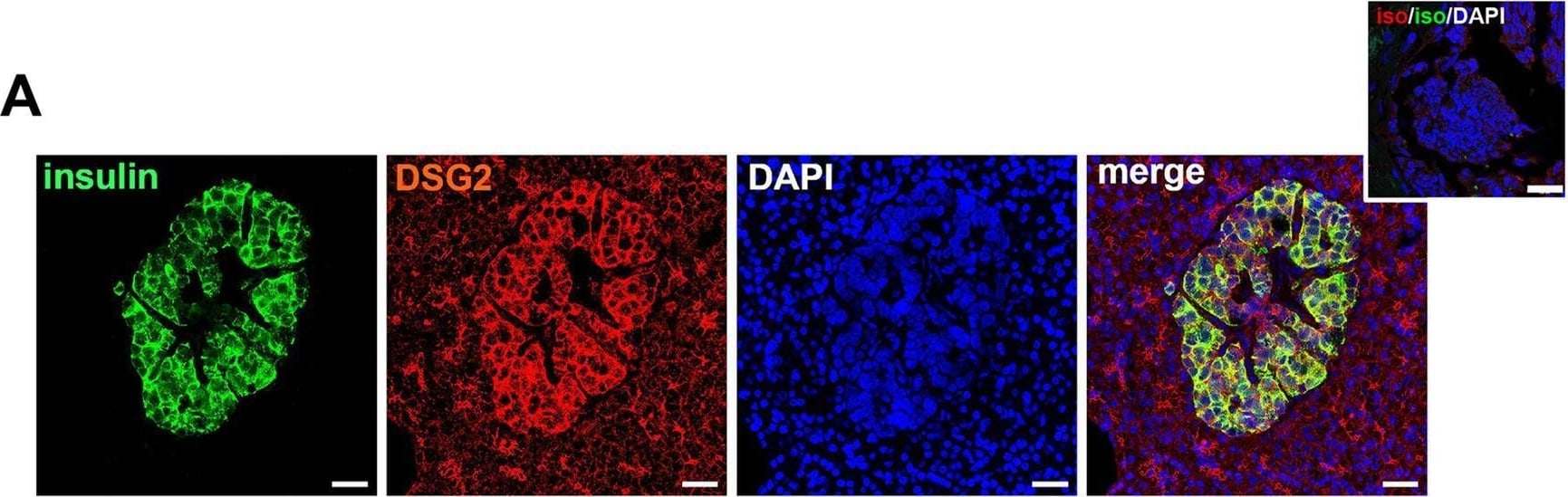
Detection of Desmoglein-2 by Immunohistochemistry
DSG2 protein and gene expression by human islets. A Immunofluorescence confocal microscopy of human pancreas from a healthy body donor stained for insulin (green), DSG2 (red), and nuclei (blue). Scale bar = 20 μm. Insert top right is representative of isotype control stains. B Surface expression of DSG2 by flow cytometric analysis on freshly isolated human islet cells from healthy donors labelled with Newport Green (NPG) dye identifying beta -cells, isotype control (dotted line), and DSG2 (solid line); with all single cells gated from a live population (7-AAD). C Immunofluorescence microscopy of partly digested human islets from a healthy donor stained for beta -cells by labelling for insulin (green), DSG2 (red), and nuclei (blue). Scale bar = 10 μm. Insert top right is representative of isotype control stains. D Microarray gene expression of insulin (INS, green), desmoglein's (DSG1-4, red), and desmocollins (DSC1-3, purple) in isolated islet preparations from 9 healthy human body donors. Data represented as the average log2 expression ± SEM with a threshold cut off of 5. E Complete RNA sequencing data from 188 human islets expressed as log2 FPKM (Fragments Per Kilobase Million, value of 1 noted in blue line) with ranked expression of DSG2 (red line) compared to insulin (INS, grey line) and potassium channel (KCNJ1, grey line). Image collected and cropped by CiteAb from the following open publication (https://pubmed.ncbi.nlm.nih.gov/36309486), licensed under a CC-BY license. Not internally tested by R&D Systems.Applications for Human Desmoglein-2 Antibody
Simple Western
Sample: A431 human epithelial carcinoma cell line and A549 human lung carcinoma cell line
Western Blot
Sample: A431 human epithelial carcinoma cell line and A549 human lung carcinoma cell line
Formulation, Preparation, and Storage
Purification
Reconstitution
Reconstitute at 0.2 mg/mL in sterile PBS. For liquid material, refer to CoA for concentration.
Formulation
Shipping
Stability & Storage
- 12 months from date of receipt, -20 to -70 °C as supplied.
- 1 month, 2 to 8 °C under sterile conditions after reconstitution.
- 6 months, -20 to -70 °C under sterile conditions after reconstitution.
Calculators
Background: Desmoglein-2
References
- Nollet, R. et al. (2000) J. Mol. Biol. 299:551.
- Elias, P. et al. (2001) J. Cell Biol. 153:243.
- Arnemann, J. et al. (1992) Genomics 13:484.
Alternate Names
Gene Symbol
UniProt
Additional Desmoglein-2 Products
Product Documents for Human Desmoglein-2 Antibody
Certificate of Analysis
To download a Certificate of Analysis, please enter a lot or batch number in the search box below.
Note: Certificate of Analysis not available for kit components.
Product Specific Notices for Human Desmoglein-2 Antibody
For research use only
Related Research Areas
Citations for Human Desmoglein-2 Antibody
 Powered by Bioz
Customer Reviews for Human Desmoglein-2 Antibody
There are currently no reviews for this product. Be the first to review Human Desmoglein-2 Antibody and earn rewards!
Have you used Human Desmoglein-2 Antibody?
Submit a review and receive an Amazon gift card!
$25/€18/£15/$25CAN/¥2500 for a review with an image
$10/€7/£6/$10CAN/¥1110 for a review without an image
Submit a review
Protocols
Find general support by application which include: protocols, troubleshooting, illustrated assays, videos and webinars.
- Cellular Response to Hypoxia Protocols
- R&D Systems Quality Control Western Blot Protocol
- Troubleshooting Guide: Western Blot Figures
- Western Blot Conditions
- Western Blot Protocol
- Western Blot Protocol for Cell Lysates
- Western Blot Troubleshooting
- Western Blot Troubleshooting Guide
- View all Protocols, Troubleshooting, Illustrated assays and Webinars