Glut1 belongs to the facilitative glucose transport protein family that comprises 13 members. It is an integral membrane protein with 12 transmembrane domains and is expressed at variable levels in many tissues including brain endothelial cells, CD8+ T cells, and erythrocytes (1‑5). Glut1 is a major glucose transporter that mediates glucose transport across the mammalian blood‑brain barrier.
Human Glut1 Antibody (202921)
R&D Systems | Catalog # MAB14181

Scientific images may be resized, cropped, or adjusted for brightness or contrast for presentation purposes. These updates are limited to presentation and do not affect the underlying scientific interpretation of the data. Where available, additional source data may be provided upon request.
Key Product Details
Species Reactivity
Validated:
Human
Cited:
Human
Applications
Validated:
Western Blot, Simple Western
Cited:
Western Blot
Label
Unconjugated
Antibody Source
Monoclonal Mouse IgG3 Clone # 202921
Loading...
Product Specifications
Immunogen
NS0 mouse myeloma cell line transfected with human Glut1
Met1-Val492
Accession # AAA52571
Met1-Val492
Accession # AAA52571
Specificity
Detects human Glut1 in ELISAs.
Clonality
Monoclonal
Host
Mouse
Isotype
IgG3
Scientific Data Images for Human Glut1 Antibody (202921)
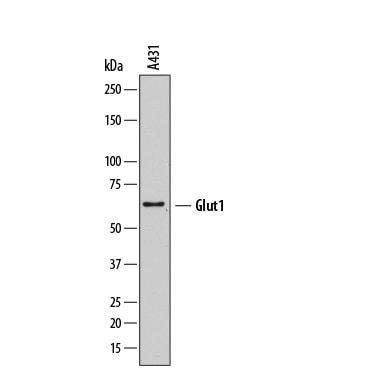
Detection of Human Glut1 by Western Blot.
Western blot shows lysates of A431 human epithelial carcinoma cell line. PVDF membrane was probed with 2 µg/mL of Mouse Anti-Human Glut1 Monoclonal Antibody (Catalog # MAB14181) followed by HRP-conjugated Anti-Mouse IgG Secondary Antibody (Catalog # HAF007). A specific band was detected for Glut1 at approximately 60 kDa (as indicated). This experiment was conducted under reducing conditions and using Immunoblot Buffer Group 1.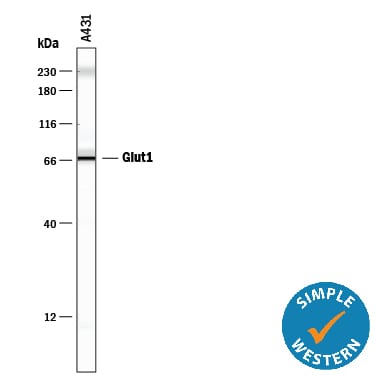
Detection of Human Glut1 by Simple WesternTM.
Simple Western lane view shows lysates of A431 human epithelial carcinoma cell line, loaded at 0.2 mg/mL. A specific band was detected for Glut1 at approximately 69 kDa (as indicated) using 20 µg/mL of Mouse Anti-Human Glut1 Monoclonal Antibody (Catalog # MAB14181). This experiment was conducted under reducing conditions and using the 12-230 kDa separation system. Non-specific interaction with the 230 kDa Simple Western standard may be seen with this antibody.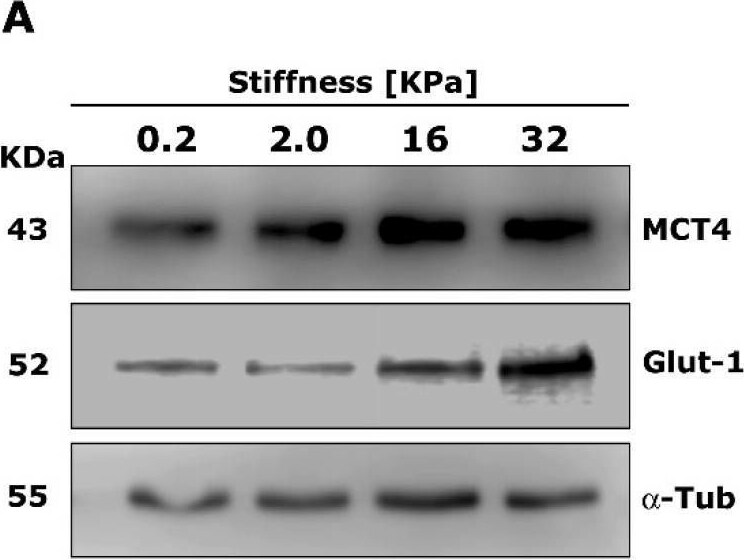
Detection of Glut1 by Western Blot
Extracellular matrix stiffness modulates the expression of monocarboxylate transporters in mammary stromal cells. RMF 621 cells (2.5 × 10⁵ per plate) were incubated on plates displaying increasing stiffness and coated with collagen I, as described above, in media +10% FCS. Afterward, 72 cells were lysed and Western blots of MCT4 (A) and Glut1 (B) were performed as described in Section 4. Densitometric analyses of three different experiments were performed from three independent experiments, as shown in (C). The data are presented as the means ± standard error (SEM). (*) and (**) indicate statistically significant differences, with p ≤ 0.05 and p ≤ 0.01, respectively, using the Friedman test followed by Dunn’s posthoc test. Image collected and cropped by CiteAb from the following open publication (https://pubmed.ncbi.nlm.nih.gov/34357326), licensed under a CC-BY license. Not internally tested by R&D Systems.Applications for Human Glut1 Antibody (202921)
Application
Recommended Usage
Simple Western
20 µg/mL
Sample: A431 human epithelial carcinoma cell line
Sample: A431 human epithelial carcinoma cell line
Western Blot
2 µg/mL
Sample: A431 human epithelial carcinoma cell line
Sample: A431 human epithelial carcinoma cell line
Formulation, Preparation, and Storage
Purification
Protein A or G purified from hybridoma culture supernatant
Reconstitution
Reconstitute at 0.5 mg/mL in sterile PBS. For liquid material, refer to CoA for concentration.
Loading...
Formulation
Lyophilized from a 0.2 μm filtered solution in PBS with Trehalose. *Small pack size (SP) is supplied either lyophilized or as a 0.2 µm filtered solution in PBS.
Shipping
Lyophilized product is shipped at ambient temperature. Liquid small pack size (-SP) is shipped with polar packs. Upon receipt, store immediately at the temperature recommended below.
Stability & Storage
Use a manual defrost freezer and avoid repeated freeze-thaw cycles.
- 12 months from date of receipt, -20 to -70 °C as supplied.
- 1 month, 2 to 8 °C under sterile conditions after reconstitution.
- 6 months, -20 to -70 °C under sterile conditions after reconstitution.
Calculators
Background: Glut1
References
- Mueckler, M. et al. 1994, Eur. J. Biochem. 219:713.
- Meuckler, M. et al. 1985, Science 229:941.
- Jones, K.S. et al. 2006, J. Virol. 8291.
- Takenouchi, N. et al. 2007, J. Virol. 1506.
- Kinet, S. et al. 2007, Retrovirology 4:31.
Long Name
Glucose Transporter Type 1
Alternate Names
DYT17, DYT18, DYT9, EIG12, GLUT1DS, SLC2A1
Gene Symbol
SLC2A1
UniProt
Additional Glut1 Products
Product Documents for Human Glut1 Antibody (202921)
Certificate of Analysis
To download a Certificate of Analysis, please enter a lot or batch number in the search box below.
Note: Certificate of Analysis not available for kit components.
Product Specific Notices for Human Glut1 Antibody (202921)
For research use only
Related Research Areas
Citations for Human Glut1 Antibody (202921)
 Powered by Bioz
Customer Reviews for Human Glut1 Antibody (202921)
There are currently no reviews for this product. Be the first to review Human Glut1 Antibody (202921) and earn rewards!
Have you used Human Glut1 Antibody (202921)?
Submit a review and receive an Amazon gift card!
$25/€18/£15/$25CAN/¥2500 for a review with an image
$10/€7/£6/$10CAN/¥1110 for a review without an image
Submit a review
Protocols
Find general support by application which include: protocols, troubleshooting, illustrated assays, videos and webinars.
- Cellular Response to Hypoxia Protocols
- R&D Systems Quality Control Western Blot Protocol
- Troubleshooting Guide: Western Blot Figures
- Western Blot Conditions
- Western Blot Protocol
- Western Blot Protocol for Cell Lysates
- Western Blot Troubleshooting
- Western Blot Troubleshooting Guide
- View all Protocols, Troubleshooting, Illustrated assays and Webinars