
Human Glutathione S-Transferase mu 1/GSTM1 Antibody (842516)
R&D Systems | Catalog # MAB6894

Scientific images may be resized, cropped, or adjusted for brightness or contrast for presentation purposes. These updates are limited to presentation and do not affect the underlying scientific interpretation of the data. Where available, additional source data may be provided upon request.
Key Product Details
Species Reactivity
Validated:
Cited:
Applications
Validated:
Cited:
Label
Antibody Source
Product Specifications
Immunogen
Met1-Lys218
Accession # P09488
Specificity
Clonality
Host
Isotype
Scientific Data Images for Human Glutathione S-Transferase mu 1/GSTM1 Antibody (842516)
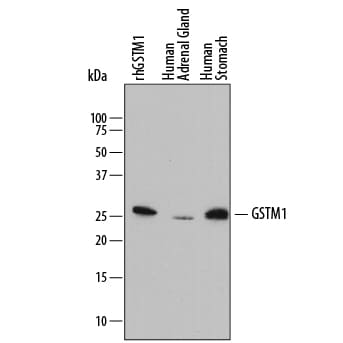
Detection of Human Glutathione S‑Transferase mu 1/GS by Western Blot.
Western blot shows Recombinant Human GSTM1 (Catalog # 6894-GT, 3 ng/lane) and lysates of human adrenal gland tissue and human stomach tissue. PVDF membrane was probed with 1 µg/mL of Mouse Anti-Human Glutathione S-Transferase mu 1/GS Monoclonal Antibody (Catalog # MAB6894) followed by HRP-conjugated Anti-Mouse IgG Secondary Antibody (Catalog # HAF018). A specific band was detected for Glutathione S-Transferase mu 1/GS at approximately 25 kDa (as indicated). This experiment was conducted under reducing conditions and using Immunoblot Buffer Group 1.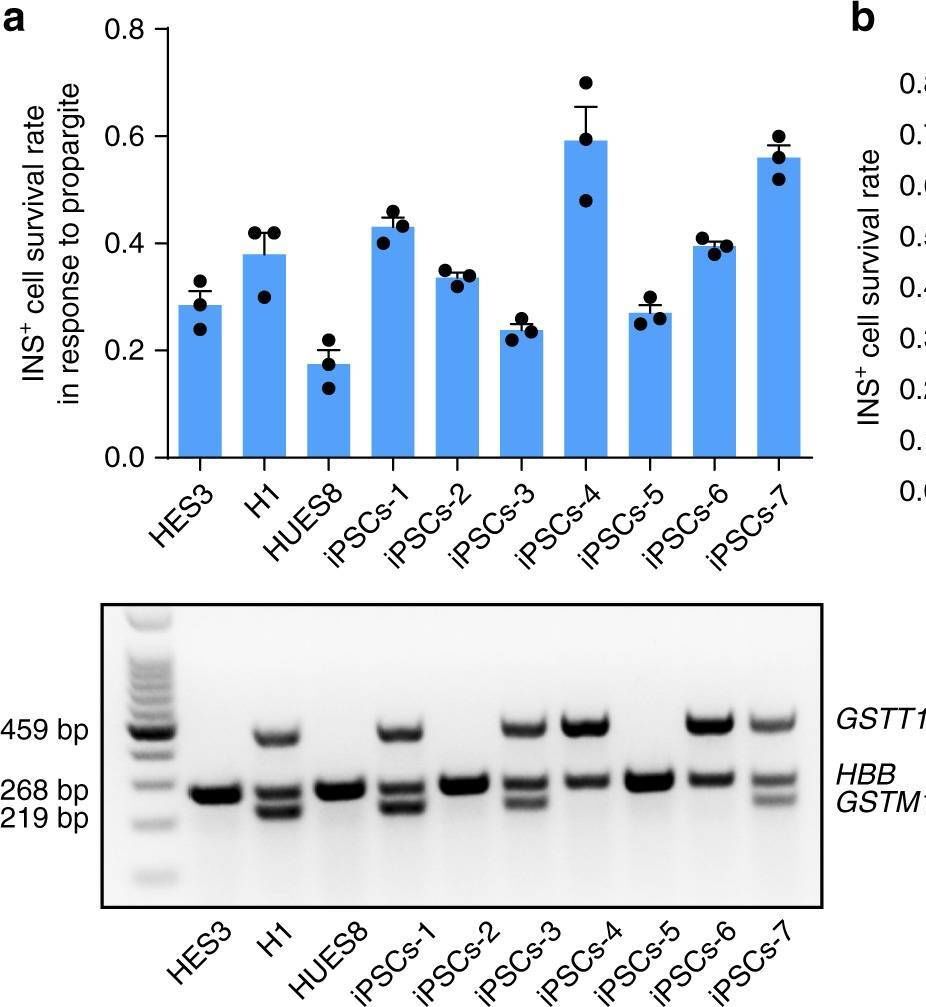
Detection of Glutathione S-Transferase mu 1/GSTM1 by Western Blot
A hPSC-based population study discovers that GSTT1-null pancreatic beta -like cells are hypersensitive to propargite-induced cell death. a Survival rate of INS+ cells derived from 10 different hESC or iPSC lines cultured in the presence of 1.6 μM propargite (n = 3), and genotype analysis of GSTM1 and GSTT1 in those hESCs and iPSCs. b, c Correlation of INS+ cell survival rate in the presence of 1.6 μM propargite in cells lacking both GSTM1 and GSTT1 (b), or lacking only GSTM1 (c). n.s. indicates a non-significant difference. d Western blotting analysis of GSTT1 or GSTM1 protein expression in INS+ cells derived from isogenic wild type, GSTT1−/− or GSTM1−/− H1 hESCs. The −/− null clones were CRSIPR-induced biallelic frameshift mutants. The two GSTT1 knockout clones were both homozygous null mutants, and the two GSTM1 knockout clones were both compound-null mutants. e Flow cytometry analysis of C-peptide+ cells in isogenic GSTT1−/− or GSTM1−/− hESC-derived D18 cells. f Inhibition curve of propargite on INS+ cells derived from GSTT1+/+ or GSTT1−/− H1 hESCs (n = 3). g, h Representative images (g) and DNA damage rate (h) of GSTT1+/+ and GSTT1−/− beta -like cells (n = 3). Scale bars, 800 μm. gamma -H2A.X +/INS+ cells are highlighted with yellow arrows. i Western blot analysis of GSTT1 protein in EndoC-beta H1 cells carrying sgGSTT1. Two CRISPR gRNAs (sgGSTT1-1 and sgGSTT1-2) were used for generating GSTT1−/− EndoC-beta H1 cells. j, k Representative images (j) and cell death rate (k) of GSTT1−/− EndoC-beta H1 cells treated with 1.6 μM propargite (n = 3). Scale bars, 200 μm. Values presented as mean ± S.D. n.s. indicates a non-significant difference. p values calculated by unpaired two-tailed Student’s t-test were *p < 0.05, ***p < 0.001. Related to Supplementary Fig. 3 Image collected and cropped by CiteAb from the following open publication (https://pubmed.ncbi.nlm.nih.gov/30446643), licensed under a CC-BY license. Not internally tested by R&D Systems.Applications for Human Glutathione S-Transferase mu 1/GSTM1 Antibody (842516)
Western Blot
Sample: Recombinant Human GSTM1 (Catalog # 6894-GT, 3 ng/lane) and lysates of human adrenal gland tissue and human stomach tissue
Formulation, Preparation, and Storage
Purification
Reconstitution
Sterile PBS to a final concentration of 0.5 mg/mL. For liquid material, refer to CoA for concentration.
Formulation
Shipping
Stability & Storage
- 12 months from date of receipt, -20 to -70 °C as supplied.
- 1 month, 2 to 8 °C under sterile conditions after reconstitution.
- 6 months, -20 to -70 °C under sterile conditions after reconstitution.
Calculators
Background: Glutathione S-Transferase mu 1/GSTM1
References
- Pearson, W. R. et al. (1993) Am. J. Hum. Genet. 53:220.
- Mohr, L.C. et al. (2003) Anticancer. Res. 23:2111.
- Wang, H. et al. (2010) Dig. Dis. Sci. 55:1824.
- Engel, L. S. et al. (2002) Am. J. Epidermiol. 156:95.
- Mo, Z. et al. (2009) Prostate. 69:662.
- Mukherjee, S. B. et al. (1999) Biochem. J. 340:309.
- Ishigaki, S. et al. (1989) Arch. Biochem. Biophys. 273:265.
Alternate Names
Entrez Gene IDs
Gene Symbol
UniProt
Additional Glutathione S-Transferase mu 1/GSTM1 Products
Product Documents for Human Glutathione S-Transferase mu 1/GSTM1 Antibody (842516)
Certificate of Analysis
To download a Certificate of Analysis, please enter a lot or batch number in the search box below.
Note: Certificate of Analysis not available for kit components.
Product Specific Notices for Human Glutathione S-Transferase mu 1/GSTM1 Antibody (842516)
For research use only
Citations for Human Glutathione S-Transferase mu 1/GSTM1 Antibody (842516)
 Powered by Bioz
Customer Reviews for Human Glutathione S-Transferase mu 1/GSTM1 Antibody (842516)
There are currently no reviews for this product. Be the first to review Human Glutathione S-Transferase mu 1/GSTM1 Antibody (842516) and earn rewards!
Have you used Human Glutathione S-Transferase mu 1/GSTM1 Antibody (842516)?
Submit a review and receive an Amazon gift card!
$25/€18/£15/$25CAN/¥2500 for a review with an image
$10/€7/£6/$10CAN/¥1110 for a review without an image
Submit a review
Protocols
Find general support by application which include: protocols, troubleshooting, illustrated assays, videos and webinars.
- Cellular Response to Hypoxia Protocols
- R&D Systems Quality Control Western Blot Protocol
- Troubleshooting Guide: Western Blot Figures
- Western Blot Conditions
- Western Blot Protocol
- Western Blot Protocol for Cell Lysates
- Western Blot Troubleshooting
- Western Blot Troubleshooting Guide
- View all Protocols, Troubleshooting, Illustrated assays and Webinars