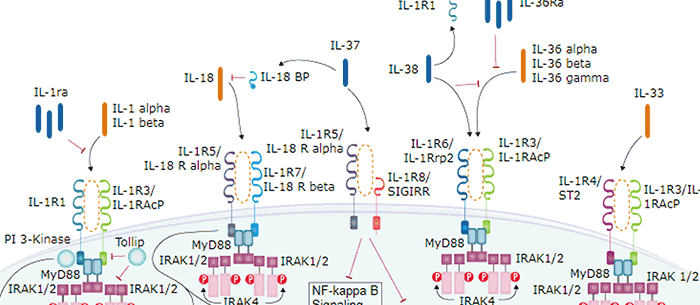
The Interleukin 1 receptor family (IL-1 R) comprises at least eleven members including IL-1 RI (IL-1 R1), IL-1 RII (IL-1 R2), IL-1 RAcP (IL‑1 R3), ST2 (T1/IL‑1 R4),
IL‑18 Ra (IL-1 Rrp/IL-1 R5), IL-1 Rrp2 (IL-1 RL2/IL-1 R6), IL-18 Rb (AcPL/IL-1 R7), IL-1RAPL‑1 (TIGIRR‑2/IL‑1 R8), and TIGIRR-1 (IL-1 R9) (1). All family members possess three immunoglobulin (Ig)-like domains in their extracellular region. Most members also have an intracellular TIR (Toll-like receptor/IL-1 receptor signaling) domain that is also conserved in the Toll-like receptor family. Related proteins, SIGIRR (single Ig domain-containing IL-1 R-related molecule) and IL-18BP, differ from the other members by having only one Ig domain (1). Human IL-1 Rrp2 cDNA encodes a 561 amino acid (aa) residue precursor protein with a putative 19 aa signal peptide and a 318 aa extracellular domain. It shares 67% and 65% amino acid sequence identity with rat and mouse IL 1 Rrp2, respectively. IL-1 Rrp2 is expressed in lung epitheium, brain vasculature, kidney, testis, onocytes, skin-derived keratinocytes, fibroblasts and, to a lesser extent, endothelial cells (2, 3). IL-1 Rrp2 has been shown to mediate the activation of the transcription factor NF kappa B by the IL-1 family ligands IL-1 F6, F8 or F9 (also known as IL-1 epsilon ), with IL-1RAcP as a co‑factor (3, 4). Response to IL-1 F9 is specifically antagonized by IL‑1 F5 (also known as IL-1 delta ), an IL-1 family ligand that is most closely related to IL-1ra (3). IL-1 Rrp2,
IL‑1 F5, and IL-1 F9 are all up-regulated in lesional psoriasis skin, suggesting that the IL-1 Rrp2 mediated signaling pathway may take part in local inflammatory responses (3).
 Powered by Bioz