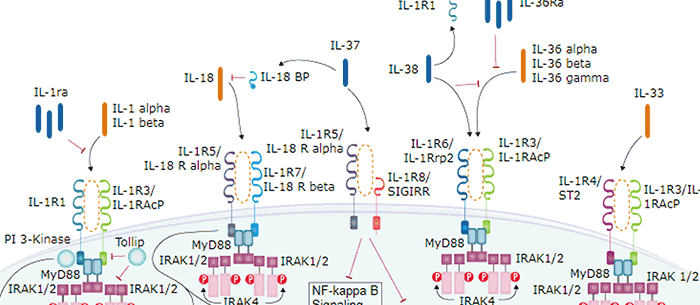
Human Interleukin-36 receptor antagonist protein [IL36Ra; also named interleukin 1 family member 5, IL-1F5, FIL-1 delta (delta), IL36RN, IL-1HY1, IL-1H3, and IL-1L1] is a member of the IL-1 family of proteins (1‑6). IL-1 family members include IL-1 beta, IL-1 alpha, IL-1ra, IL-18 and IL-1F5-F10 (6, 7). All family members show a 12 beta -strand, beta -trefoil configuration, and all family members are believed to have arisen from a common ancestral gene that underwent multiple duplications (7). The human IL-1F5 gene is in closest proximity to the gene for IL-1ra and is likely a relatively recent duplication of the IL-1ra gene (2, 3). IL-1F5 is synthesized as a 155 amino acid (aa) protein that contains no signal sequence, no prosegment and no potential N-linked glycosylation site(s) (2‑5). Nevertheless, it appears to be secreted as a 17 kDa monomer (5). There is an alternate start site that potentially gives rise to an alternate splice form (5). The translated product, however, has a premature stop codon, resulting in a truncated 16 aa peptide. Human to mouse, full length IL-1F5 has 90% aa identity. Within the family, IL-1F5 is 50% aa identical to IL-1ra, and 32%, 31%, 35%, 37%, 32% and 42% aa identical to IL-1 beta, IL-1F6, F7, F8, F9 and F10, respectively. Cells reported to express IL-1F5 include monocytes, B cells, dendritic cells/Langerhans cells, keratinocytes, and gastric fundus Parietal and Chief cells (1, 8). The receptor for IL-1F5 has not been positively identified. Indirect evidence suggests it is IL-1 Rrp2 and/or IL-1 RAcP (9). In either case, activity association with receptor binding is also unclear. It was initially reported to be an antagonist of IL‑1F9 activity (4, 7). This would be consistent with its hypothesized relationship to IL-1ra. Studies, however, find IL-1F5 antagonist activity difficult to demonstrate (9).
Human IL-36Ra/IL-1F5 Antibody
R&D Systems | Catalog # AF1275


Key Product Details
Species Reactivity
Validated:
Human
Cited:
Human, Mouse, Rat
Applications
Validated:
Western Blot, Blockade of Receptor-ligand Interaction
Cited:
Immunohistochemistry, Western Blot
Label
Unconjugated
Antibody Source
Polyclonal Goat IgG
Loading...
Product Specifications
Immunogen
E. coli-derived recombinant human IL-36Ra/IL-1F5
Val2-Asp155
Accession # Q9UBH0
Val2-Asp155
Accession # Q9UBH0
Specificity
Detects human IL-36Ra/IL-1F5 in direct ELISAs and Western blots. In direct ELISAs, less than 1% cross-reactivity with recombinant human (rh) IL-1ra is observed.
Clonality
Polyclonal
Host
Goat
Isotype
IgG
Endotoxin Level
<0.10 EU per 1 μg of the antibody by the LAL method.
Applications for Human IL-36Ra/IL-1F5 Antibody
Application
Recommended Usage
Blockade of Receptor-ligand Interaction
In a functional ELISA, 0.5-2 µg/mL of this antibody will block 50% of the binding of 5 μg/mL of Recombinant Human IL-1 Rrp2 Fc Chimera or Recombinant Mouse IL-1 Rrp2 (Catalog # 872-RP
or
2354-RP) to immobilized Recombinant Human IL-36Ra/IL-1F5 or Recombinant Mouse IL-36Ra/IL-1F5, respectively (Catalog # 1275-IL
or
2714-ML) coated at 1 µg/mL (100 µL/well). At 100 μg/mL, this antibody will block >90% of the binding.
Western Blot
0.1 µg/mL
Sample: Recombinant Human IL-36Ra/IL-1F5 (Catalog # 1275-IL)
Sample: Recombinant Human IL-36Ra/IL-1F5 (Catalog # 1275-IL)
Formulation, Preparation, and Storage
Purification
Antigen Affinity-purified
Reconstitution
Reconstitute at 0.2 mg/mL in sterile PBS. For liquid material, refer to CoA for concentration.
Loading...
Formulation
Lyophilized from a 0.2 μm filtered solution in PBS with Trehalose. *Small pack size (SP) is supplied either lyophilized or as a 0.2 µm filtered solution in PBS.
Shipping
Lyophilized product is shipped at ambient temperature. Liquid small pack size (-SP) is shipped with polar packs. Upon receipt, store immediately at the temperature recommended below.
Stability & Storage
Use a manual defrost freezer and avoid repeated freeze-thaw cycles.
- 12 months from date of receipt, -20 to -70 °C as supplied.
- 1 month, 2 to 8 °C under sterile conditions after reconstitution.
- 6 months, -20 to -70 °C under sterile conditions after reconstitution.
Calculators
Background: IL-36Ra/IL-1F5
References
- Smith, D. E. et al. (2000) J. Biol. Chem. 275:1169.
- Kumar, S. et al. (2000) J. Biol. Chem. 275:10308.
- Mulero, J.J. et al. (1999) Biochem. Biophys. Res. Commun. 263:702.
- Nicklin, M.J.H. et al. (2002) Genomics. 79:718.
- Barton, J.L. et al. (2000) Eur. J. Immunol. 30:3299.
- Dinarello, C. et al. (2010) Nature Immunology 11. 973.
- Dunn, E. et al. (2001) Trends Immunol. 22:533.
- Debets, R. et al. (2001) J. Immunol. 167:1440.
- Towne, J.E. et al. (2004) J. Biol. Chem. 279:13677.
Long Name
Interleukin 36 Receptor Antagonist/Interleukin 1 Family 5
Alternate Names
FIL1 delta, IL-1HY1, IL-1L1, IL-1RP3, IL1F5, IL36Ra, IL36RN
Gene Symbol
IL36RN
UniProt
Additional IL-36Ra/IL-1F5 Products
Product Documents for Human IL-36Ra/IL-1F5 Antibody
Certificate of Analysis
To download a Certificate of Analysis, please enter a lot or batch number in the search box below.
Note: Certificate of Analysis not available for kit components.
Product Specific Notices for Human IL-36Ra/IL-1F5 Antibody
For research use only
Related Research Areas
Citations for Human IL-36Ra/IL-1F5 Antibody
 Powered by Bioz
Customer Reviews for Human IL-36Ra/IL-1F5 Antibody
There are currently no reviews for this product. Be the first to review Human IL-36Ra/IL-1F5 Antibody and earn rewards!
Have you used Human IL-36Ra/IL-1F5 Antibody?
Submit a review and receive an Amazon gift card!
$25/€18/£15/$25CAN/¥2500 for a review with an image
$10/€7/£6/$10CAN/¥1110 for a review without an image
Submit a review
Protocols
Find general support by application which include: protocols, troubleshooting, illustrated assays, videos and webinars.
- Cellular Response to Hypoxia Protocols
- R&D Systems Quality Control Western Blot Protocol
- Troubleshooting Guide: Western Blot Figures
- Western Blot Conditions
- Western Blot Protocol
- Western Blot Protocol for Cell Lysates
- Western Blot Troubleshooting
- Western Blot Troubleshooting Guide
- View all Protocols, Troubleshooting, Illustrated assays and Webinars
Loading...
Associated Pathways