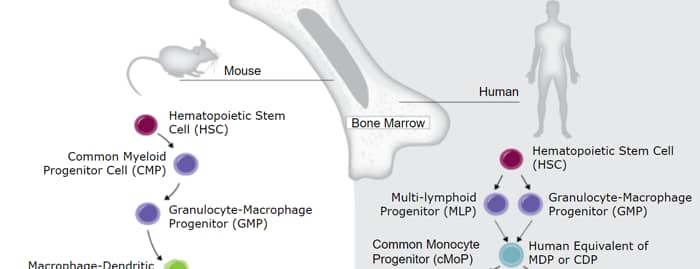
M-CSF receptor, the product of the c-fms proto-oncogene, is a member of the type III subfamily of receptor tyrosine kinases that also includes receptors for SCF and PDGF. These receptors each contain five immunoglobulin-like domains in their extracellular domain (ECD) and a split kinase domain in their intracellular region (1‑4). M-CSF receptor is expressed primarily on cells of the monocyte/macrophage lineage, dendritic cells, stem cells and in the developing placenta (1). Human M-CSF receptor cDNA encodes a 972 amino acid (aa) type I membrane protein with a 19 aa signal peptide, a 493 aa extracellular region containing the ligand-binding domain, a 25 aa transmembrane domain, and a 435 aa cytoplasmic domain. The human M-CSF R ECD shares 60%, 64%, 72%, 75%, 75%, and 76% aa identity with mouse, rat, bovine, canine, feline, and equine M-CSF R, respectively. Activators of protein kinase C induce TACE/ADAM17 cleavage of the M-CSF receptor, releasing the functional ligand-binding extracellular domain (5). M-CSF binding induces receptor homodimerization, resulting in transphosphorylation of specific cytoplasmic tyrosine residues and signal transduction (6). The intracellular domain of activated M-CSF R binds more than 150 proteins that affect cell proliferation, survival, differentiation and cytoskeletal reorganization. Among these, PI3Kinase, P42/44 ERK, and c-Cbl are key transducers of M-CSF R signals (3, 4). M-CSF R engagement is continuously required for macrophage survival and regulates lineage decisions and maturation of monocytes, macrophages, osteoclasts and DC (3, 4). M-CSF R and integrin alpha v beta 3 share signaling pathways during osteoclastogenesis and deletion of either causes osteopetrosis (7, 8). In the brain, microglia expressing increased M-CSF R are concentrated with Alzheimers a beta peptide, but their role in pathogenesis is unclear (9, 10).
Human M-CSF R/CD115 Antibody (61710)
R&D Systems | Catalog # MAB3293


Key Product Details
Species Reactivity
Human
Applications
Blockade of Receptor-ligand Interaction
Label
Unconjugated
Antibody Source
Monoclonal Mouse IgG1 Clone # 61710
Loading...
Product Specifications
Immunogen
Mouse myeloma cell line NS0-derived recombinant human M-CSF R/CD115
Ile20-Glu512
Accession # P07333.2
Ile20-Glu512
Accession # P07333.2
Specificity
Detects human M-CSF R/CD115 in direct ELISAs.
Clonality
Monoclonal
Host
Mouse
Isotype
IgG1
Applications for Human M-CSF R/CD115 Antibody (61710)
Application
Recommended Usage
Blockade of Receptor-ligand Interaction
In a functional ELISA, 0.02-1 μg/mL of this antibody will block 50% of the binding of 2 ng/mL of Recombinant Human M-CSF (Catalog # 216-MC) to immobilized Recombinant Human M-CSF R/CD115 Fc Chimera (Catalog # 329-MR) coated at 0.5 μg/mL (100 µL/well). At 2.5 μg/mL, this antibody will block >90% of the binding.
Formulation, Preparation, and Storage
Purification
Protein A or G purified from hybridoma culture supernatant
Reconstitution
Reconstitute at 0.5 mg/mL in sterile PBS. For liquid material, refer to CoA for concentration.
Loading...
Formulation
Lyophilized from a 0.2 μm filtered solution in PBS with Trehalose. *Small pack size (SP) is supplied either lyophilized or as a 0.2 µm filtered solution in PBS.
Shipping
Lyophilized product is shipped at ambient temperature. Liquid small pack size (-SP) is shipped with polar packs. Upon receipt, store immediately at the temperature recommended below.
Stability & Storage
Use a manual defrost freezer and avoid repeated freeze-thaw cycles.
- 12 months from date of receipt, -20 to -70 °C as supplied.
- 1 month, 2 to 8 °C under sterile conditions after reconstitution.
- 6 months, -20 to -70 °C under sterile conditions after reconstitution.
Calculators
Background: M-CSF R/CD115
References
- deParseval, N. et al. (1993) Nucleic Acids Res. 21:750.
- Rothwell, V.M. and L.R. Rohrschneider (1987) Oncogene Res. 1:311.
- Chitu, V. and E.R. Stanley (2006) Curr. Opin. Immunol. 18:39.
- Ross, F.P. and S.L. Teitelbaum (2005) Immunol. Rev. 208:88.
- Rovida, E. et al. (2001) J. Immunol. 166:1583.
- Yeung, Y. et al. (1998) J. Biol. Chem. 273:17128.
- Dai, X. et al. (2002) Blood 99:111.
- Faccio, R. et al. (2003) J. Clin. Invest. 111:749.
- Li, M. et al. (2004) J. Neurochem. 91:623.
- Mitrasinovic, O.M. et al. (2005) J. Neurosci. 25:4442.
Long Name
Macrophage Colony Stimulating Factor Receptor
Alternate Names
c-fms, CD115, CSF1R, M-CSFR, MCSFR
Gene Symbol
CSF1R
UniProt
Additional M-CSF R/CD115 Products
Product Documents for Human M-CSF R/CD115 Antibody (61710)
Certificate of Analysis
To download a Certificate of Analysis, please enter a lot or batch number in the search box below.
Note: Certificate of Analysis not available for kit components.
Product Specific Notices for Human M-CSF R/CD115 Antibody (61710)
For research use only
Customer Reviews for Human M-CSF R/CD115 Antibody (61710)
There are currently no reviews for this product. Be the first to review Human M-CSF R/CD115 Antibody (61710) and earn rewards!
Have you used Human M-CSF R/CD115 Antibody (61710)?
Submit a review and receive an Amazon gift card!
$25/€18/£15/$25CAN/¥2500 for a review with an image
$10/€7/£6/$10CAN/¥1110 for a review without an image
Submit a review
Loading...
Associated Pathways