
Matrix metalloproteinases are a family of zinc and calcium dependent endopeptidases with the combined ability to degrade all the components of the extracellular matrix. MMP-1 (interstitial collagenase), can degrade a broad range of substrates including types I, II, III, VII, VIII, and X collagens as well as casein, gelatin,
alpha -1 antitrypsin, myelin basic protein, L-Selectin, pro-TNF, IL-1 beta, IGFBP-3, IGFBP-5, pro-MMP-2, and pro-MMP-9. A significant role of MMP-1 is the degradation of fibrillar collagens in extracellular matrix remodeling, characterized by the cleavage of the interstitial collagen triple helix into ¾, ¼ fragments. However, as the list of substrates above illustrates, the role of MMP-1 is more diverse than originally envisaged, and may involve enzyme cascades, cytokine regulation, and cell surface molecule modulation. MMP-1 is expressed by fibroblasts, keratinocytes, endothelial cells, monocytes, and macrophages. Structurally, MMP-1 may be divided into several distinct domains; a pro-domain which is cleaved upon activation; a catalytic domain containing the zinc binding site; a short hinge region and a carboxyl terminal (hemopexin-like) domain.
Human MMP-1 Antibody (40013F)
R&D Systems | Catalog # MAB9011

Scientific images may be resized, cropped, or adjusted for brightness or contrast for presentation purposes. These updates are limited to presentation and do not affect the underlying scientific interpretation of the data. Where available, additional source data may be provided upon request.
Key Product Details
Validated by
Species Reactivity
Applications
Label
Antibody Source
Product Specifications
Immunogen
Phe20-Asn469
Accession # P03956
Specificity
Clonality
Host
Isotype
Scientific Data Images for Human MMP-1 Antibody (40013F)
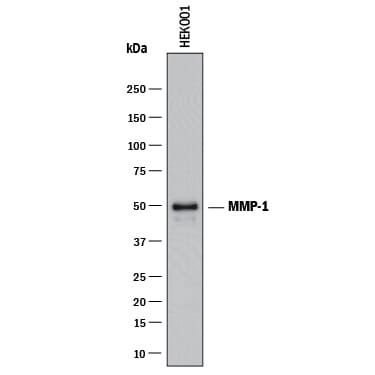
Detection of Human MMP‑1 by Western Blot.
Western blot shows lysates of HEK001 human epidermal keratinocyte cell line. PVDF membrane was probed with 5 µg/mL of Goat Anti-Human MMP-1 Monoclonal Antibody (Catalog # MAB9011) followed by HRP-conjugated Anti-Goat IgG Secondary Antibody (Catalog # HAF017). A specific band was detected for MMP-1 at approximately 50 kDa (as indicated). This experiment was conducted under reducing conditions and using Immunoblot Buffer Group 1.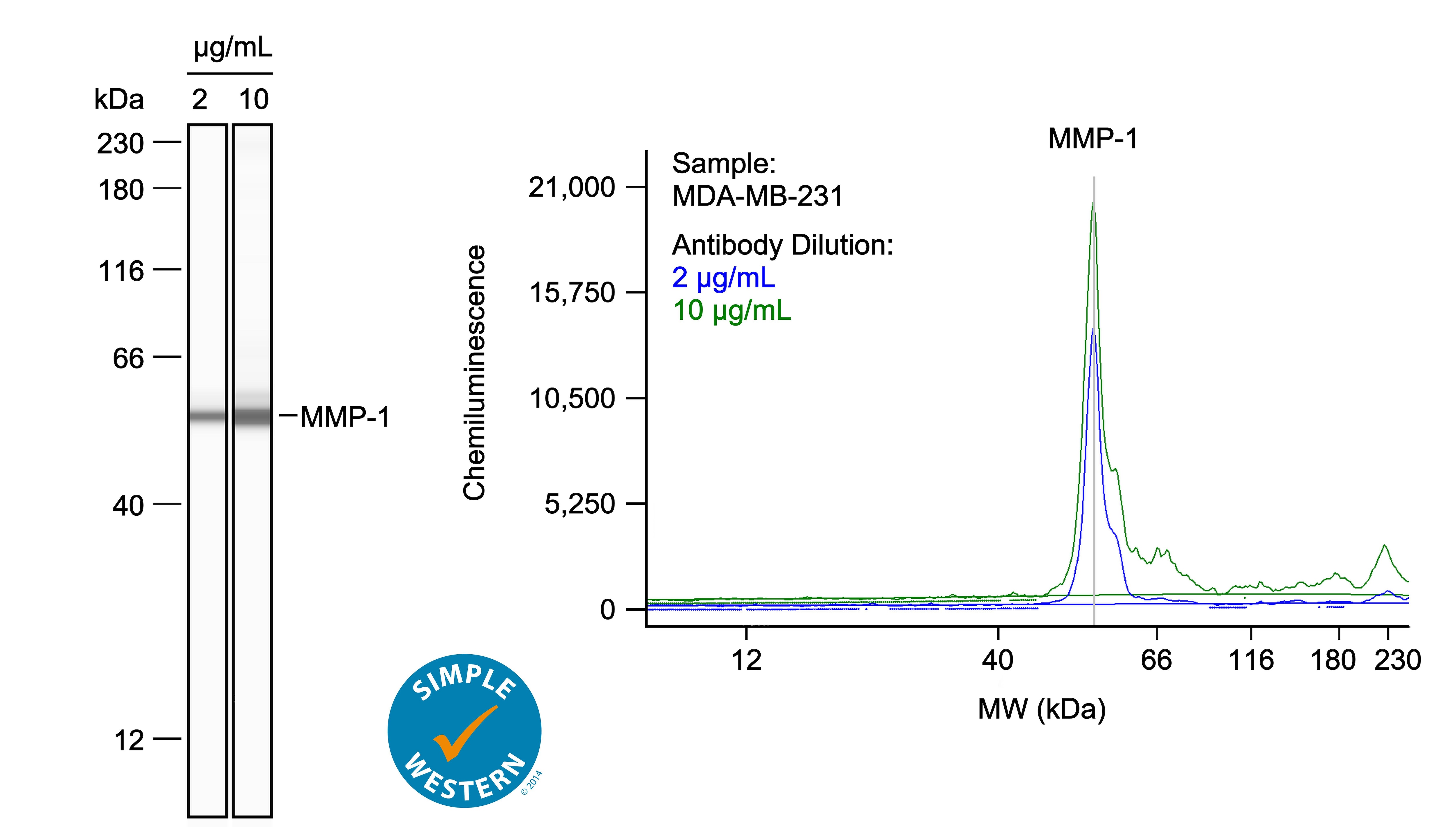
Detection of Human MMP‑1 by Simple WesternTM.
Left: Simple Western lane view shows lysates of MDA‑MB‑231 human breast cancer cell line, loaded at 0.1 mg/ml. A specific band was detected for MMP‑1 at approximately 55 kDa (as indicated) using both 2 µg/ml and 10 µg/ml of Goat Anti-Human MMP‑1 Monoclonal Antibody (Catalog # MAB9011) followed by HRP-conjugated Donkey Anti-Goat Secondary Antibody (Catalog # 043-522-2). This experiment was conducted under reducing conditions and using the 12-230kDa separation system. Right: Simple Western electropherogram showing the same Goat Anti-Human MMP‑1 Monoclonal Antibody (Catalog # MAB9011) tested at 2 µg/ml (blue line) and 10 µg/ml (green line) in the MDA‑MB‑231 human breast cancer cell line.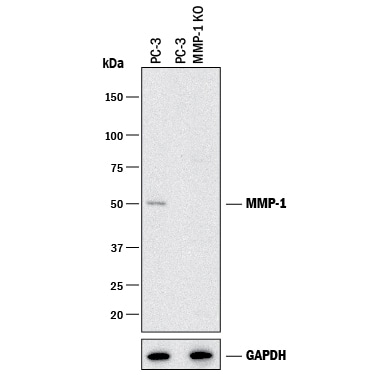
Western Blot Shows Human MMP-1 Specificity by Using Knockout Cell Line.
Western blot shows lysates of PC-3 human prostate cancer parental cell line and MMP-1 knockout PC-3 cell line (KO). PVDF membrane was probed with 5 µg/mL of Goat Anti-Human MMP-1 Monoclonal Antibody (Catalog # MAB9011) followed by HRP-conjugated Anti-Goat IgG Secondary Antibody (Catalog # HAF017). A specific band was detected for MMP-1 at approximately 50 kDa (as indicated) in the parental PC-3 cell line, but is not detectable in knockout PC-3 cell line. GAPDH (Catalog # AF5718) is shown as a loading control.This experiment was conducted under reducing conditions and using Immunoblot Buffer Group 1.Applications for Human MMP-1 Antibody (40013F)
Knockout Validated
Simple Western
Sample: MDA-MB-231 human breast cancer cell line
Western Blot
Sample: HEK001 human epidermal keratinocyte cell line
Formulation, Preparation, and Storage
Purification
Reconstitution
Reconstitute at 0.5 mg/mL in sterile PBS. For liquid material, refer to CoA for concentration.
Formulation
Shipping
Stability & Storage
- 12 months from date of receipt, -20 to -70 °C as supplied.
- 1 month, 2 to 8 °C under sterile conditions after reconstitution.
- 6 months, -20 to -70 °C under sterile conditions after reconstitution.
Calculators
Background: MMP-1
References
- Cawston, T.E. (2004) in Interstitial Collagenase. Barrett, A.J. et al. (eds): Handbook of Proteolytic Enzymes, San Diego: Academic Press, p. 472.
Long Name
Alternate Names
Gene Symbol
UniProt
Additional MMP-1 Products
Product Documents for Human MMP-1 Antibody (40013F)
Certificate of Analysis
To download a Certificate of Analysis, please enter a lot or batch number in the search box below.
Note: Certificate of Analysis not available for kit components.
Product Specific Notices for Human MMP-1 Antibody (40013F)
For research use only
Related Research Areas
Customer Reviews for Human MMP-1 Antibody (40013F)
There are currently no reviews for this product. Be the first to review Human MMP-1 Antibody (40013F) and earn rewards!
Have you used Human MMP-1 Antibody (40013F)?
Submit a review and receive an Amazon gift card!
$25/€18/£15/$25CAN/¥2500 for a review with an image
$10/€7/£6/$10CAN/¥1110 for a review without an image
Submit a review
Protocols
Find general support by application which include: protocols, troubleshooting, illustrated assays, videos and webinars.
- Cellular Response to Hypoxia Protocols
- R&D Systems Quality Control Western Blot Protocol
- Troubleshooting Guide: Western Blot Figures
- Western Blot Conditions
- Western Blot Protocol
- Western Blot Protocol for Cell Lysates
- Western Blot Troubleshooting
- Western Blot Troubleshooting Guide
- View all Protocols, Troubleshooting, Illustrated assays and Webinars