
The D-type cyclins (cyclins D1, D2, and D3) and their associated kinases, Cdk4 and Cdk6, play an important role in the progression from G0/G1 to S phase in the mammalian cell cycle. Cyclin D complexes containing Cdk4 or Cdk6 phosphorylate the retinoblastoma protein (pRb). pRb phosphorylation leads to the release of E2F transcription factors, which activate the expression of S-phase genes and thereby induce cell cycle progression. Cyclin D1, independent of Cdk4 activity, functions as a transcriptional modulator by regulating the activity of several transcription factors, such as estrogen receptor, Myb, and STAT3. Cyclin D1 has also been linked to the development and progression of several cancers including breast, bladder, esophagus, and lung. Overexpression of Cyclin D2 has been reported in gastric carcinoma, ovarian granulose cell tumors, and hematopoietic cell cancers, while in breast cancers, cyclin D2 expression is undetectable in 80% of the tumors.
Cyclin D1/D2 Antibody
R&D Systems | Catalog # AF4196

Scientific images may be resized, cropped, or adjusted for brightness or contrast for presentation purposes. These updates are limited to presentation and do not affect the underlying scientific interpretation of the data. Where available, additional source data may be provided upon request.
Key Product Details
Species Reactivity
Validated:
Cited:
Applications
Validated:
Cited:
Label
Antibody Source
Product Specifications
Immunogen
Met1-Ile295
Accession # P24385
Specificity
Clonality
Host
Isotype
Scientific Data Images for Cyclin D1/D2 Antibody
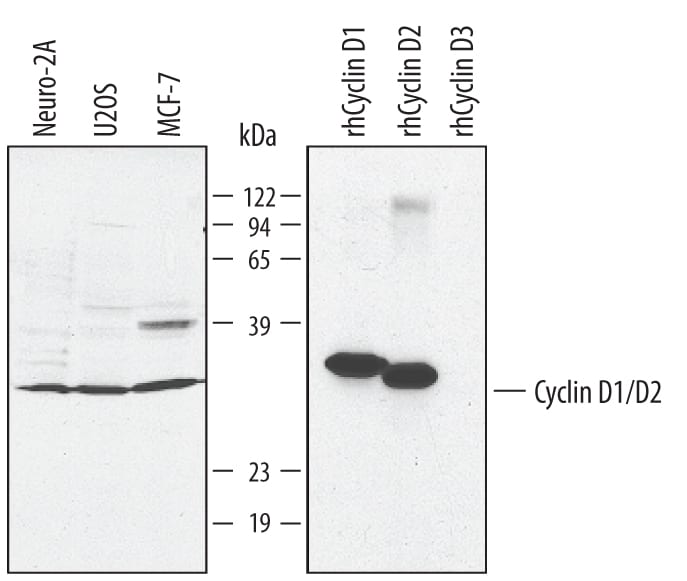
Detection of Human/Mouse Cyclin D1/D2 by Western Blot.
Western blot shows lysates of Neuro-2A mouse neuroblastoma cell line, U2OS human osteosarcoma cell line, and MCF-7 human breast cancer cell line. PVDF membrane was probed with 1 µg/mL Goat Anti-Human/Mouse Cyclin D1/D2 Cross-reactive Antigen Affinity-purified Polyclonal Antibody (Catalog # AF4196) followed by HRP-conjugated Anti-Goat IgG Secondary Antibody (Catalog # HAF017). For additional reference, recombinant human Cyclin D1, D2, and D3 (5 ng/lane) were included. A specific band for Cyclin D1 was detected at approximately 33 kDa (as indicated). This experiment was conducted under reducing conditions and using Immunoblot Buffer Group 1.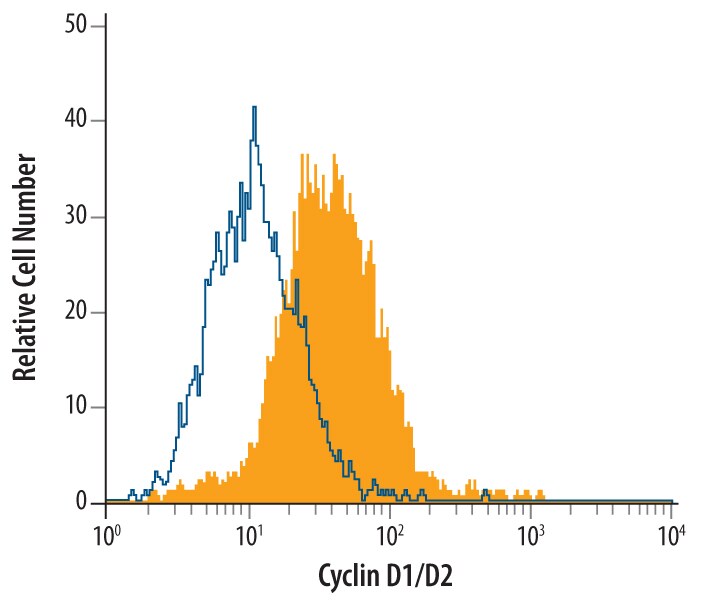
Detection of Cyclin D1/D2 in MCF‑7 Human Cell Line by Flow Cytometry.
MCF-7 human breast cancer cell line was stained with Goat Anti-Human/Mouse Cross-reactive Antigen Affinity-purified Polyclonal Antibody (Catalog # AF4196, filled histogram) or isotype control AA175antibody (Catalog # AB-108-C, open histogram), followed by Phycoerythrin-conjugated Anti-Goat IgG Secondary Antibody (Catalog # F0107). To facilitate intracellular staining, cells were fixed with paraformaldeyde and permeabilized with saponin.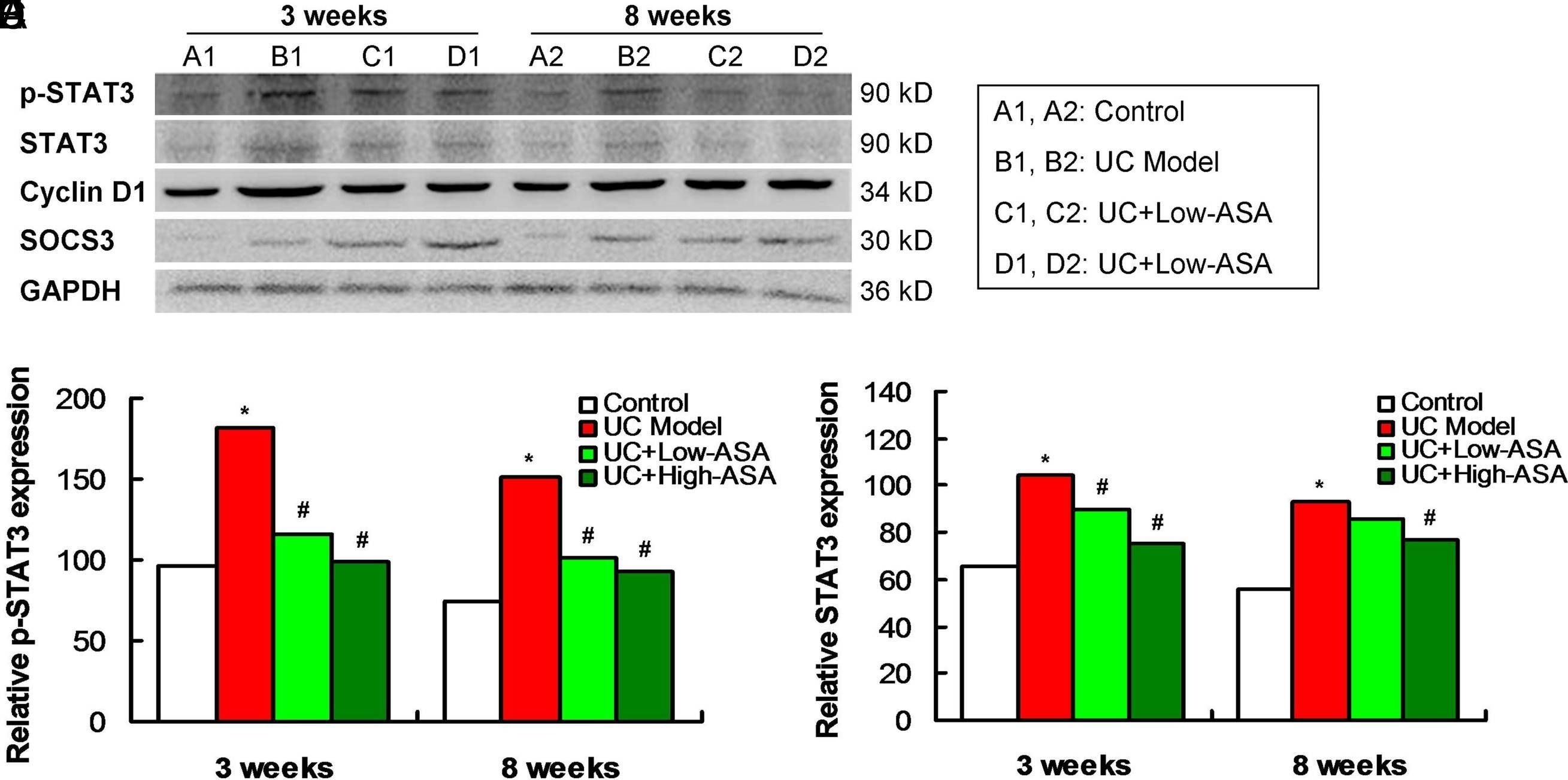
Detection of Cyclin D1/D2 by Western Blot
Aspirin modulated the JAK/p-STAT3 signaling pathway in atypical hyperplastic intestinal mucosal cells of UC mice (n = 4 for each group). (A) Western blotting images for JAK/p-STAT3 signaling pathway-associated molecules expression. (B) Statistical analysis and comparison for p-STAT3 expression. (C) Statistical analysis and comparison for STAT3 expression. (D) Statistical analysis and comparison for cyclin D1 expression. (E) Statistical analysis and comparison for SOCS3 expression. *P <.05 versus control group. #P <.05 versus UC model group. JAK, Janus kinase; UC, ulcerative colitis; p-STAT3, phosphorylated-STAT3; STAT3, signal transducer and activator of transcription 3; SOCS3, suppressor of cytokine signaling 3. Image collected and cropped by CiteAb from the following open publication (https://pubmed.ncbi.nlm.nih.gov/35946886), licensed under a CC-BY license. Not internally tested by R&D Systems.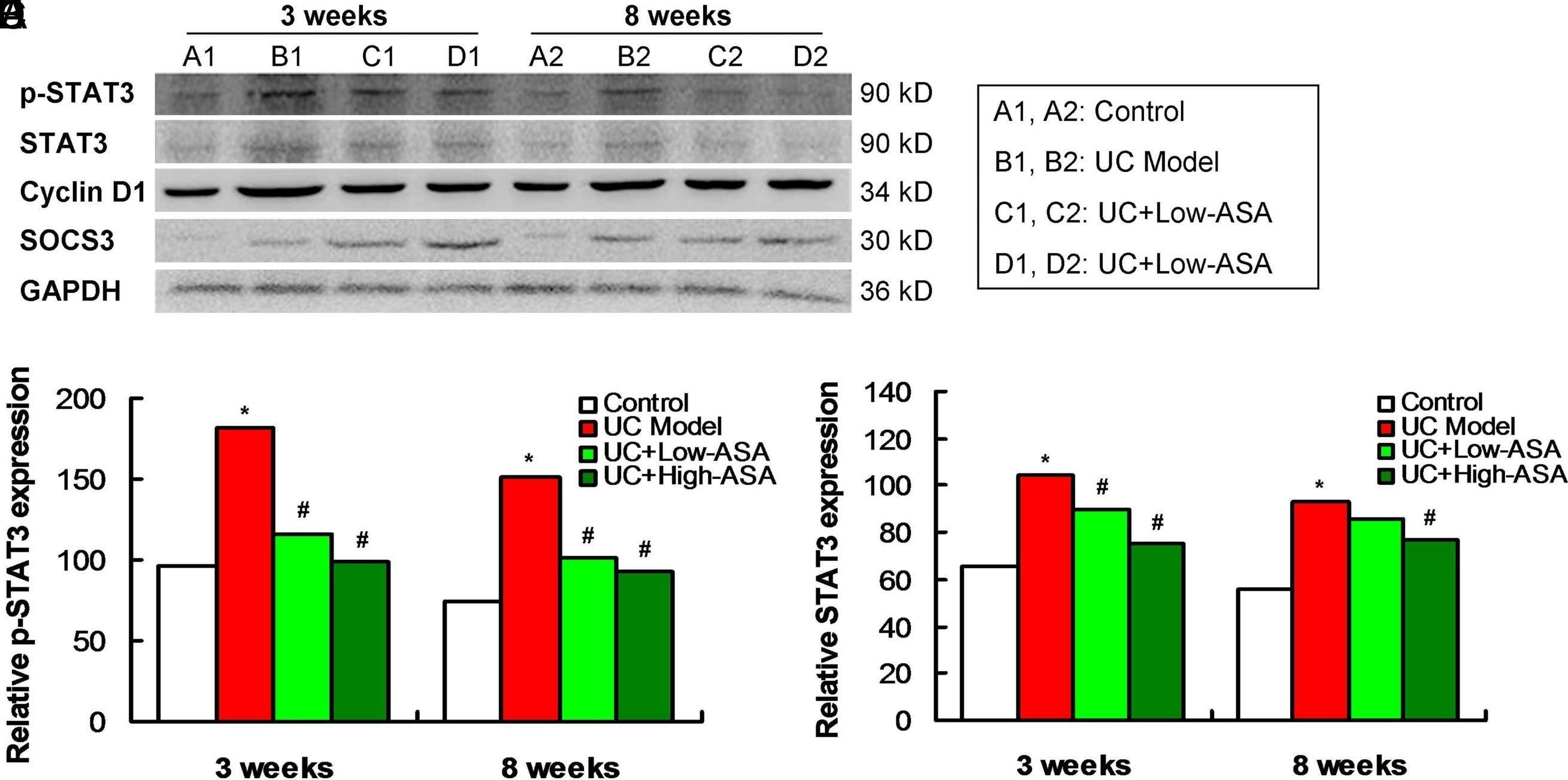
Detection of Cyclin D1/D2 by Western Blot
Aspirin modulated the JAK/p-STAT3 signaling pathway in atypical hyperplastic intestinal mucosal cells of UC mice (n = 4 for each group). (A) Western blotting images for JAK/p-STAT3 signaling pathway-associated molecules expression. (B) Statistical analysis and comparison for p-STAT3 expression. (C) Statistical analysis and comparison for STAT3 expression. (D) Statistical analysis and comparison for cyclin D1 expression. (E) Statistical analysis and comparison for SOCS3 expression. *P <.05 versus control group. #P <.05 versus UC model group. JAK, Janus kinase; UC, ulcerative colitis; p-STAT3, phosphorylated-STAT3; STAT3, signal transducer and activator of transcription 3; SOCS3, suppressor of cytokine signaling 3. Image collected and cropped by CiteAb from the following open publication (https://pubmed.ncbi.nlm.nih.gov/35946886), licensed under a CC-BY license. Not internally tested by R&D Systems.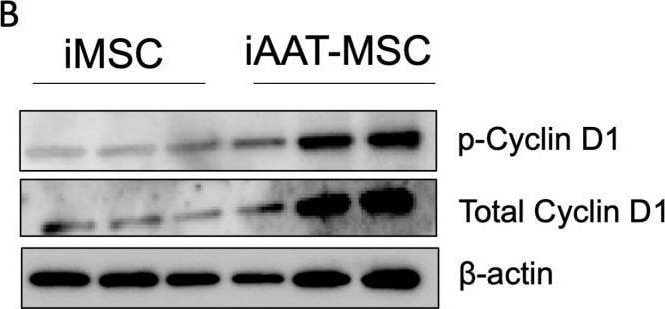
Detection of Human Cyclin D1/D2 by Western Blot
Cyclin D1 mRNA and protein expression in iAAT-MSCs and iMSCs. (A). Cyclin D1 mRNA expression was higher in iAAT-MSCs compared to iMSCs; data are fold changes compared to GAPDH expression in each sample. (B) Expression of Cyclin D1 and phosphorylated (p)-Cyclin D1 and beta -actin in iMSCs and iAAT-MSC. Lanes 1–3 are iMSCs in triplicate and 4–6 are iAAT-MSCs in triplicate. (C,D). Quantification/relative expression of CyclinD1/ beta -actin and p-Cyclin D1/ beta -actin, p-Cyclin D1/total Cyclin D1 at the protein level (C) and ratios (D) in iAAT-MSCs compared to iMSCs. (E) Representative expression of Cyclin D1 stained from cell culture of iMSCs and iAAT-MSCs. Red signals identify Cyclin D and blue staining structures are nuclei. Scale bar = 40 μm. * p < 0.05, Student’s t-test. NS: not significant. Image collected and cropped by CiteAb from the following open publication (https://pubmed.ncbi.nlm.nih.gov/38396691), licensed under a CC-BY license. Not internally tested by R&D Systems.Applications for Cyclin D1/D2 Antibody
CyTOF-ready
Intracellular Staining by Flow Cytometry
Sample:
MCF‑7 human breast cancer cell line fixed with paraformaldeyde and permeabilized with saponin.
Western Blot
Sample: Neuro-2A mouse neuroblastoma cell line, U2OS human osteosarcoma cell line, and MCF-7 human breast cancer cell line
Flow Cytometry Panel Builder
Bio-Techne Knows Flow Cytometry
Save time and reduce costly mistakes by quickly finding compatible reagents using the Panel Builder Tool.
Advanced Features
- Spectra Viewer - Custom analysis of spectra from multiple fluorochromes
- Spillover Popups - Visualize the spectra of individual fluorochromes
- Antigen Density Selector - Match fluorochrome brightness with antigen density

Formulation, Preparation, and Storage
Purification
Reconstitution
Reconstitute at 0.2 mg/mL in sterile PBS. For liquid material, refer to CoA for concentration.
Formulation
Shipping
Stability & Storage
- 12 months from date of receipt, -20 to -70 °C as supplied.
- 1 month, 2 to 8 °C under sterile conditions after reconstitution.
- 6 months, -20 to -70 °C under sterile conditions after reconstitution.
Calculators
Background: Cyclin D1/D2
Alternate Names
Gene Symbol
UniProt
Additional Cyclin D1/D2 Products
Product Documents for Cyclin D1/D2 Antibody
Certificate of Analysis
To download a Certificate of Analysis, please enter a lot or batch number in the search box below.
Note: Certificate of Analysis not available for kit components.
Product Specific Notices for Cyclin D1/D2 Antibody
For research use only
Related Research Areas
Citations for Cyclin D1/D2 Antibody
 Powered by Bioz
Customer Reviews for Cyclin D1/D2 Antibody
There are currently no reviews for this product. Be the first to review Cyclin D1/D2 Antibody and earn rewards!
Have you used Cyclin D1/D2 Antibody?
Submit a review and receive an Amazon gift card!
$25/€18/£15/$25CAN/¥2500 for a review with an image
$10/€7/£6/$10CAN/¥1110 for a review without an image
Submit a review
Protocols
Find general support by application which include: protocols, troubleshooting, illustrated assays, videos and webinars.
- 7-Amino Actinomycin D (7-AAD) Cell Viability Flow Cytometry Protocol
- Cellular Response to Hypoxia Protocols
- Extracellular Membrane Flow Cytometry Protocol
- Flow Cytometry Protocol for Cell Surface Markers
- Flow Cytometry Protocol for Staining Membrane Associated Proteins
- Flow Cytometry Staining Protocols
- Flow Cytometry Troubleshooting Guide
- Intracellular Flow Cytometry Protocol Using Alcohol (Methanol)
- Intracellular Flow Cytometry Protocol Using Detergents
- Intracellular Nuclear Staining Flow Cytometry Protocol Using Detergents
- Intracellular Staining Flow Cytometry Protocol Using Alcohol Permeabilization
- Intracellular Staining Flow Cytometry Protocol Using Detergents to Permeabilize Cells
- Propidium Iodide Cell Viability Flow Cytometry Protocol
- Protocol for Liperfluo
- Protocol for the Characterization of Human Th22 Cells
- Protocol for the Characterization of Human Th9 Cells
- Protocol: Annexin V and PI Staining by Flow Cytometry
- Protocol: Annexin V and PI Staining for Apoptosis by Flow Cytometry
- R&D Systems Quality Control Western Blot Protocol
- Troubleshooting Guide: Fluorokine Flow Cytometry Kits
- Troubleshooting Guide: Western Blot Figures
- Western Blot Conditions
- Western Blot Protocol
- Western Blot Protocol for Cell Lysates
- Western Blot Troubleshooting
- Western Blot Troubleshooting Guide
- View all Protocols, Troubleshooting, Illustrated assays and Webinars
Associated Pathways
