
Glyoxalase I (also lactoylglutathione lyase, methylglyoxalase, and glx I) is a 21 kDa member of the Glyoxalase I family. The enzyme is an isomerase that catalyzes the formation of S-D-lactoylglutathione from the hemimercaptal adduct that forms spontaneously between methylglyoxal and reduced GSH (1‑4). The monomeric subunit for human Glyoxalase I is 184 amino acids (aa) in length. In the mature protein, the methionine at the N-terminus is removed. Human Glyoxalase I exists in three separable isoforms as homo-and hetero-dimers of two allelic subunit variants, which differ in charge (1). The isoforms are formed when residue 19 is changed from cysteine to tyrosine and residue 111 is changed from glutamine to alanine. Each subunit binds one Zn2+ atom (1, 3‑4). The protein is made up of multiple beta strands and alpha helical regions. Human Glyoxalase I shares 91% and 90% aa sequence identity with rat and mouse Glyoxalase I, respectively. The enzyme is ubiquitously expressed and is also present in many tumor cell lines, in which its concentration is often upregulated (1). The biological role of the enzyme remains unclear, but the glyoxalase system detoxifies the precursors of advanced glycation end products, which take part in the pathogenesis of vascular, diabetic, and uremic complications (5).
Glyoxalase I Antibody
R&D Systems | Catalog # AF4959

Scientific images may be resized, cropped, or adjusted for brightness or contrast for presentation purposes. These updates are limited to presentation and do not affect the underlying scientific interpretation of the data. Where available, additional source data may be provided upon request.
Key Product Details
Species Reactivity
Applications
Label
Antibody Source
Product Specifications
Immunogen
Ala2-Met184
Accession # Q04760
Specificity
Clonality
Host
Isotype
Scientific Data Images for Glyoxalase I Antibody
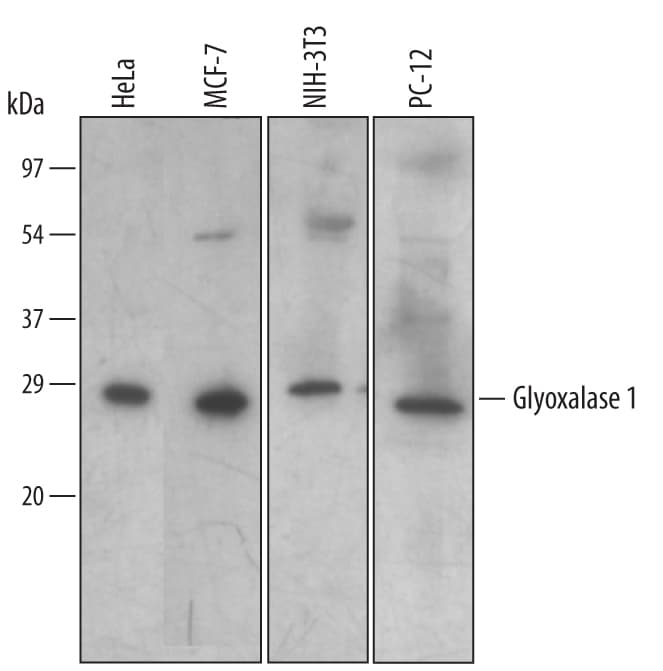
Detection of Human/Mouse/Rat Glyoxalase I by Western Blot.
Western blot shows lysates of HeLa human cervical epithelial carcinoma cell line, MCF-7 human breast cancer cell line, NIH-3T3 mouse embryonic fibroblast cell line, and PC-12 rat adrenal pheochromocytoma cell line. PVDF membrane was probed with 1 µg/mL of Goat Anti-Human/Mouse/Rat Glyoxalase I Antigen Affinity-purified Polyclonal Antibody (Catalog # AF4959) followed by HRP-conjugated Anti-Goat IgG Secondary Antibody (Catalog # HAF109). A specific band was detected for Glyoxalase I at approximately 28 kDa (as indicated). This experiment was conducted using Immunoblot Buffer Group 2.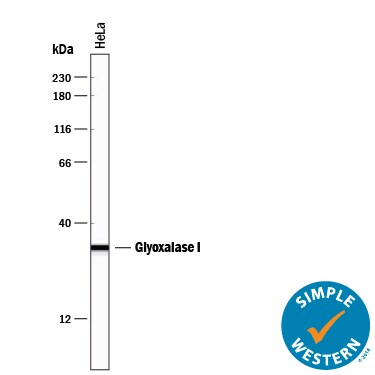
Detection of Human Glyoxalase I by Simple WesternTM
Simple Western lane view shows lysates of HeLa human cervical epithelial carcinoma cell line, loaded at 0.2 mg/mL. A specific band was detected for Glyoxalase I at approximately 33 kDa (as indicated) using 50 µg/mL of Goat Anti-Human/Mouse/Rat Glyoxalase I Antigen Affinity-purified Polyclonal Antibody (Catalog # AF4959) followed by 1:50 dilution of HRP-conjugated Anti-Goat IgG Secondary Antibody (Catalog # HAF109). This experiment was conducted under reducing conditions and using the 12-230 kDa separation system.Applications for Glyoxalase I Antibody
Simple Western
Sample: HeLa human cervical epithelial carcinoma cell line
Western Blot
Sample: HeLa human cervical epithelial carcinoma cell line, MCF-7 human breast cancer cell line, NIH-3T3 mouse embryonic fibroblast cell line, and PC-12 rat adrenal pheochromocytoma cell line
Formulation, Preparation, and Storage
Purification
Reconstitution
Reconstitute at 0.2 mg/mL in sterile PBS. For liquid material, refer to CoA for concentration.
Formulation
Shipping
Stability & Storage
- 12 months from date of receipt, -20 to -70 °C as supplied.
- 1 month, 2 to 8 °C under sterile conditions after reconstitution.
- 6 months, -20 to -70 °C under sterile conditions after reconstitution.
Calculators
Background: Glyoxalase I
References
- Ridderstrom, M. & B. Mannervik (1996) Biochem. J. 314:463.
- Marmstal, E. & B. Mannervik (1981) FEBS Lett. 131:301.
- Kim, N-S. et al. (1993) J. Biol. Chem. 268:11217.
- Ranganathan, S. et al. (1993) J. Biol. Chem. 268:5661.
- Kalousova, M. et al. (2007) Ann. N. Y. Acad. Sci. 1126:268.
Alternate Names
Gene Symbol
UniProt
Additional Glyoxalase I Products
Product Documents for Glyoxalase I Antibody
Certificate of Analysis
To download a Certificate of Analysis, please enter a lot or batch number in the search box below.
Note: Certificate of Analysis not available for kit components.
Product Specific Notices for Glyoxalase I Antibody
For research use only
Citations for Glyoxalase I Antibody
 Powered by Bioz
Customer Reviews for Glyoxalase I Antibody
There are currently no reviews for this product. Be the first to review Glyoxalase I Antibody and earn rewards!
Have you used Glyoxalase I Antibody?
Submit a review and receive an Amazon gift card!
$25/€18/£15/$25CAN/¥2500 for a review with an image
$10/€7/£6/$10CAN/¥1110 for a review without an image
Submit a review
Protocols
Find general support by application which include: protocols, troubleshooting, illustrated assays, videos and webinars.
- Cellular Response to Hypoxia Protocols
- R&D Systems Quality Control Western Blot Protocol
- Troubleshooting Guide: Western Blot Figures
- Western Blot Conditions
- Western Blot Protocol
- Western Blot Protocol for Cell Lysates
- Western Blot Troubleshooting
- Western Blot Troubleshooting Guide
- View all Protocols, Troubleshooting, Illustrated assays and Webinars