
The cyclin-dependent kinase (cdk) inhibitor p27/Kip1 is a tumor suppressor protein that acts in the nucleus to enforce cell cycle checkpoints. p27/Kip1 binds to and inhibits many cyclin/cdk complexes, including cyclin D/cdk4, cyclin E/cdk2, and cyclin A/cdk2. This inhibition can subsequently block progression through different phases of the cell cycle.


Scientific images may be resized, cropped, or adjusted for brightness or contrast for presentation purposes. These updates are limited to presentation and do not affect the underlying scientific interpretation of the data. Where available, additional source data may be provided upon request.
Key Product Details
Species Reactivity
Validated:
Human, Mouse, Rat
Cited:
Human, Yeast
Applications
Validated:
Western Blot, Flow Cytometry, Simple Western, CyTOF-ready
Cited:
Western Blot
Label
Unconjugated
Antibody Source
Polyclonal Goat IgG
Loading...
Product Specifications
Immunogen
E. coli-derived recombinant human p27
Met1-Thr198
Accession # P46527
Met1-Thr198
Accession # P46527
Specificity
Detects human, mouse and rat p27.
Clonality
Polyclonal
Host
Goat
Isotype
IgG
Scientific Data Images for p27/Kip1 Antibody
Detection of Human p27/Kip1 by Western Blot.
Western blot shows lysates of MCF-7 human breast cancer cell line and U2OS human osteosarcoma cell line. PVDF membrane was probed with 1 µg/mL of Goat Anti-Human p27/Kip1 Antigen Affinity-purified Polyclonal Antibody (Catalog # AF2256) followed by HRP-conjugated Anti-Goat IgG Secondary Antibody (Catalog # HAF109). A specific band was detected for p27/Kip1 at approximately 30 kDa (as indicated). This experiment was conducted under reducing conditions and using Immunoblot Buffer Group 1.
Detection of p27/Kip1in Human PBMCs by Flow Cytometry.
Human peripheral blood mononuclear cells were stained with Goat Anti-Human p27/Kip1 Antigen Affinity-purified Polyclonal Antibody (Catalog # AF2256, filled histogram) or control antibody (Catalog # AB-108-C, open histogram), followed by Phycoerythrin-conjugated Anti-Goat IgG Secondary Antibody (Catalog # F0107).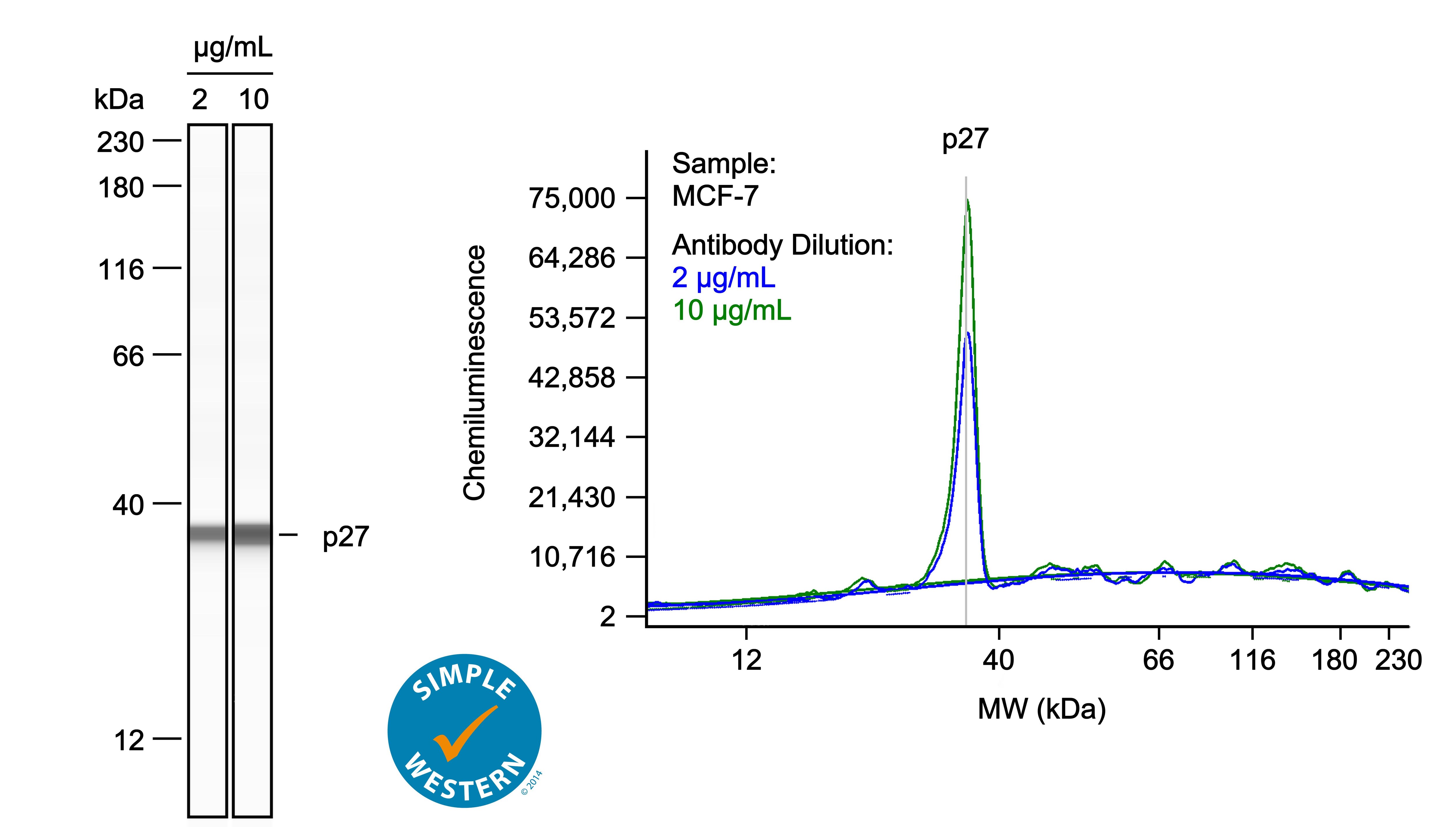
Detection of Human p27/Kip1 by Simple WesternTM.
Left: Simple Western lane view shows lysates of MCF‑7 human breast cancer cell line, loaded at 1 mg/ml. A specific band was detected for p27/Kip1 at approximately 36 kDa (as indicated) using both 2 µg/ml and 10 µg/ml of Goat Anti-Human/Mouse/Rat p27/Kip1 Antigen Affinity-purified Polyclonal Antibody (Catalog # AF2256) followed by HRP-conjugated Donkey Anti-Goat Secondary Antibody (Catalog # 043-522-2). This experiment was conducted under reducing conditions and using the 12-230kDa separation system. Right: Simple Western electropherogram showing the same Goat Anti-Human/Mouse/Rat p27/Kip1 Antigen Affinity-purified Polyclonal Antibody (Catalog # AF2256) tested at 2 µg/ml (blue line) and 10 µg/ml (green line) in the MCF‑7 human breast cancer cell line.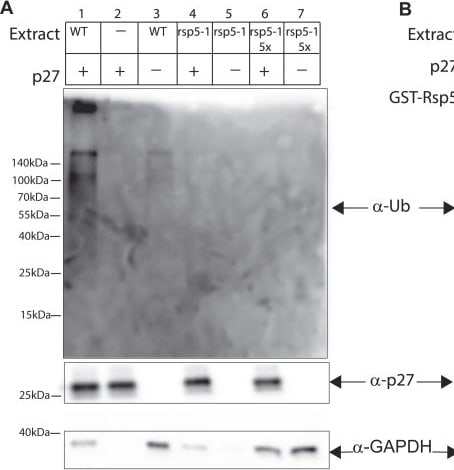
Detection of p27/Kip1 by Western Blot
In vitro ubiquitination of p27 in yeast extract. In vitro ubiquitination of p27 was carried out with yeast extracts with the indicated mutations, UbcH7, and His6-p27. His6-p27 was pulled down with Ni-NTA beads, and gels were blotted with anti-ubiquitin and anti-p27 antibodies. A, wild-type yeast extract shows strong ubiquitination of p27 (lane 1) whereas the no p27 (lane 3) and no extract (lane 2) controls show little ubiquitination. The addition of rsp5-1 mutant extract does not promote p27 ubiquitination (lane 4), even with the addition of excess extract (lane 6). The lower panel shows equal loading of p27 in lanes 1, 2 4, and 6. B, as in A, WT but not rsp5-1 mutant extract supports p27 ubiquitination (lane 1 vs lane 4). The addition of purified Rsp5 promotes p27 ubiquitination in a dose-dependent manner (lanes 4, 5, 6), while the addition of a catalytically dead mutant Rsp5 does not support p27 ubiquitination (lane 7). The lower panel shows p27 loading. The bottom panel shows GAPDH loading control. Image collected and cropped by CiteAb from the following open publication (https://pubmed.ncbi.nlm.nih.gov/38301893), licensed under a CC-BY license. Not internally tested by R&D Systems.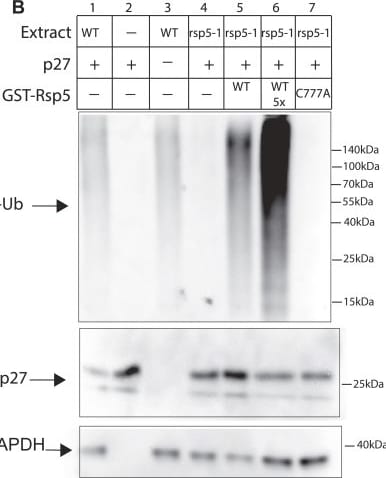
Detection of p27/Kip1 by Western Blot
In vitro ubiquitination of p27 in yeast extract. In vitro ubiquitination of p27 was carried out with yeast extracts with the indicated mutations, UbcH7, and His6-p27. His6-p27 was pulled down with Ni-NTA beads, and gels were blotted with anti-ubiquitin and anti-p27 antibodies. A, wild-type yeast extract shows strong ubiquitination of p27 (lane 1) whereas the no p27 (lane 3) and no extract (lane 2) controls show little ubiquitination. The addition of rsp5-1 mutant extract does not promote p27 ubiquitination (lane 4), even with the addition of excess extract (lane 6). The lower panel shows equal loading of p27 in lanes 1, 2 4, and 6. B, as in A, WT but not rsp5-1 mutant extract supports p27 ubiquitination (lane 1 vs lane 4). The addition of purified Rsp5 promotes p27 ubiquitination in a dose-dependent manner (lanes 4, 5, 6), while the addition of a catalytically dead mutant Rsp5 does not support p27 ubiquitination (lane 7). The lower panel shows p27 loading. The bottom panel shows GAPDH loading control. Image collected and cropped by CiteAb from the following open publication (https://pubmed.ncbi.nlm.nih.gov/38301893), licensed under a CC-BY license. Not internally tested by R&D Systems.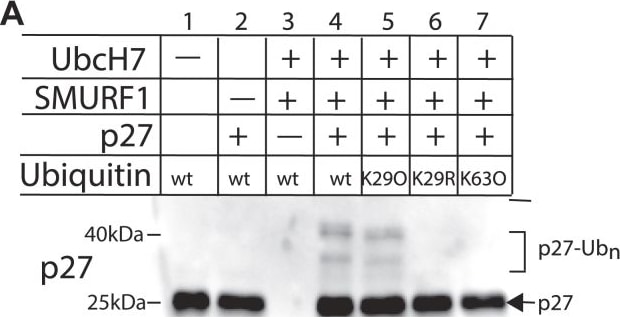
Detection of p27/Kip1 by Western Blot
UbcH7-SMURF1 prefers conjugating K29 ubiquitin to p27. Ubiquitination of p27 was carried out in a reconstituted system with Ube1, UbcH7, SMURF1, His6-p27, ATP regeneration system, and buffer. Reactions were run on SDS-PAGE gels and probed with anti-SMURF1 and anti-p27 antibodies. A, the p27 immunoblot shows p27 is ubiquitinated by SMURF1 with wild-type (lane 4 vs. lane 2) and K29O ubiquitin (lane 5 vs. lane 2) but not K29R (lane 6) or K63O ubiquitin (lane 7). B, the immunoblot for SMURF1 shows SMURF1 auto-ubiquitination with wild-type (lanes 3 and 4), K29O (lane 5), and, to a lesser extent, K63O ubiquitin (lane 7). Autoubiquitination is more extensive with p27 present (Lane 4 versus 3). Image collected and cropped by CiteAb from the following open publication (https://pubmed.ncbi.nlm.nih.gov/38301893), licensed under a CC-BY license. Not internally tested by R&D Systems.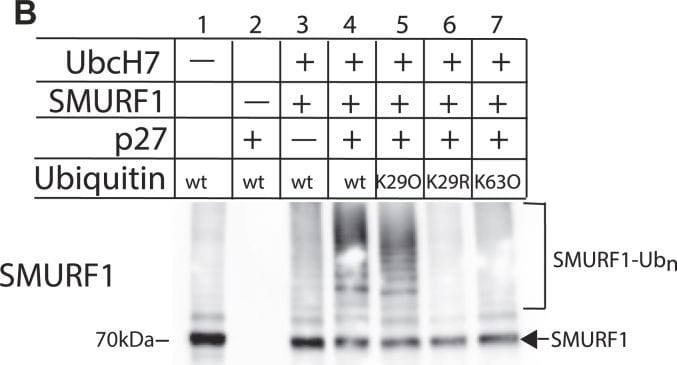
Detection of p27/Kip1 by Western Blot
UbcH7-SMURF1 prefers conjugating K29 ubiquitin to p27. Ubiquitination of p27 was carried out in a reconstituted system with Ube1, UbcH7, SMURF1, His6-p27, ATP regeneration system, and buffer. Reactions were run on SDS-PAGE gels and probed with anti-SMURF1 and anti-p27 antibodies. A, the p27 immunoblot shows p27 is ubiquitinated by SMURF1 with wild-type (lane 4 vs. lane 2) and K29O ubiquitin (lane 5 vs. lane 2) but not K29R (lane 6) or K63O ubiquitin (lane 7). B, the immunoblot for SMURF1 shows SMURF1 auto-ubiquitination with wild-type (lanes 3 and 4), K29O (lane 5), and, to a lesser extent, K63O ubiquitin (lane 7). Autoubiquitination is more extensive with p27 present (Lane 4 versus 3). Image collected and cropped by CiteAb from the following open publication (https://pubmed.ncbi.nlm.nih.gov/38301893), licensed under a CC-BY license. Not internally tested by R&D Systems.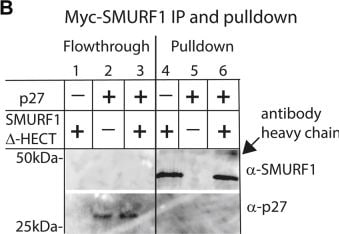
Detection of p27/Kip1 by Western Blot
A, His-p27 and FLAG-SMURF1 were allowed to interact, and then the p27 was pulled down with Ni-NTA beads. The flowthrough and bead bound proteins were analyzed by Western blot. His-p27 was able to pull down SMURF1. B, Myc-SMURF1 -HECT was immunoprecipitated from HELA cells using anti-Myc antibody and protein G beads. His-p27 was then incubated with the beads, and Western blots were used to analyze the bead bound proteins after washing. His-p27 did not interact with the truncated SMURF1. Image collected and cropped by CiteAb from the following open publication (https://pubmed.ncbi.nlm.nih.gov/38301893), licensed under a CC-BY license. Not internally tested by R&D Systems.Applications for p27/Kip1 Antibody
Application
Recommended Usage
CyTOF-ready
Ready to be labeled using established conjugation methods. No BSA or other carrier proteins that could interfere with conjugation.
Flow Cytometry
2.5 µg/106 cells
Sample: Human peripheral blood mononuclear cells
Sample: Human peripheral blood mononuclear cells
Simple Western
2-10 µg/mL
Sample: MCF-7 human breast cancer cell line
Sample: MCF-7 human breast cancer cell line
Western Blot
1 µg/mL
Sample: MCF-7 human breast cancer cell line and U2OS human osteosarcoma cell line
Sample: MCF-7 human breast cancer cell line and U2OS human osteosarcoma cell line
Reviewed Applications
Read 1 review rated 4 using AF2256 in the following applications:
Flow Cytometry Panel Builder
Bio-Techne Knows Flow Cytometry
Save time and reduce costly mistakes by quickly finding compatible reagents using the Panel Builder Tool.
Advanced Features
- Spectra Viewer - Custom analysis of spectra from multiple fluorochromes
- Spillover Popups - Visualize the spectra of individual fluorochromes
- Antigen Density Selector - Match fluorochrome brightness with antigen density

Formulation, Preparation, and Storage
Purification
Antigen Affinity-purified
Reconstitution
Reconstitute at 0.2 mg/mL in sterile PBS. For liquid material, refer to CoA for concentration.
Loading...
Formulation
Lyophilized from a 0.2 μm filtered solution in PBS with Trehalose. See Certificate of Analysis for details.<br/>*Small pack size (-SP) is supplied either lyophilized or as a 0.2 µm filtered solution in PBS.
Shipping
Lyophilized product is shipped at ambient temperature. Liquid small pack size (-SP) is shipped with polar packs. Upon receipt, store immediately at the temperature recommended below.
Stability & Storage
Use a manual defrost freezer and avoid repeated freeze-thaw cycles.
- 12 months from date of receipt, -20 to -70 °C as supplied.
- 1 month, 2 to 8 °C under sterile conditions after reconstitution.
- 6 months, -20 to -70 °C under sterile conditions after reconstitution.
Calculators
Background: p27/Kip1
Long Name
p27 Cyclin Dependent Kinase 4 Inhibitor 1B
Alternate Names
CDKN1B, Kip1
Gene Symbol
CDKN1B
UniProt
Additional p27/Kip1 Products
Product Documents for p27/Kip1 Antibody
Certificate of Analysis
To download a Certificate of Analysis, please enter a lot or batch number in the search box below.
Note: Certificate of Analysis not available for kit components.
Product Specific Notices for p27/Kip1 Antibody
For research use only
Related Research Areas
Citations for p27/Kip1 Antibody
 Powered by Bioz
Customer Reviews for p27/Kip1 Antibody (1)
4 out of 5
1 Customer Rating
Have you used p27/Kip1 Antibody?
Submit a review and receive an Amazon gift card!
$25/€18/£15/$25CAN/¥2500 for a review with an image
$10/€7/£6/$10CAN/¥1110 for a review without an image
Submit a review
Customer Images
Showing
1
-
1 of
1 review
Showing All
Filter By:
-
Application: ImmunoprecipitationSample Tested: Prostate cancerSpecies: HumanVerified Customer | Posted 01/25/2018

There are no reviews that match your criteria.
Protocols
Find general support by application which include: protocols, troubleshooting, illustrated assays, videos and webinars.
- 7-Amino Actinomycin D (7-AAD) Cell Viability Flow Cytometry Protocol
- Cellular Response to Hypoxia Protocols
- Extracellular Membrane Flow Cytometry Protocol
- Flow Cytometry Protocol for Cell Surface Markers
- Flow Cytometry Protocol for Staining Membrane Associated Proteins
- Flow Cytometry Staining Protocols
- Flow Cytometry Troubleshooting Guide
- Intracellular Flow Cytometry Protocol Using Alcohol (Methanol)
- Intracellular Flow Cytometry Protocol Using Detergents
- Intracellular Nuclear Staining Flow Cytometry Protocol Using Detergents
- Intracellular Staining Flow Cytometry Protocol Using Alcohol Permeabilization
- Intracellular Staining Flow Cytometry Protocol Using Detergents to Permeabilize Cells
- Propidium Iodide Cell Viability Flow Cytometry Protocol
- Protocol for Liperfluo
- Protocol for the Characterization of Human Th22 Cells
- Protocol for the Characterization of Human Th9 Cells
- Protocol: Annexin V and PI Staining by Flow Cytometry
- Protocol: Annexin V and PI Staining for Apoptosis by Flow Cytometry
- R&D Systems Quality Control Western Blot Protocol
- Troubleshooting Guide: Fluorokine Flow Cytometry Kits
- Troubleshooting Guide: Western Blot Figures
- Western Blot Conditions
- Western Blot Protocol
- Western Blot Protocol for Cell Lysates
- Western Blot Troubleshooting
- Western Blot Troubleshooting Guide
- View all Protocols, Troubleshooting, Illustrated assays and Webinars
Loading...
Associated Pathways
