
OX40 Ligand (OX40L), also known as gp34, is a type II transmembrane glycoprotein designated TNFSF4 within the TNF superfamily. Human OX40L cDNA encodes a 183 amino acids (aa) polypeptide with an amino-terminal cytoplasmic domain (aa 1-23) and a carboxy-terminal extracellular domain (aa 51-183). It shares 46% aa sequence identity with the mouse counterpart. OX40L is expressed on the surface of activated B cells, T cells, dendritic cells and endothelial cells. Like other TNF superfamily members, membrane-bound OX40 Ligand exists as a homotrimer. OX40L binds to OX40 (CD134), a member of the TNF receptor superfamily that is expressed predominantly on activated CD4+ T cells. OX40 Ligand is one of the group of co-stimulatory molecules in the immune system that includes B7, CD40 Ligand, CD30 Ligand, CD27 Ligand and 4-1BB Ligand. OX40 appears as a late activation-induced T cell surface antigen, and its major function of OX40-OX40L interaction may be to transmit a late co-stimulatory signal to promote the survival and proliferation of activated CD4+ T cells and prolong the immune response. Engagement of OX40 on activated T cells in situ in tumors has been shown to augment immune responses and subsequent tumor regression.
Human OX40 Ligand/TNFSF4 Antibody (159403)
R&D Systems | Catalog # MAB10541


Scientific images may be resized, cropped, or adjusted for brightness or contrast for presentation purposes. These updates are limited to presentation and do not affect the underlying scientific interpretation of the data. Where available, additional source data may be provided upon request.
Key Product Details
Validated by
Species Reactivity
Validated:
Cited:
Applications
Validated:
Cited:
Label
Antibody Source
Product Specifications
Immunogen
Gln51-Leu183
Accession # P23510
Specificity
Clonality
Host
Isotype
Endotoxin Level
Scientific Data Images for Human OX40 Ligand/TNFSF4 Antibody (159403)
Detection of OX40 Ligand/ TNFSF4 in Human Mature Dendritic Cells by Flow Cytometry.
Human mature dentritic cells differentated from human peripheral blood mononuclear cell derived CD14+cells treated with 20 ng/mL Recombinant Human IL-4 (Catalog # 204-IL) and 50 ng/mL Recombinant Human GM-CSF (Catalog # 215-GM) for 7 days and 1 µg/mL LPS, 20 ng/mL Recombinant Human TNF-a (Catalog # 210-TA), and 20 ng/mL Recombinant Human IL-1 beta /IL-1F2 (Catalog # 201-LB) for last 24 hours were stained with Mouse Anti-Human OX40 Ligand/TNFSF4 Monoclonal Antibody(Catalog # MAB10541, filled histogram) or isotype control (Catalog # MAB002, open histogram), followed by Goat F(ab)2 Anti-Mouse IgG (H+L) Allophycocyanin (Catalog # F0101B).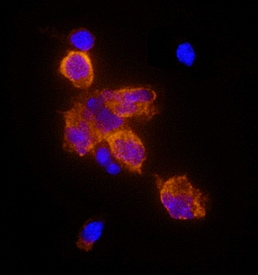
OX40 Ligand/TNFSF4 in Human PBMCs.
OX40 Ligand/TNFSF4 was detected in immersion fixed human peripheral blood mononuclear cells (PBMCs) stimulated with LPS using Mouse Anti-Human OX40 Ligand/ TNFSF4 Monoclonal Antibody (Catalog # MAB10541) at 25 µg/mL for 3 hours at room temperature. Cells were stained using the NorthernLights™ 557-conjugated Anti-Mouse IgG Secondary Antibody (orange; Catalog # NL007) and counterstained with DAPI (blue). View our protocol for Fluorescent ICC Staining of Non-adherent Cells.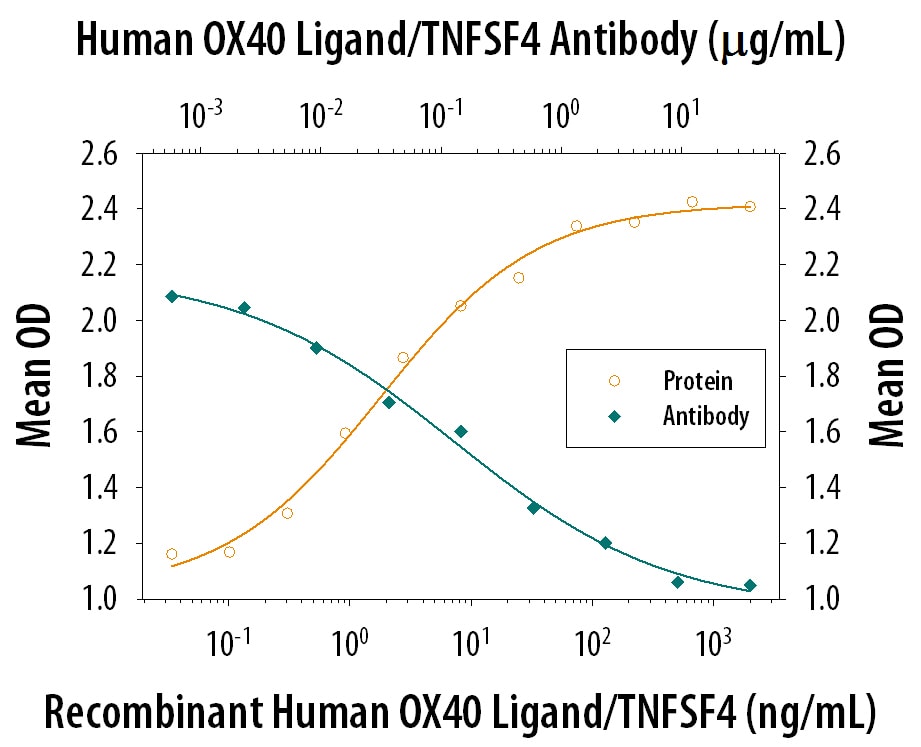
IL‑8 Secretion Induced by OX40 Ligand/TNFSF4 and Neutralization by Human OX40 Ligand/TNFSF4 Antibody.
Recombinant Human OX40 Ligand/TNFSF4 (Catalog # 1054-OX) induces IL-8 secretion in the HT1080 human fibrosarcoma cell line transfected with human OX40 in a dose-dependent manner (orange line) as measured by Human IL-8 Duoset (Catalog # DY208). IL-8 Secretion elicited by Recombinant Human OX40 Ligand/TNFSF4 (10 ng/mL) is neutralized (green line) by increasing concentrations of Mouse Anti-Human OX40 Ligand/TNFSF4 Monoclonal Antibody (Catalog # MAB10541). The ND50 is typically 0.1-0.6 µg/mL.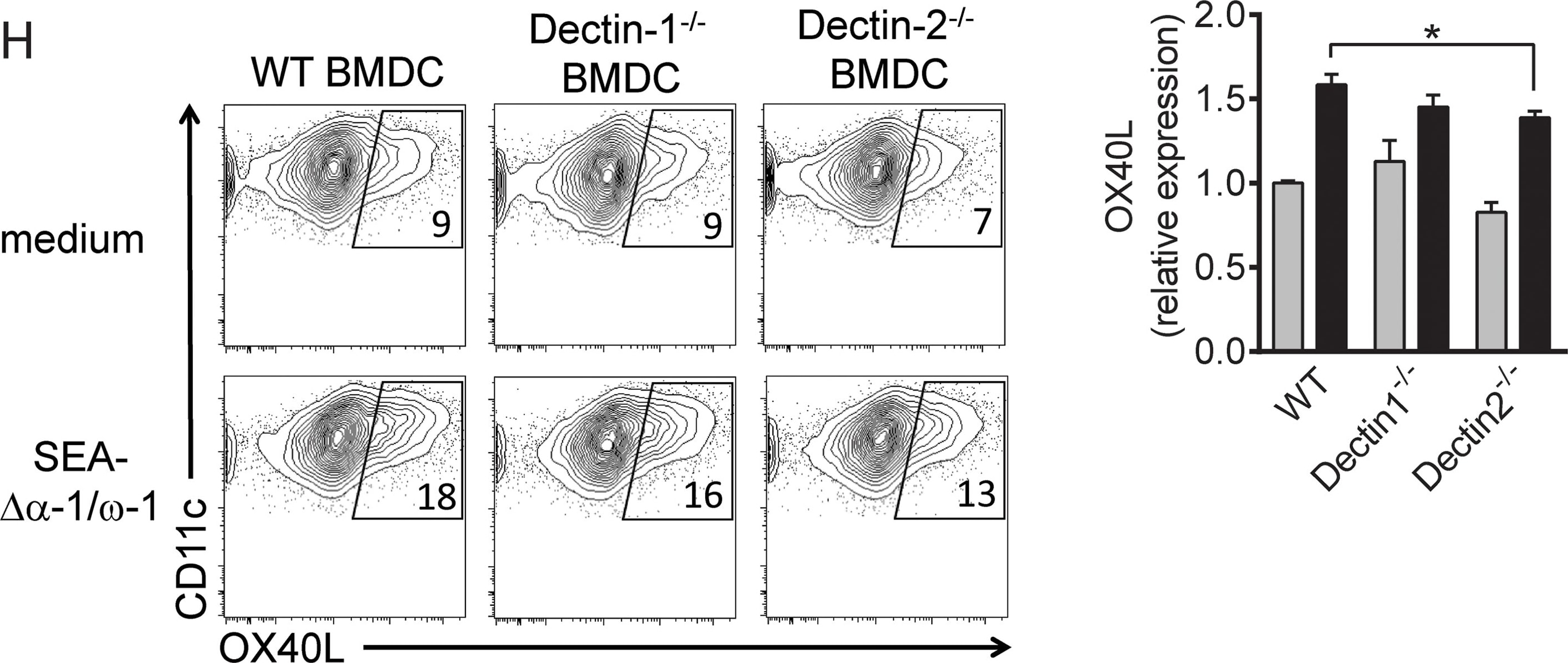
Detection of Mouse OX40 Ligand/TNFSF4 by Flow Cytometry
Th2 polarization induced by SEA is mediated via Dectin-2 and Syk signaling in vivo.(A–D) WT or CD11c delta Syk mice were injected with SEA (panel A, B), SEA delta alpha -1/ omega -1 (panel C), or omega -1 (panel D) in the hind footpad, and draining pLNs were analyzed 7 d later. (A, C, D) pLN cells were restimulated with PMA/Ionomycin in the presence of brefeldin A, and CD4+ T cells were stained for indicated intracellular cytokines and percentage cytokine-positive CD4+ T cells enumerated. Based on these data, the ratio between the percentage IL-4+ over IFN-gamma + CD4+ T cells was determined as a measure for overall skewing towards Th2. (B) pLN cells were restimulated with SEA for 72 h, and cytokine levels in culture supernatants were determined. (A–D) Bar graphs represent mean ± SEM of 5 to 6 mice per group and are representative of 2 (panel A–C) or 1 (panel D) experiment. (E) BMDCs cultured from BM from WT, Dectin-1−/−, or Dectin-2−/− mice were pulsed overnight with SEA delta alpha -1/ omega -1 and injected into hind footpads after which CD4+ T-cell responses were analyzed as in panel A. Representative flow cytometry plots of intracellular staining of CD4+ T cells are depicted, of which the data are enumerated in bar graphs representing mean ± SEM of 2 independent experiments with 3 to 6 mice per group. (F) SEA binding and uptake was determined as in Fig 4F. (G) ROS production by indicated BMDCs was determined as described in Fig 5E, 1 h after stimulation with SEA delta alpha -1/ omega -1. Based on MFI, bar graphs represent fold change relative to control condition, which is set to 1. (H) BMDCs were stimulated as indicated for 18 h after which expression of OX40L was analyzed by flow cytometry. Representative plots are depicted, of which the data are enumerated in bar graphs and shown as fold change relative to control condition, which is set to 1, based on percentage positive cells. (F–H) Bar graphs represent mean of duplicates or triplicates ± SEM of 2 independent experiments. “*”: P < 0.05; “**” and “##”: P < 0.01; “***” and “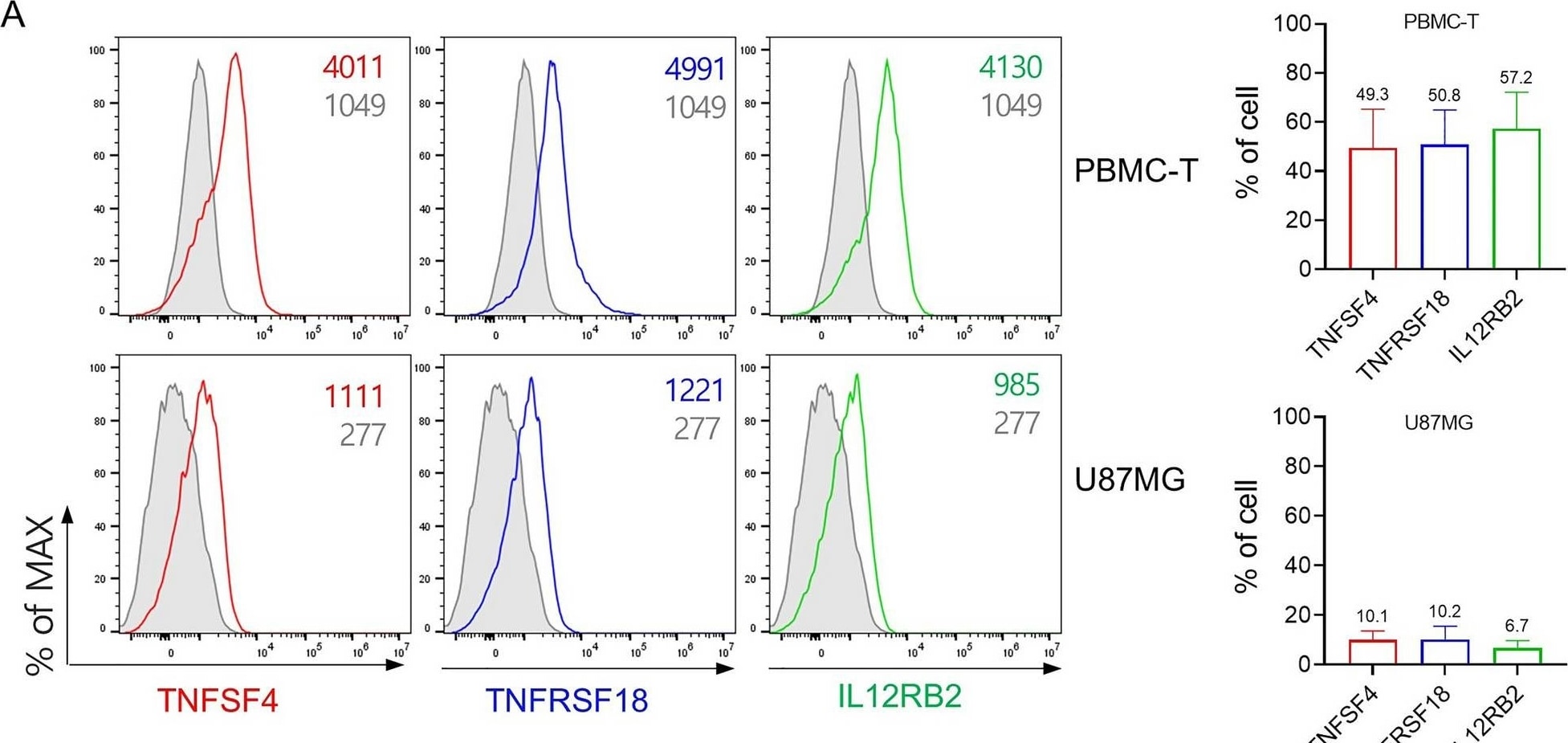
Detection of OX40 Ligand/TNFSF4 by Flow Cytometry
Effects of three candidate genes on migration of NK cells toward GBM cancer cells. A Expression of TNFSF4, TNFRSF18, and IL12RB2 in T cells and U87MG cells was analyzed by flow cytometry. Left: Representative histogram plots. Gray histograms represent isotype controls. Right: Column graphs show the frequencies of TNFSF4+, TNFRSF18+, and IL12RB2+ cells. B Transwell migration assay: CFSE-stained NK cells were plated in the upper chamber of a Transwell insert with an 8-mm pore size. Cells were allowed to migrate for 8 h toward U87MG cells with or without T cells in the lower chamber. T cells were pre-incubated with blocking antibodies to TNFSF4, TNFRSF18, and IL12RB2 for 1 h. NK cells that migrated to the lower chamber were counted using a cell counter. The experiments were performed in triplicate Image collected and cropped by CiteAb from the following open publication (https://pubmed.ncbi.nlm.nih.gov/36694264), licensed under a CC-BY license. Not internally tested by R&D Systems.Applications for Human OX40 Ligand/TNFSF4 Antibody (159403)
CyTOF-ready
Flow Cytometry
Sample: Human mature dentritic cells differentated from human peripheral blood mononuclear cell derived CD14+ cells treated with Recombinant Human IL‑4 (Catalog # 204-IL), Recombinant Human GM‑CSF (Catalog # 215-GM), LPS, Recombinant Human TNF‑ alpha (Catalog # 210-TA), and Recombinant Human IL‑1 beta /IL‑1F2 (Catalog # 201-LB)
Immunocytochemistry
Sample: Immersion fixed human peripheral blood mononuclear cells stimulated with LPS
Neutralization
Flow Cytometry Panel Builder
Bio-Techne Knows Flow Cytometry
Save time and reduce costly mistakes by quickly finding compatible reagents using the Panel Builder Tool.
Advanced Features
- Spectra Viewer - Custom analysis of spectra from multiple fluorochromes
- Spillover Popups - Visualize the spectra of individual fluorochromes
- Antigen Density Selector - Match fluorochrome brightness with antigen density

Formulation, Preparation, and Storage
Purification
Reconstitution
Reconstitute at 0.5 mg/mL in sterile PBS. For liquid material, refer to CoA for concentration.
Formulation
Shipping
Stability & Storage
- 12 months from date of receipt, -20 to -70 °C as supplied.
- 1 month, 2 to 8 °C under sterile conditions after reconstitution.
- 6 months, -20 to -70 °C under sterile conditions after reconstitution.
Calculators
Background: OX40 Ligand/TNFSF4
References
- Godfrey, W.R. et al. (1994) J. Exp. Med. 180:757.
- Baum, P.R. et al. (1994) EMBO J. 13:3992.
- Al-Shamkhani, A. et al. (1997) J. Biol. Chem. 272:5275.
- Kjaergaard, J. et al. (2000) Cancer Res. 60:5514.
Alternate Names
Gene Symbol
UniProt
Additional OX40 Ligand/TNFSF4 Products
Product Documents for Human OX40 Ligand/TNFSF4 Antibody (159403)
Certificate of Analysis
To download a Certificate of Analysis, please enter a lot or batch number in the search box below.
Note: Certificate of Analysis not available for kit components.
Product Specific Notices for Human OX40 Ligand/TNFSF4 Antibody (159403)
For research use only
Citations for Human OX40 Ligand/TNFSF4 Antibody (159403)
 Powered by Bioz
Customer Reviews for Human OX40 Ligand/TNFSF4 Antibody (159403)
There are currently no reviews for this product. Be the first to review Human OX40 Ligand/TNFSF4 Antibody (159403) and earn rewards!
Have you used Human OX40 Ligand/TNFSF4 Antibody (159403)?
Submit a review and receive an Amazon gift card!
$25/€18/£15/$25CAN/¥2500 for a review with an image
$10/€7/£6/$10CAN/¥1110 for a review without an image
Submit a review
Protocols
Find general support by application which include: protocols, troubleshooting, illustrated assays, videos and webinars.
- 7-Amino Actinomycin D (7-AAD) Cell Viability Flow Cytometry Protocol
- Appropriate Fixation of IHC/ICC Samples
- Cellular Response to Hypoxia Protocols
- ClariTSA™ Fluorophore Kits
- Detection & Visualization of Antibody Binding
- Extracellular Membrane Flow Cytometry Protocol
- Flow Cytometry Protocol for Cell Surface Markers
- Flow Cytometry Protocol for Staining Membrane Associated Proteins
- Flow Cytometry Staining Protocols
- Flow Cytometry Troubleshooting Guide
- ICC Cell Smear Protocol for Suspension Cells
- ICC Immunocytochemistry Protocol Videos
- ICC for Adherent Cells
- Immunocytochemistry (ICC) Protocol
- Immunocytochemistry Troubleshooting
- Immunofluorescence of Organoids Embedded in Cultrex Basement Membrane Extract
- Immunohistochemistry (IHC) and Immunocytochemistry (ICC) Protocols
- Intracellular Flow Cytometry Protocol Using Alcohol (Methanol)
- Intracellular Flow Cytometry Protocol Using Detergents
- Intracellular Nuclear Staining Flow Cytometry Protocol Using Detergents
- Intracellular Staining Flow Cytometry Protocol Using Alcohol Permeabilization
- Intracellular Staining Flow Cytometry Protocol Using Detergents to Permeabilize Cells
- Preparing Samples for IHC/ICC Experiments
- Preventing Non-Specific Staining (Non-Specific Binding)
- Primary Antibody Selection & Optimization
- Propidium Iodide Cell Viability Flow Cytometry Protocol
- Protocol for Liperfluo
- Protocol for VisUCyte™ HRP Polymer Detection Reagent
- Protocol for the Characterization of Human Th22 Cells
- Protocol for the Characterization of Human Th9 Cells
- Protocol for the Fluorescent ICC Staining of Cell Smears - Graphic
- Protocol for the Fluorescent ICC Staining of Cultured Cells on Coverslips - Graphic
- Protocol for the Preparation and Fluorescent ICC Staining of Cells on Coverslips
- Protocol for the Preparation and Fluorescent ICC Staining of Non-adherent Cells
- Protocol for the Preparation and Fluorescent ICC Staining of Stem Cells on Coverslips
- Protocol for the Preparation of a Cell Smear for Non-adherent Cell ICC - Graphic
- Protocol: Annexin V and PI Staining by Flow Cytometry
- Protocol: Annexin V and PI Staining for Apoptosis by Flow Cytometry
- TUNEL and Active Caspase-3 Detection by IHC/ICC Protocol
- The Importance of IHC/ICC Controls
- Troubleshooting Guide: Fluorokine Flow Cytometry Kits
- View all Protocols, Troubleshooting, Illustrated assays and Webinars
Associated Pathways

