
VEGFR1 (vascular endothelial growth factor receptor 1; Flt-1) binds to VEGF-A, VEGF-B, and PlGF and functions in vasculogenesis, angiogenesis, lymphangiogenesis, and wound healing. It is expressed on endothelial cells, osteoblasts, placental trophoblasts, renal mesangial cells, and some hematopoietic stem cells. It can heterodimerize with VEGFR2 and modulate VEGFR2 mediated endothelial cell proliferation and vessel branching. VEGFR1 engagement on monocyte/macrophage lineage cells enhances their migration, and release of growth factors and cytokines.
Human Phospho-VEGFR1/Flt-1 DuoSet IC ELISA
R&D Systems | Catalog # DYC4170-2

Loading...
Key Product Details
Assay Type
Solid Phase Sandwich ELISA
Sample Type
Cell Lysates
Reactivity
Human
Human Phospho-VEGFR1/Flt-1 DuoSet IC ELISA Features
- Optimized capture and detection antibody pairings and recommended concentrations save lengthy development time
- Development protocols are provided to guide further assay optimization
- Assay can be customized to your specific needs
- Available in 2, 5, and 15-(96-well) plate pack sizes
- Economical alternative to Western blot
Loading...
Product Summary for Human Phospho-VEGFR1/Flt-1 DuoSet IC ELISA
This DuoSet IC ELISA contains the basic components required for the development of sandwich ELISAs to measure tyrosine-phosphorylated human VEGF R1 / Flt-1 in cell lysates. An immobilized capture antibody specific for VEGF R1 / Flt-1 binds both phosphorylated and unphosphorylated VEGF R1 / Flt-1. After washing away unbound material, a biotinylated detection antibody is used to detect only phosphorylated receptor, utilizing a standard HRP format.
Product Specifications
Assay Format
96-well strip plate (sold separately)
Sample Volume Required
Cell lysates (100 µL)
Detection Method
Colorimetric ELISA - 450nm (TMB)
Conjugate
Biotin
Specificity
Label
HRP
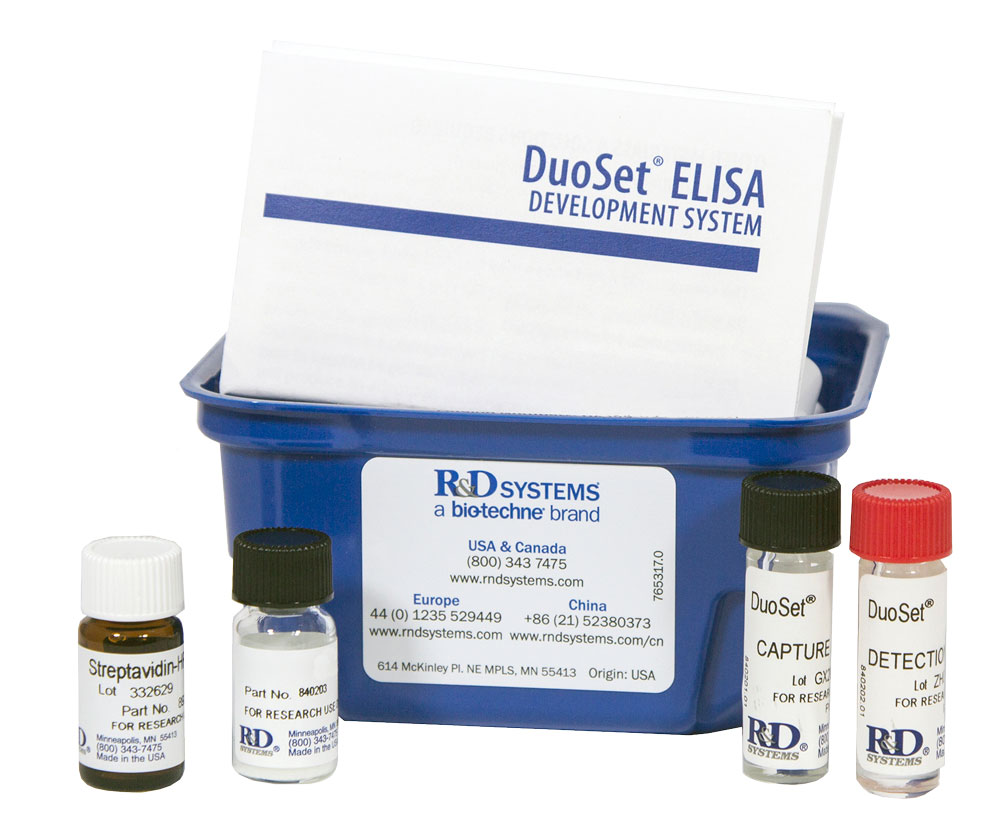
Kit Contents for Human Phospho-VEGFR1/Flt-1 DuoSet IC ELISA
- Capture Antibody
- Conjugated Detection Antibody
- Calibrated Immunoassay Standard or Control
Other Reagents Required
PBS: (Catalog # DY006), or 137 mM NaCl, 2.7 mM KCl, 8.1 mM Na2HPO4, 1.5 mM KH2O4, pH 7.2 - 7.4, 0.2 µm filtered
Wash Buffer: (Catalog # WA126), or equivalent
Lysis Buffer*
IC Diluent*
Blocking Buffer*
Substrate Solution: 1:1 mixture of Color Reagent A (H2O2) and Color Reagent B (Tetramethylbenzidine) (Catalog # DY999)
Stop Solution: 2 N H2SO4 (Catalog # DY994)
Microplates: R&D Systems (Catalog # DY990), or equivalent
Plate Sealers: ELISA Plate Sealers (Catalog # DY992), or equivalent
*For the Lysis Buffer, IC Diluent, and Blocking BUffer recommended for a specific DuoSet ELISA Development Kit, please see the product
Preparation and Storage
Shipping
The product is shipped at ambient temperature. Upon receipt, store it immediately at the temperature recommended below.
Stability & Storage
Store the unopened product at 2 - 8 °C. Do not use past expiration date.
Background: VEGFR1/Flt-1
Long Name
Vascular Endothelial Growth Factor Receptor 1
Alternate Names
Flt-1, FLT1, FRT, VEGF R1, VEGFR-1
Gene Symbol
FLT1
Additional VEGFR1/Flt-1 Products
Product Documents for Human Phospho-VEGFR1/Flt-1 DuoSet IC ELISA
Certificate of Analysis
To download a Certificate of Analysis, please enter a lot or batch number in the search box below.
Note: Certificate of Analysis not available for kit components.
Product Specific Notices for Human Phospho-VEGFR1/Flt-1 DuoSet IC ELISA
For research use only
Citations for Human Phospho-VEGFR1/Flt-1 DuoSet IC ELISA
 Powered by Bioz
Customer Reviews for Human Phospho-VEGFR1/Flt-1 DuoSet IC ELISA
There are currently no reviews for this product. Be the first to review Human Phospho-VEGFR1/Flt-1 DuoSet IC ELISA and earn rewards!
Have you used Human Phospho-VEGFR1/Flt-1 DuoSet IC ELISA?
Submit a review and receive an Amazon gift card!
$25/€18/£15/$25CAN/¥2500 for a review with an image
$10/€7/£6/$10CAN/¥1110 for a review without an image
Submit a review
Protocols
Find general support by application which include: protocols, troubleshooting, illustrated assays, videos and webinars.
- ELISA Sample Preparation & Collection Guide
- ELISA Troubleshooting Guide
- How to Run an R&D Systems DuoSet ELISA
- How to Run an R&D Systems Quantikine ELISA
- How to Run an R&D Systems Quantikine™ QuicKit™ ELISA
- Quantikine HS ELISA Kit Assay Principle, Alkaline Phosphatase
- Quantikine HS ELISA Kit Principle, Streptavidin-HRP Polymer
- Sandwich ELISA (Colorimetric) – Biotin/Streptavidin Detection Protocol
- Sandwich ELISA (Colorimetric) – Direct Detection Protocol
- Troubleshooting Guide: ELISA
- View all Protocols, Troubleshooting, Illustrated assays and Webinars
FAQs for Human Phospho-VEGFR1/Flt-1 DuoSet IC ELISA
Showing
1
-
2 of
2 FAQs
Showing All
-
Q: What are the recommended methods for removal of adherent cells for preparation of cell lysates?
A: Enzymatic and chemical methods for the removal of cells is not recommended, as they may interfere with the assay. As stated in the datasheet, wash the adherent cells twice with PBS, then add Lysis Buffer #9. Finally, we recommend scraping to remove the adherent cells and resuspend them in the lysis buffer.
-
Q: Which phosphorylated sites are recognized by this assay?
A: This assay utilizes an anti-phosphorylated tyrosine monoclonal detection antibody, and it recognizes all phosphorylated tyrosine residues.
-
Q: What are the recommended methods for removal of adherent cells for preparation of cell lysates?
A: Enzymatic and chemical methods for the removal of cells is not recommended, as they may interfere with the assay. As stated in the datasheet, wash the adherent cells twice with PBS, then add Lysis Buffer #9. Finally, we recommend scraping to remove the adherent cells and resuspend them in the lysis buffer.
-
Q: Which phosphorylated sites are recognized by this assay?
A: This assay utilizes an anti-phosphorylated tyrosine monoclonal detection antibody, and it recognizes all phosphorylated tyrosine residues.
Loading...
Associated Pathways


