
Human Pro EGF Antibody
R&D Systems | Catalog # AF4289

Scientific images may be resized, cropped, or adjusted for brightness or contrast for presentation purposes. These updates are limited to presentation and do not affect the underlying scientific interpretation of the data. Where available, additional source data may be provided upon request.
Key Product Details
Species Reactivity
Validated:
Cited:
Applications
Validated:
Cited:
Label
Antibody Source
Product Specifications
Immunogen
Ser21-Arg1023
Accession # CAA28240
Specificity
Clonality
Host
Isotype
Scientific Data Images for Human Pro EGF Antibody
Detection of Pro-EGF by Western Blot
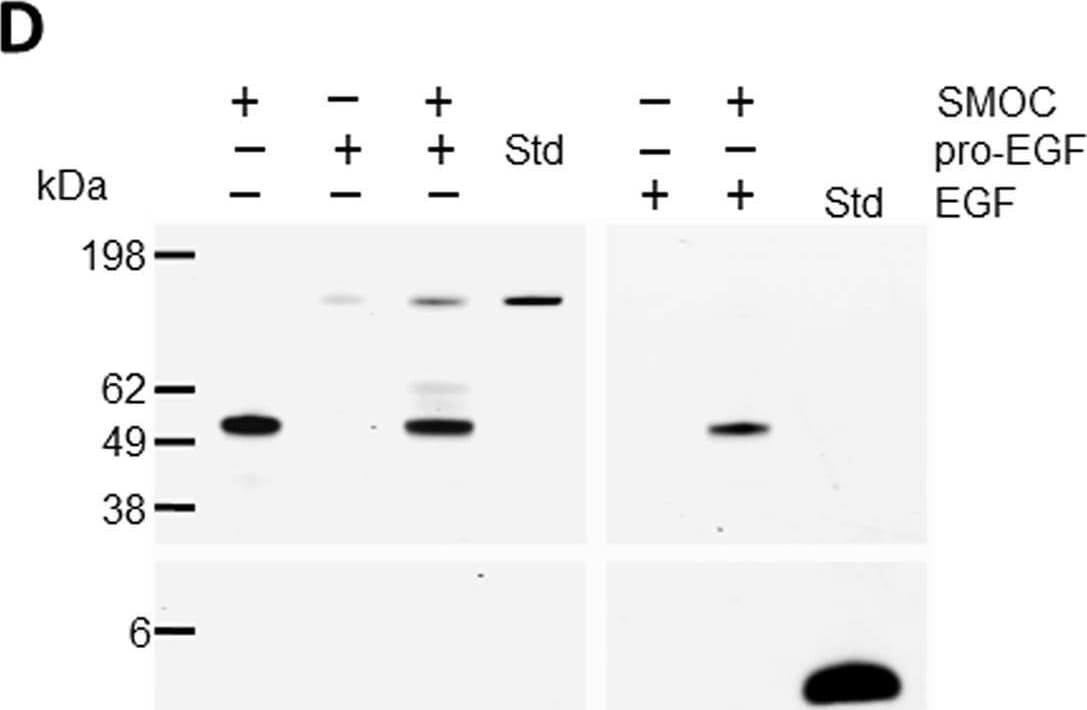
XSMOC-1 does not potentiate MAPK signaling by pro-EGF, but can bind to pro-EGF when bound to heparin sepharose.(A) Immunoblot of 32D/EGFR cell lysates showing Erk phosphorylation (dpErk) following a six minute exposure to a dilution series (0–500ng/ml) of pro-EGF. Total Erk is shown as loading control. (B) Graph showing relative dpErk fluorescence obtained on immunoblots from triplicate experiments of 32D/EGFR cells following a six minute exposure to submaximal concentrations of pro-EGF (2ng or 5ng/ml) in the presence or absence of XSMOC-1 (100μg/ml).The level of dpErk by pro-EGF was not significantly affected by XSMOC-1. (C) Coomassie-stained SDS-PAGE showing the heparin sepharose (HS) elution profile of pro-EGF in the presence of increasing concentrations of NaCl (D) Coomasie-stained SDS-PAGE showing HS elution profiles (±) following incubation of 5μg XSMOC-1 with 5μg of either pro-EGF or EGF in PBS/500mM NaCl, compared to each protein alone. A standard (std) lane is provided for pro-EGF and EGF to demonstrate their expected migration position. Image collected and cropped by CiteAb from the following open publication (https://pubmed.ncbi.nlm.nih.gov/27101391), licensed under a CC0-1.0 license. Not internally tested by R&D Systems.Applications for Human Pro EGF Antibody
Western Blot
Sample: Recombinant Human Pro EGF aa 21-1023 (Catalog # 4289-EG)
Formulation, Preparation, and Storage
Purification
Reconstitution
Reconstitute at 0.2 mg/mL in sterile PBS. For liquid material, refer to CoA for concentration.
Formulation
Shipping
Stability & Storage
- 12 months from date of receipt, -20 to -70 °C as supplied.
- 1 month, 2 to 8 °C under sterile conditions after reconstitution.
- 6 months, -20 to -70 °C under sterile conditions after reconstitution.
Calculators
Background: EGF
References
- Harris, R.C. et al. (2003) Exp. Cell Res. 284:2.
- Carpenter, G. and Cohen, S. (1990) J. Biol. Chem. 265:7709.
- Bell, G.I. et al. (1986) Nucl. Acids Res. 14:8427.
- Carpenter, G. and Zendegui, J.G. (1986) Exp. Cell Res. 164:1.
- Jorissen, R.N. et al. (2003) Exp. Cell Res. 284:31.
- Gamett, D.C. et al. (1997) J. Biol. Chem. 272:12052.
- Qian, X. et al. (1994) Proc. Natl. Acad. Sci. 91:1500.
- Qian, X. et al. (1999) J. Biol. Chem. 274:574.
Long Name
Alternate Names
Gene Symbol
UniProt
Additional EGF Products
Product Documents for Human Pro EGF Antibody
Certificate of Analysis
To download a Certificate of Analysis, please enter a lot or batch number in the search box below.
Note: Certificate of Analysis not available for kit components.
Product Specific Notices for Human Pro EGF Antibody
For research use only
Related Research Areas
Citations for Human Pro EGF Antibody
 Powered by Bioz
Customer Reviews for Human Pro EGF Antibody
There are currently no reviews for this product. Be the first to review Human Pro EGF Antibody and earn rewards!
Have you used Human Pro EGF Antibody?
Submit a review and receive an Amazon gift card!
$25/€18/£15/$25CAN/¥2500 for a review with an image
$10/€7/£6/$10CAN/¥1110 for a review without an image
Submit a review
Protocols
Find general support by application which include: protocols, troubleshooting, illustrated assays, videos and webinars.
- Cellular Response to Hypoxia Protocols
- R&D Systems Quality Control Western Blot Protocol
- Troubleshooting Guide: Western Blot Figures
- Western Blot Conditions
- Western Blot Protocol
- Western Blot Protocol for Cell Lysates
- Western Blot Troubleshooting
- Western Blot Troubleshooting Guide
- View all Protocols, Troubleshooting, Illustrated assays and Webinars


