
ROBO1 (Roundabout-like protein 1) is a 190-230 kDa member of the ROBO/roundabout receptor family. It is expressed by commissural axons from multiple nuclei, and is also found on vascular endothelium, bronchial epithelium, and synctiotrophoblasts. It interacts with Slit and DCC to temporally regulate the migration of axonal processes. The human ROBO1 precursor is a 1651 amino acid (aa) type I transmembrane protein. It contains a 25 aa signal sequence, followed by an 872 aa extracellular region (aa 26-897) that possesses five C2-type Ig-like domains (aa 68-541) and three fibronectin type III domains (aa 561-864). ROBO1 shows multiple isoform variants. The variant used here is termed ROBO1b/DUTT1, and it possesses an 18 aa substitution for aa 1‑47, accompanied by a three aa insertion after Gln348, and a deletion of aa 939-947. ROBO1a, by contrast, possesses only the 18 aa substitution just described. A third isoform possesses the same changes as ROBO1b plus an additional deletion of aa 1013-1067, while a final variant utilizes an alternative start site at Met120. Proteolytic cleavage generates a soluble 120 kDa N-terminal fragment. Over aa 20-861, human ROBO1b shares 97% aa identity with mouse ROBO1.
Human ROBO1 Antibody (770506)
R&D Systems | Catalog # MAB7118


Scientific images may be resized, cropped, or adjusted for brightness or contrast for presentation purposes. These updates are limited to presentation and do not affect the underlying scientific interpretation of the data. Where available, additional source data may be provided upon request.
Key Product Details
Validated by
Species Reactivity
Validated:
Cited:
Applications
Validated:
Cited:
Label
Antibody Source
Product Specifications
Immunogen
Ser20-Pro861 (Val310Ser312 del)
Accession # NP_598334
Specificity
Clonality
Host
Isotype
Scientific Data Images for Human ROBO1 Antibody (770506)
Detection of Human ROBO1 by Western Blot.
Western blot shows lysates of HeLa human cervical epithelial carcinoma cell line and SH-SY5Y human neuroblastoma cell line. PVDF membrane was probed with 2 µg/mL of Mouse Anti-Human ROBO1 Monoclonal Antibody (Catalog # MAB7118) followed by HRP-conjugated Anti-Mouse IgG Secondary Antibody (Catalog # HAF007). A specific band was detected for ROBO1 at approximately 220 kDa (as indicated). This experiment was conducted under reducing conditions and using Immunoblot Buffer Group 1.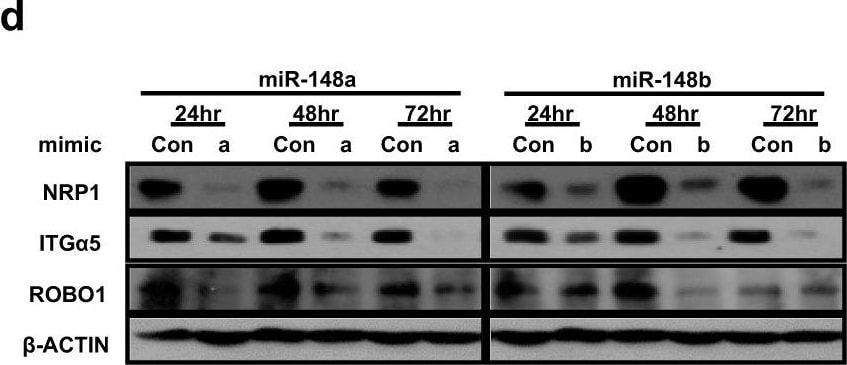
Detection of Human ROBO1 by Western Blot
NRP1, ROBO1, and ITG alpha 5 were identified as target genes of miR-148a/b-3p.a Venn diagrams illustrate the intersection between three algorithms that were used to predict potential gene targets of miR-148a/b-3p. b RT-PCR analysis indicates that the expression of NRP1, ROBO1, and ITG alpha 5 increased during UCB-MNC to OEC differentiation. c The mRNA levels of NRP1, ROBO1, and ITGɑ5 in ECs were regulated by miR-148a/b. ECs were transfected with miR mimics (80 µM), and 48 h after transfection, endogenous NRP1 expression was detected by RT-PCR. d At 24, 48, or 72 h after transfection, Western blotting analysis was performed to investigate the protein levels of target genes. The internal loading control was beta -actin. e Relative mRNA expression of NRP1, ROBO1, and ITGɑ5 was confirmed by RT-PCR. PECAM1 expression was unchanged following treatment with the miR-148a/b-3p mimic (n = 5 per group). f Quantification of the luciferase reporter assay data comparing the wildtype (Wt) NRP1-3′UTR and a mutated (Mut) NRP1-3′UTR; the (Mut) contained a 7-nucleotide mutation in the predicted miR-148a/b-3p binding site. The schematic depicts the predicted miR-148a/b-3p binding site (blue) in the NRP1-3′UTR and shows the 7-nucleotide mutation. All data are presented as the mean ± SEM, **P < 0.01, ***P < 0.001 Image collected and cropped by CiteAb from the following publication (https://pubmed.ncbi.nlm.nih.gov/31723119), licensed under a CC-BY license. Not internally tested by R&D Systems.Applications for Human ROBO1 Antibody (770506)
Western Blot
Sample: HeLa human cervical epithelial carcinoma cell line and SH‑SY5Y human neuroblastoma cell line
Formulation, Preparation, and Storage
Purification
Reconstitution
Sterile PBS to a final concentration of 0.5 mg/mL. For liquid material, refer to CoA for concentration.
Formulation
Shipping
Stability & Storage
- 12 months from date of receipt, -20 to -70 °C as supplied.
- 1 month, 2 to 8 °C under sterile conditions after reconstitution.
- 6 months, -20 to -70 °C under sterile conditions after reconstitution.
Calculators
Background: ROBO1
Long Name
Alternate Names
Gene Symbol
UniProt
Additional ROBO1 Products
Product Documents for Human ROBO1 Antibody (770506)
Certificate of Analysis
To download a Certificate of Analysis, please enter a lot or batch number in the search box below.
Note: Certificate of Analysis not available for kit components.
Product Specific Notices for Human ROBO1 Antibody (770506)
For research use only
Citations for Human ROBO1 Antibody (770506)
 Powered by Bioz
Customer Reviews for Human ROBO1 Antibody (770506)
There are currently no reviews for this product. Be the first to review Human ROBO1 Antibody (770506) and earn rewards!
Have you used Human ROBO1 Antibody (770506)?
Submit a review and receive an Amazon gift card!
$25/€18/£15/$25CAN/¥2500 for a review with an image
$10/€7/£6/$10CAN/¥1110 for a review without an image
Submit a review
Protocols
Find general support by application which include: protocols, troubleshooting, illustrated assays, videos and webinars.
- Cellular Response to Hypoxia Protocols
- R&D Systems Quality Control Western Blot Protocol
- Troubleshooting Guide: Western Blot Figures
- Western Blot Conditions
- Western Blot Protocol
- Western Blot Protocol for Cell Lysates
- Western Blot Troubleshooting
- Western Blot Troubleshooting Guide
- View all Protocols, Troubleshooting, Illustrated assays and Webinars