
Scavenger Receptor, class B, member 1 (SR-B1), gene name SCARB1, is also known as CD36L1 (CD36-like 1) or CLA-1 (CD36 and LIMPII analogous 1) (1-5). SR-B1 is a transmembrane glycoprotein found on macrophages, liver cells and other steroidogenic cells as a lipoprotein receptor. The 552 amino acid (aa) human SR-B1 contains a central extracellular domain (ECD), flanked by N- and C-terminal transmembrane domains. Human splice variants differ at the N-terminal cytoplasmic and transmembrane domains (SR-BIII, 474 aa), the N-terminal end of the ECD (SR-BII, 409 aa), or the C-terminal cytoplasmic domain (isoform 3, 552 aa) (2). The human SR-B1 ECD shares 80%, 80%, 89%, 86% and 84% aa sequence identity with mouse, rat, porcine, rabbit, and bovine SR-B1, respectively. SR-B1 functions in reverse cholesterol transport (RCT), which is thought to be anti-atherogenic by facilitating transport of cholesteryl esters from macrophages back to the liver for degradation (3). In rodent hepatocytes, SR-B1 is the main receptor mediating RCT, while human hepatocytes also express a second mediator, CETP (cholesteryl ester transfer protein) (3-5). The importance of SR-B1 in humans is shown by human SR-B1 genetic variants that alter lipid metabolism (3-7). For example, the P297S polymorphism lowers uptake of high-density lipoprotein (HDL) cholesterol in the liver and increases plasma HDL cholesterol (3-5). On endothelial cells, signaling through SR-B1 activates nitric oxide production, which attenuates monocyte adhesion (6). On adrenocortical cells, SR-B1 mediates uptake of cholesteryl esters from HDL for the synthesis of glucocorticoid hormones such as cortisol (3-5). On platelets, HDL binding to surface SR-B1 inhibits aggregation and increases platelet survival time (3-5). On human ovarian granulosa cells, deficiency of SR-B1 correlates with low fertility (3). SR-B1 and its SR-BII isoform also bind bacterial lipopolysaccharides, facilitating uptake of various bacteria by cells such as peritoneal macrophages (8, 9). This uptake enhances inflammatory responses which, unless properly controlled, can result in sepsis (9-11).

Scientific images may be resized, cropped, or adjusted for brightness or contrast for presentation purposes. These updates are limited to presentation and do not affect the underlying scientific interpretation of the data. Where available, additional source data may be provided upon request.
Key Product Details
Species Reactivity
Applications
Label
Antibody Source
Product Specifications
Immunogen
Specificity
Clonality
Host
Isotype
Scientific Data Images for Human SR-BI Antibody (947007)
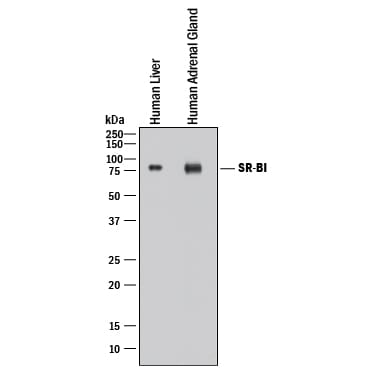
Detection of Human SR-BI by Western Blot.
Western blot shows lysates of human liver tissue and human adrenal gland tissue. PVDF membrane was probed with 2 µg/mL of Mouse Anti-Human SR-BI Monoclonal Antibody (Catalog # MAB8114) followed by HRP-conjugated Anti-Mouse IgG Secondary Antibody (Catalog # HAF018). A specific band was detected for SR-BI at approximately 80 kDa (as indicated). This experiment was conducted under reducing conditions and using Immunoblot Buffer Group 1.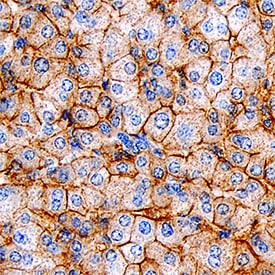
SR-BI in Human Liver.
SR-BI was detected in immersion fixed paraffin-embedded sections of human liver using Mouse Anti-Human SR-BI Monoclonal Antibody (Catalog # MAB8114) at 15 µg/mL overnight at 4 °C. Tissue was stained using the Anti-Mouse HRP-DAB Cell & Tissue Staining Kit (brown; Catalog # CTS002) and counterstained with hematoxylin (blue). Specific staining was localized to cell membranes in hepatocytes. View our protocol for Chromogenic IHC Staining of Paraffin-embedded Tissue Sections.Applications for Human SR-BI Antibody (947007)
Immunohistochemistry
Sample: Immersion fixed paraffin-embedded sections of human liver
Western Blot
Sample: Human liver tissue and human adrenal gland tissue
Reviewed Applications
Read 1 review rated 4 using MAB8114 in the following applications:
Formulation, Preparation, and Storage
Purification
Reconstitution
Reconstitute at 0.5 mg/mL in sterile PBS. For liquid material, refer to CoA for concentration.
Formulation
Shipping
Stability & Storage
- 12 months from date of receipt, -20 to -70 °C as supplied.
- 1 month, 2 to 8 °C under sterile conditions after reconstitution.
- 6 months, -20 to -70 °C under sterile conditions after reconstitution.
Calculators
Background: SR-BI
References
- Calvo, D. and M. A. Vega (1993) J. Biol. Chem. 268:18929.
- Swiss-Prot accession Q8WTV0
- Chadwick, A.C. and D. Sahoo (2013) Curr. Opin. Endocrinol. Diabetes Obes. 20:124.
- Hoekstra, M. et al. (2012) Curr. Opin. Lipidol. 23:127.
- Vergeer, M. et al. (2011) N. Engl. J. Med. 364:136.
- Guo, L. et al. (2011) J. Lipid Res. 52:2272.
- Saddar, S. et al. (2012) Circ. Res. 112:140.
- Vishnyakova, T.G. et al. (2006) Proc. Natl. Acad. Sci. USA 103:16888.
- Baranova, I.N. et al. (2012) J. Immunol. 188:1371.
- Leelahavanichkul, A. et al. (2012) J. Immunol. 188:2749.
- Guo, L. et al. (2009) J. Biol. Chem. 284:19826.
Long Name
Alternate Names
Gene Symbol
Additional SR-BI Products
Product Documents for Human SR-BI Antibody (947007)
Certificate of Analysis
To download a Certificate of Analysis, please enter a lot or batch number in the search box below.
Note: Certificate of Analysis not available for kit components.
Product Specific Notices for Human SR-BI Antibody (947007)
For research use only
Related Research Areas
Citations for Human SR-BI Antibody (947007)
 Powered by Bioz
Customer Reviews for Human SR-BI Antibody (947007) (1)
Have you used Human SR-BI Antibody (947007)?
Submit a review and receive an Amazon gift card!
$25/€18/£15/$25CAN/¥2500 for a review with an image
$10/€7/£6/$10CAN/¥1110 for a review without an image
Submit a review
-
Application: Flow CytometrySample Tested: Recombinant protein and Liver cellsSpecies: Human and MouseVerified Customer | Posted 06/28/2016also FACS, and functional assay
There are no reviews that match your criteria.
Protocols
Find general support by application which include: protocols, troubleshooting, illustrated assays, videos and webinars.
- Antigen Retrieval Protocol (PIER)
- Antigen Retrieval for Frozen Sections Protocol
- Appropriate Fixation of IHC/ICC Samples
- Cellular Response to Hypoxia Protocols
- Chromogenic IHC Staining of Formalin-Fixed Paraffin-Embedded (FFPE) Tissue Protocol
- Chromogenic Immunohistochemistry Staining of Frozen Tissue
- ClariTSA™ Fluorophore Kits
- Detection & Visualization of Antibody Binding
- Fluorescent IHC Staining of Frozen Tissue Protocol
- Graphic Protocol for Heat-induced Epitope Retrieval
- Graphic Protocol for the Preparation and Fluorescent IHC Staining of Frozen Tissue Sections
- Graphic Protocol for the Preparation and Fluorescent IHC Staining of Paraffin-embedded Tissue Sections
- Graphic Protocol for the Preparation of Gelatin-coated Slides for Histological Tissue Sections
- IHC Sample Preparation (Frozen sections vs Paraffin)
- Immunofluorescent IHC Staining of Formalin-Fixed Paraffin-Embedded (FFPE) Tissue Protocol
- Immunohistochemistry (IHC) and Immunocytochemistry (ICC) Protocols
- Immunohistochemistry Frozen Troubleshooting
- Immunohistochemistry Paraffin Troubleshooting
- Preparing Samples for IHC/ICC Experiments
- Preventing Non-Specific Staining (Non-Specific Binding)
- Primary Antibody Selection & Optimization
- Protocol for Heat-Induced Epitope Retrieval (HIER)
- Protocol for Making a 4% Formaldehyde Solution in PBS
- Protocol for VisUCyte™ HRP Polymer Detection Reagent
- Protocol for the Preparation & Fixation of Cells on Coverslips
- Protocol for the Preparation and Chromogenic IHC Staining of Frozen Tissue Sections
- Protocol for the Preparation and Chromogenic IHC Staining of Frozen Tissue Sections - Graphic
- Protocol for the Preparation and Chromogenic IHC Staining of Paraffin-embedded Tissue Sections
- Protocol for the Preparation and Chromogenic IHC Staining of Paraffin-embedded Tissue Sections - Graphic
- Protocol for the Preparation and Fluorescent IHC Staining of Frozen Tissue Sections
- Protocol for the Preparation and Fluorescent IHC Staining of Paraffin-embedded Tissue Sections
- Protocol for the Preparation of Gelatin-coated Slides for Histological Tissue Sections
- R&D Systems Quality Control Western Blot Protocol
- TUNEL and Active Caspase-3 Detection by IHC/ICC Protocol
- The Importance of IHC/ICC Controls
- Troubleshooting Guide: Immunohistochemistry
- Troubleshooting Guide: Western Blot Figures
- Western Blot Conditions
- Western Blot Protocol
- Western Blot Protocol for Cell Lysates
- Western Blot Troubleshooting
- Western Blot Troubleshooting Guide
- View all Protocols, Troubleshooting, Illustrated assays and Webinars