Best Seller

Human TNF-alpha Quantikine QuicKit ELISA

R&D Systems | Catalog # QK210

R&D Systems
Loading...

Key Product Details

Assay Length

80 minutes

Sample Type & Volume Required Per Well

Cell Culture Supernates (50 µL), Serum (50 µL), EDTA Plasma (50 µL), Heparin Plasma (50 µL)

Sensitivity

7.02 pg/mL

Assay Range

31.3-2000 pg/mL (Cell Culture Supernates, Serum, EDTA Plasma, Heparin Plasma)
Loading...

Product Summary for Human TNF-alpha Quantikine QuicKit ELISA

The Quantikine® QuicKit™ Human TNF-alpha Immunoassay is a one step, 80 minute solid phase ELISA designed to measure human TNF-alpha in cell culture supernates, serum, and plasma. It contains E. coli-expressed recombinant human TNF-alpha and antibodies raised against the recombinant protein. Results obtained for naturally occurring human TNF-alpha showed linear curves that were parallel to the standard curves obtained using the recombinant QuicKit™ standards. These results indicate that this kit can be used to determine relative mass values for natural human TNF-alpha.

Product Specifications

Measurement

Quantitative ELISA

Detection Method

Colorimetric - 450nm (TMB)

Conjugate

HRP

Species

Human

Specificity

Natural and recombinant human TNF-alpha.

Cross-reactivity

< 0.5% cross-reactivity observed with available related molecules. < 50% cross-species reactivity observed with species tested.

Interference

No significant interference observed with available related molecules.

Sample Values

Serum/Plasma - Ten serum and plasma samples from apparently healthy volunteers were evaluated for the presence of human TNF-alpha in this assay. All samples measured less than the lowest standard, 31.3 pg/mL. No medical histories were available for the donors used in this study.

Cell Culture Supernates - Human peripheral blood mononuclear cells (PBMCs) (1 x 10⁶ cells/mL) were cultured in RPMI 1640 supplemented with 10% fetal bovine serum, 2 mM L-glutamine, 100 U/mL penicillin, and 100 μg/mL streptomycin sulfate. Cells were unstimulated or stimulated with 10 μg/mL of PHA for 5 days. Aliquots of the culture supernates were removed, assayed for levels of human TNF-alpha, and measured 80.9 pg/mL and 9317 pg/mL, respectively.

Human monocyte-derived macrophages (MDM) were obtained from PBMCs and attached monocytes were cultured in StemXVivo Serum-free Dendritic Cell Base Media (R&D Systems, Catalog#, CCM003) supplemented with 100 U/mL penicillin, 100 μg/mL streptomycin sulfate, and 100 ng/mL of recombinant human M-CSF for 5 days. Cells were unstimulated or stimulated with 1 μg/mL LPS and 40 ng/mL of recombinant human IFN-gamma for 24 hours. Aliquots of the cell culture supernates were removed, assayed for levels of human TNF-alpha, and measured 40.5 pg/mL and 6482 pg/mL, respectively.

Precision

Intra-Assay Precision (Precision within an assay) Two samples of known concentration were tested twenty times on one plate to assess intra-assay precision.

Inter-Assay Precision (Precision between assays) Two samples of known concentration were tested in ten separate assays to assess inter-assay precision. Assays were performed by at least three technicians.

Cell Culture Supernates, EDTA Plasma, Heparin Plasma, Serum

Intra-Assay Precision Inter-Assay Precision
Sample 1 2 1 2
n 20 20 10 10
Mean (pg/mL) 200 1177 214 1243
Standard Deviation 3.64 28.5 13.9 67.8
CV% 1.8 2.4 6.5 5.5

Recovery for Human TNF-alpha Quantikine QuicKit ELISA

The recovery of human TNF-alpha spiked to three different levels in samples throughout the range of the assay in various matrices was evaluated.

Sample Type Average % Recovery Range %
Cell Culture Media (n=4) 120 108-126
EDTA Plasma (n=2) 95 87-106
Heparin Plasma (n=2) 89 81-103
Serum (n=2) 86 83-88

Linearity

To assess linearity of the assay, samples containing and/or spiked with high concentrations of human TNF-alpha in various matrices were diluted with the calibrator diluent to produce samples with values within the dynamic range of the assay.

Scientific Data Images for Human TNF-alpha Quantikine QuicKit ELISA

Human TNF-  alpha  Standard Curve

Human TNF- alpha Standard Curve

Human TNF-  alpha  Standard Curve

Human TNF- alpha Standard Curve

Human TNF-alpha  ELISA Standard Curve

Human TNF-alpha ELISA Standard Curve

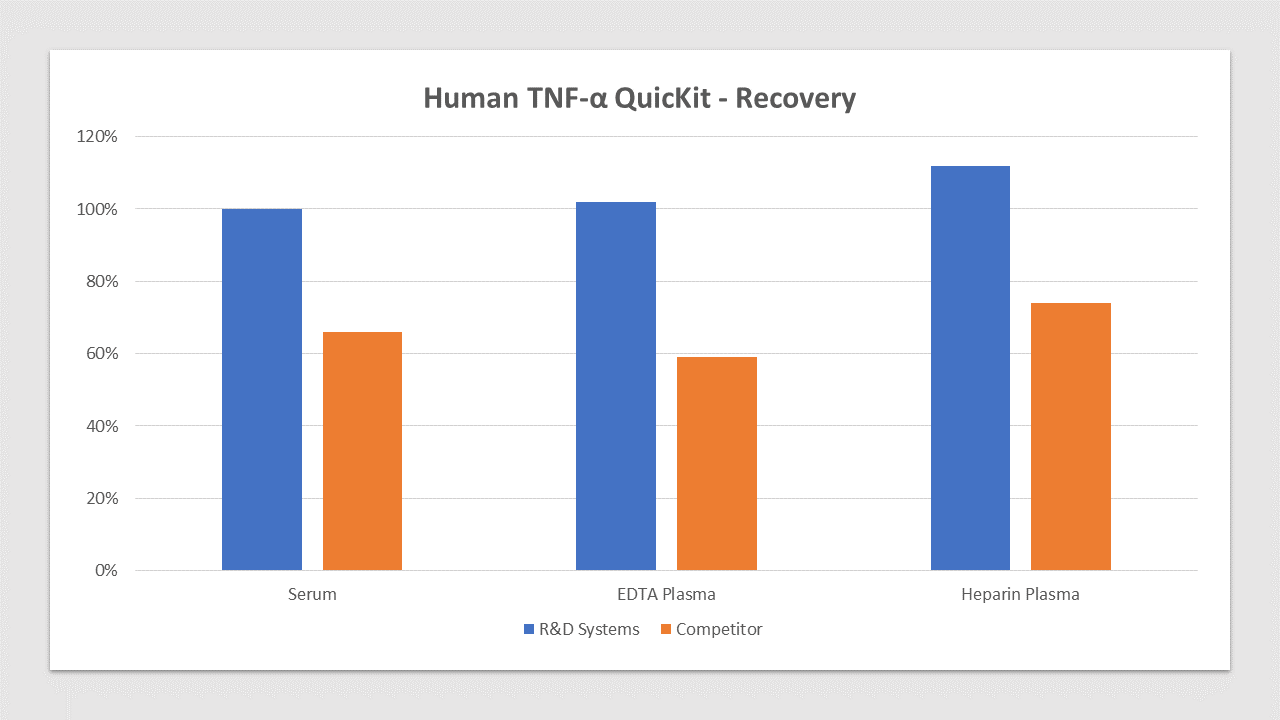
Human TNF-alpha QuicKit Spiked Recovery Competitor Comparison

TNF-alpha is spiked at three known concentrations throughout the range of the assay and run to measure response of the spiked sample matrix. Serum recovery is 100% compared to 66% for the top competitor. EDTA plasma recovery is 102% compared to 59% for the top competitor. Heparin plasma recovery is 112% compared to 74% for the top competitor. In spike and recovery experiments, natural samples are spiked with the recombinant target analyte of interest to identify interference caused by sample matrices.

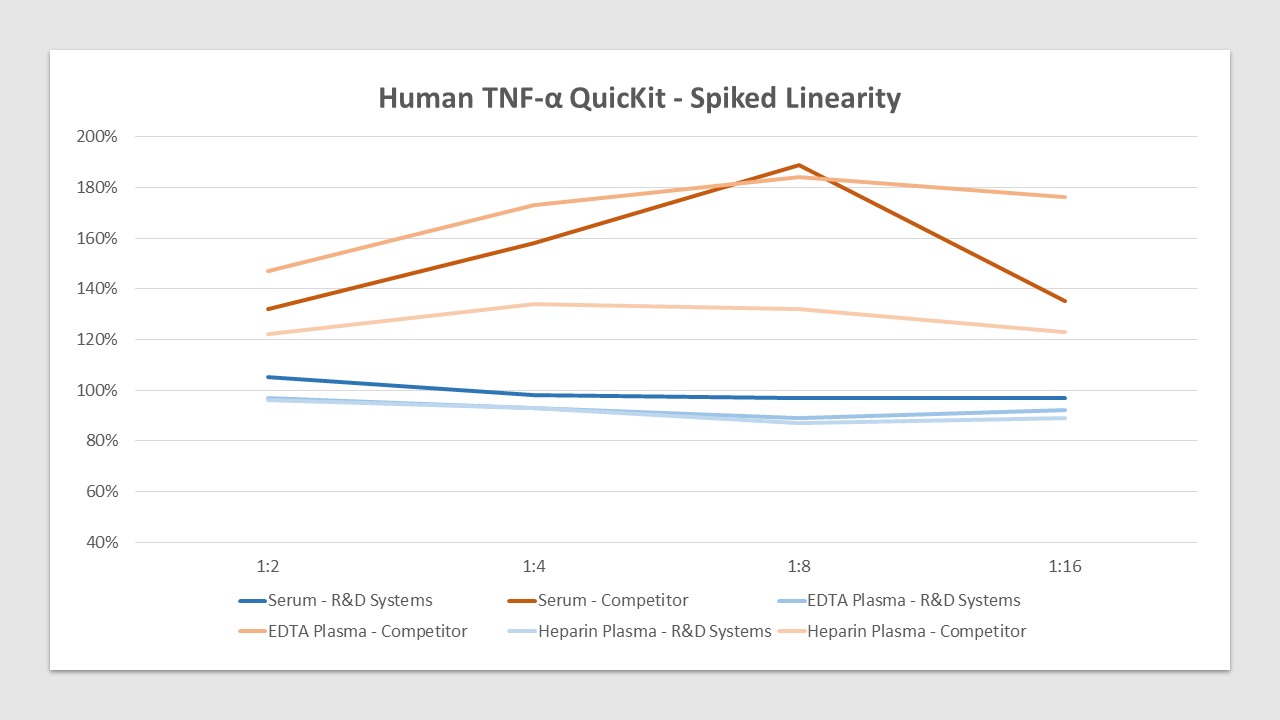
Human TNF-alpha QuicKit Spiked Linearity Competitor Comparison

TNF-alpha is spiked at high concentration in various matrices and diluted with appropriate Calibrator Diluent to produce samples with values within the dynamic range of the assay. The linearity is between 87%-105% compared to 122%-189% for the top competitor.

Preparation and Storage

Shipping

The product is shipped with polar packs. Upon receipt, store it immediately at the temperature recommended below.

Stability & Storage

Store the unopened product at 2 - 8 °C. Do not use past expiration date.

Background: TNF-alpha

Tumor Necrosis Factor alpha (TNF-alpha ), also known as cachectin and TNFSF1A, is the prototypic ligand of the TNF superfamily (1). It is a pleiotropic molecule that plays a central role in inflammation, immune system development, apoptosis, and lipid metabolism (2-5). TNF-alpha is also involved in a number of pathological conditions including asthma, Crohn's disease, rheumatoid arthritis, neuropathic pain, obesity, type 2 diabetes, septic shock, autoimmunity, and cancer (5-11). 
Human TNF-alpha is synthesized as a 26 kDa type II transmembrane protein that consists of a 35 amino acid (aa) cytoplasmic domain, a 21 aa transmembrane segment, and a 177 aa extracellular domain (ECD) (12, 13). Within the ECD, human TNF-alpha shares 97% aa sequence identity with rhesus monkey, and 71%-92% aa identity with bovine, canine, cotton rat, equine, feline, mouse, porcine, and rat TNF-alpha. It is produced by a wide variety of immune, epithelial, endothelial, and tumor cells. TNF-alpha is assembled intracellularly to form a noncovalently linked homotrimer which is expressed on the cell surface (14). Cell surface TNF-alpha can both induce the lysis of tumor cells and virus infected cells, and generate its own downstream cell signaling following ligation by soluble TNF RI (15, 16). Shedding of membrane bound TNF-alpha by TACE/ ADAM17 releases the bioactive cytokine, a 55 kDa soluble trimer of the TNF-alpha extracellular domain (17-19). 
TNF-alpha binds the ubiquitous 55-60 kDa TNF RI (20, 21) and the hematopoietic cell-restricted 78-80 kDa TNF RII (22, 23), both of which are also expressed as homotrimers (1, 24). Both type I and type II receptors bind TNF-alpha with comparable affinity and can promote NF kappa B activation (25-28). Only TNF RI, however, contains a cytoplasmic death domain which triggers the activation of apoptosis (3, 29). Soluble forms of both types of receptors are released into human serum and urine and can neutralize the biological activity of TNF-alpha (30-32).

Long Name

Tumor Necrosis Factor alpha

Alternate Names

Cachetin, DIF, TNF, TNF-A, TNFA, TNFalpha, TNFG1F, TNFSF1A, TNFSF2

Entrez Gene IDs

7124 (Human); 21926 (Mouse); 24835 (Rat); 397086 (Porcine); 280943 (Bovine); 403922 (Canine); 102139631 (Cynomolgus Monkey); 100033834 (Equine); 493755 (Feline); 100009088 (Rabbit)

Gene Symbol

TNF

Additional TNF-alpha Products

Product Documents for Human TNF-alpha Quantikine QuicKit ELISA

Certificate of Analysis

To download a Certificate of Analysis, please enter a lot or batch number in the search box below.

Note: Certificate of Analysis not available for kit components.

Product Specific Notices for Human TNF-alpha Quantikine QuicKit ELISA

For research use only

Citations for Human TNF-alpha Quantikine QuicKit ELISA

Customer Reviews for Human TNF-alpha Quantikine QuicKit ELISA

There are currently no reviews for this product. Be the first to review Human TNF-alpha Quantikine QuicKit ELISA and earn rewards!

Have you used Human TNF-alpha Quantikine QuicKit ELISA?

Submit a review and receive an Amazon gift card!

$25/€18/£15/$25CAN/¥2500 Yen for a review with an image

$10/€7/£6/$10CAN/¥1110 Yen for a review without an image

Submit a review
Amazon Gift Card

Protocols

View specific protocols for Human TNF-alpha Quantikine QuicKit ELISA (QK210):

These assays utilize an anti-tag coated microplate. Standards, samples, and controls are added to plate, followed by subsequent addition of an antibody cocktail. Following a 1 hour incubation, plates are washed and substrate is added and incubated for 20 minutes. Stop solution is then added and plates are read using a standard microplate reader.

QuicKit ELISA assay procedure

Find general support by application which include: protocols, troubleshooting, illustrated assays, videos and webinars.

FAQs

No product specific FAQs exist for this product.

View all FAQs for ELISA Kits