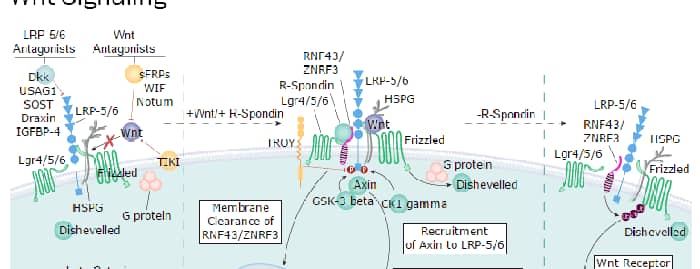
Human Wnt-7a is one of about 19 vertebrate members of the Wingless-type MMTV integration site (Wnt) family of highly conserved cysteine-rich secreted glycoproteins important for normal developmental processes (1). Wnts bind to receptors of the Frizzled family in conjunction with low-density lipoprotein receptor‑related proteins (LRPs). Downstream effects of Wnt signaling occur through activation of one of three different intracellular pathways: the canonical Wnt pathway, Wnt/Ca2+ pathway, and planar cell polarity. The highly transforming Wnts, including Wnt-1, -3, -3a, -7a and -8 activate the canonical pathway, which regulates beta ‑catenin-mediated gene expression (1, 2). Human Wnt‑7a is a 48 kDa secreted glycoprotein containing 24 cysteine residues that is expressed by epithelial and epithelially-derived cells of the placenta, kidney, testis, uterus, fetal lung, and fetal and adult brain (3, 4). Palmitate modification of a cysteine residue has been shown for Wnt‑3a; this site is conserved on all Wnts and is Cys73 on Wnt‑7a (5). When modified, increased hydrophobicity and activity is expected. Human Wnt‑7a shows 97% aa identity with mouse, rat, and dog Wnt‑7a and 92% aa identity with chicken Wnt‑7a. During development, Wnt‑7a is expressed by the dorsal ectoderm and drives expression of homeodomain transcription factors that control effectors important in patterning and cell fates in adjacent mesenchyme (6-10). When Wnt‑7a is deleted, mice show disruption of dorsalization and anterior/posterior patterning during limb development and abnormalities in the reproductive tract (6-10). Wnt‑7a is frequently downregulated in leukemia and lung cancers, potentially affecting homeobox (HOX) gene expression, differentiation state and growth control (11, 12). Roles for Wnt‑7a have also been shown during formation of neural synapses, response of the uterus to estrogen and inflammatory cartilage destruction (10, 13, 14). Wnt-7b is a 46 kDa, secreted glycosylated protein that belongs to the Wnt family. Wnt proteins can be lipid-modified and are ligands for members of the frizzled family of receptors, which mediates cell-cell communication during development. Human Wnt-7b is synthesized as a 349 amino acid (aa) precursor that contains a 318 aa mature region. The mature region contains 24 cysteines and three potential N-linked glycosylation sites. Wnt-7b is a ligand for members of the frizzled family of seven transmembrane
receptors. Probable developmental protein. May be a signaling molecule
which affects the development of discrete regions of tissues. Is likely
to signal over only few cell diameters. Mature human Wnt-7b shares 99% aa sequence identity with mature mouse and rat Wnt-7b. Wnt-7b also shares 80% aa sequence identity with Wnt-7a.

Scientific images may be resized, cropped, or adjusted for brightness or contrast for presentation purposes. These updates are limited to presentation and do not affect the underlying scientific interpretation of the data. Where available, additional source data may be provided upon request.
Key Product Details
Species Reactivity
Applications
Label
Antibody Source
Product Specifications
Immunogen
Met1-Lys349
Accession # O00755
Specificity
Clonality
Host
Isotype
Scientific Data Images for Human Wnt-7a Antibody (946744)
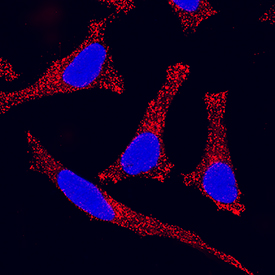
Wnt‑7a in HeLa Human Cell Line.
Wnt-7a was detected in immersion fixed HeLa human cervical epithelial carcinoma cell line using Mouse Anti-Human Wnt-7a Monoclonal Antibody (Catalog # MAB30081) at 25 µg/mL for 3 hours at room temperature. Cells were stained using the NorthernLights™ 557-conjugated Anti-Mouse IgG Secondary Antibody (red; NL007) and counterstained with DAPI (blue). Specific staining was localized to cytoplasm. View our protocol for Fluorescent ICC Staining of Cells on Coverslips.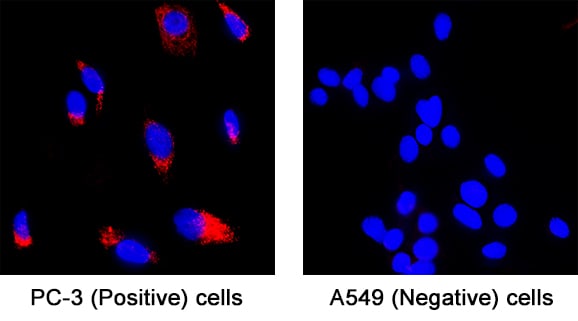
Detection of Wnt‑7a in PC‑3 cells (Positive) & A549 cells (Negative).
Wnt‑7a was detected in immersion fixed PC‑3 human prostate cancer cells (Positive) & absent in A549 human lung carcinoma cells (Negative) using Mouse Anti-Human Wnt‑7a Monoclonal Antibody (Catalog # MAB30081) at 8 µg/mL for 3 hours at room temperature. Cells were stained using the NorthernLights™ 557-conjugated Anti-Mouse IgG Secondary Antibody (red; Catalog # NL007) and counterstained with DAPI (blue). Specific staining was localized to Cytoplasmic. View our protocol for Fluorescent ICC Staining of Cells on Coverslips.Applications for Human Wnt-7a Antibody (946744)
Immunocytochemistry
Sample: Immersion fixed HeLa human cervical epithelial carcinoma cells, PC‑3 human prostate cancer cells (Positive), and A549 human lung carcinoma cells (Negative)
Formulation, Preparation, and Storage
Purification
Reconstitution
Reconstitute at 0.5 mg/mL in sterile PBS. For liquid material, refer to CoA for concentration.
Formulation
Shipping
Stability & Storage
- 12 months from date of receipt, -20 to -70 °C as supplied.
- 1 month, 2 to 8 °C under sterile conditions after reconstitution.
- 6 months, -20 to -70 °C under sterile conditions after reconstitution.
Calculators
Background: Wnt-7a
References
- Logan, C.Y. and R. Nusse (2004) Annu. Rev. Cell Dev. Biol. 20:781.
- Wong, G. T. et al. (1994) Mol. Cell. Biol. 14:6278.
- http://www.stanford.edu/~rnusse/wntwindow.html
- Bui, T. D. et al. (1997) Gene 189:25.
- Willert, K. et al. (2003) Nature 423:448.
- Parr, B.A. and A.P. McMahon (1995) Nature 374:350.
- Cygan, J.A. et al. (1997) Development 124:5021.
- Parr, B.A. and A.P. McMahon (1998) Nature 395:707.
- Miller, C. and D. Sassoon (1998) Development 125:3201.
- Carta, L. and D. Sassoon (2004) Biol. Reprod. 71:444.
- Calvo, R. et al. (2000) Proc. Natl. Acad. Sci. USA 97:12776.
- Winn, R.A. et al. (2005) J. Biol Chem. 280:19625.
- Hall, A.C. et al. (2000) Cell 100:525.
- Hwang, S-G. et al. (2004) J. Biol. Chem 279:26597.
Long Name
Alternate Names
Entrez Gene IDs
Gene Symbol
UniProt
Additional Wnt-7a Products
Product Documents for Human Wnt-7a Antibody (946744)
Certificate of Analysis
To download a Certificate of Analysis, please enter a lot or batch number in the search box below.
Note: Certificate of Analysis not available for kit components.
Product Specific Notices for Human Wnt-7a Antibody (946744)
For research use only
Related Research Areas
Customer Reviews for Human Wnt-7a Antibody (946744)
There are currently no reviews for this product. Be the first to review Human Wnt-7a Antibody (946744) and earn rewards!
Have you used Human Wnt-7a Antibody (946744)?
Submit a review and receive an Amazon gift card!
$25/€18/£15/$25CAN/¥2500 for a review with an image
$10/€7/£6/$10CAN/¥1110 for a review without an image
Submit a review
Protocols
Find general support by application which include: protocols, troubleshooting, illustrated assays, videos and webinars.
- Appropriate Fixation of IHC/ICC Samples
- Cellular Response to Hypoxia Protocols
- ClariTSA™ Fluorophore Kits
- Detection & Visualization of Antibody Binding
- ICC Cell Smear Protocol for Suspension Cells
- ICC Immunocytochemistry Protocol Videos
- ICC for Adherent Cells
- Immunocytochemistry (ICC) Protocol
- Immunocytochemistry Troubleshooting
- Immunofluorescence of Organoids Embedded in Cultrex Basement Membrane Extract
- Immunohistochemistry (IHC) and Immunocytochemistry (ICC) Protocols
- Preparing Samples for IHC/ICC Experiments
- Preventing Non-Specific Staining (Non-Specific Binding)
- Primary Antibody Selection & Optimization
- Protocol for VisUCyte™ HRP Polymer Detection Reagent
- Protocol for the Fluorescent ICC Staining of Cell Smears - Graphic
- Protocol for the Fluorescent ICC Staining of Cultured Cells on Coverslips - Graphic
- Protocol for the Preparation and Fluorescent ICC Staining of Cells on Coverslips
- Protocol for the Preparation and Fluorescent ICC Staining of Non-adherent Cells
- Protocol for the Preparation and Fluorescent ICC Staining of Stem Cells on Coverslips
- Protocol for the Preparation of a Cell Smear for Non-adherent Cell ICC - Graphic
- TUNEL and Active Caspase-3 Detection by IHC/ICC Protocol
- The Importance of IHC/ICC Controls
- View all Protocols, Troubleshooting, Illustrated assays and Webinars
Associated Pathways