
B- and T-lymphocyte attenuator (BTLA; CD272) is a 70 kDa, Ig-superfamily, type I transmembrane glycoprotein that is structurally similar to the CD28 family of T cell co-stimulatory or coinhibitory molecules (1‑3). Unlike CD28 family members, however, the BTLA extracellular Ig domain is an I-type rather than a V-type domain, and BTLA does not form homodimers (4). BTLA also differs from CD28 family members through the interaction of its Ig domain with the TNF superfamily member HVEM (herpesvirus entry mediator; TNFSF14) rather than with B7 family ligands (5). BTLA is a coinhibitory molecule expressed on T cells, B cells and, depending on the mouse strain, macrophages, dendritic and NK cells (6). Expression is low in naïve T cells and increased during antigen-specific induction of anergy. In B cells, BTLA is highest when cells are mature and naïve (6). BTLA apparently limits T cell numbers, since deletion of BTLA results in overproduction of T cells, especially CD8+ memory T cells that are hyper-responsive to TCR crosslinking (7). The 305 amino acid (aa) BTLA contains a 29 aa signal sequence, a 153 aa extracellular domain (ECD), a 21 aa transmembrane sequence, and a 102 aa cytoplasmic domain. There are two ITIM motifs and three Tyr phosphorylation sites in the cytoplasmic tail that mediate inhibitory signaling (8, 9). The binding of the BTLA to HVEM does not preclude additional binding of a mammalian stimulatory HVEM ligand, either LIGHT or lymphotoxin-alpha to the complex (4). At least three alleles varying by up to ten extracellular amino acids occur in different mouse strains (6). The ECD of C57BL/6 BTLA shows 51%, 77% and 40% aa identity to that of human, rat and canine BTLA, respectively. A splice variant lacking the Ig domain, termed BTLAs, has been reported (3).

Scientific images may be resized, cropped, or adjusted for brightness or contrast for presentation purposes. These updates are limited to presentation and do not affect the underlying scientific interpretation of the data. Where available, additional source data may be provided upon request.
Key Product Details
Validated by
Species Reactivity
Validated:
Cited:
Applications
Validated:
Cited:
Label
Antibody Source
Product Specifications
Immunogen
Glu30-Gly176 (Pro41Glu, Thr45Asn, Thr47Lys, Gln52His, Arg55Trp, Gln63Glu, Cys85Trp)
Accession # Q32MV9
Specificity
Clonality
Host
Isotype
Scientific Data Images for Mouse BTLA Antibody
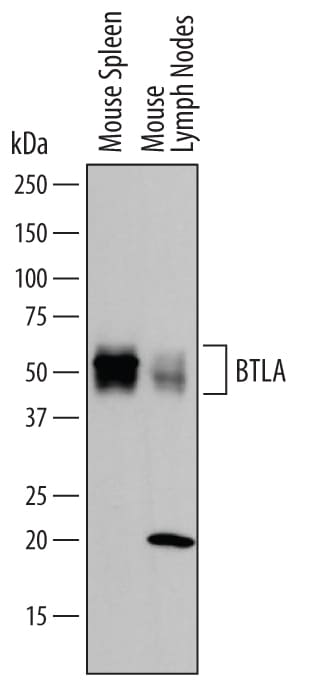
Detection of Mouse BTLA by Western Blot.
Western blot shows lysates of mouse spleen tissue and mouse lymph node tissue. PVDF membrane was probed with 1 µg/mL of Goat Anti-Mouse BTLA Antigen Affinity-purified Polyclonal Antibody (Catalog # AF3007) followed by HRP-conjugated Anti-Goat IgG Secondary Antibody (Catalog # HAF109). A specific band was detected for BTLA at approximately 60 kDa (as indicated). This experiment was conducted under reducing conditions and using Immunoblot Buffer Group 1.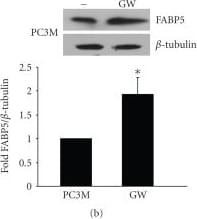
Detection of Human BTLA/CD272 by Western Blot
Activation of PPAR beta / delta results in upregulation of FABP5. (a) PC3M cells were treated with GW0742 (1 μM, 4 h). Expression of FABP5, PDK1, ADRP, and VEGF were assessed by Q-PCR. The data were normalized to the untreated control. (b, c) Denoted cells were treated with 1 μM (a) or 2 μM (b) GW0742 for 16 h. Left panels, immunoblots of FABP5 in untreated versus GW0742-treated cells. Right panel: Densitometry analyses depicting changes in FABP5 expression upon treatment with GW0742 in three independent experiments (mean ± S.D.). (d, e) PC3M cells were transfected with vectors harboring SiScramble or PPAR beta / delta siRNA. Three days later, expression of FABP5, PPAR beta / delta, and VEGF mRNA in were measured by Q-PCR (d) and FABP5 expression was assessed by immunoblot (e). (f) PC3M cells were stably transfected with an empty vector (PGIPZ), or a vector harbouring shFABP5. Expression levels of FABP5, PPAR beta / delta, and VEGF mRNA were measured by Q-PCR. *P <.05 versus nontreated controls. Image collected and cropped by CiteAb from the following publication (https://pubmed.ncbi.nlm.nih.gov/20847935), licensed under a CC-BY license. Not internally tested by R&D Systems.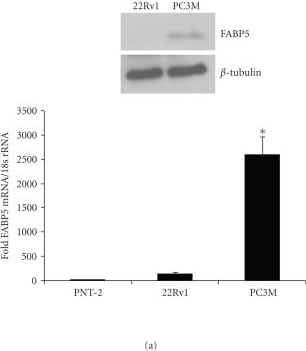
Detection of Human BTLA/CD272 by Western Blot
Prostate cancer progression is accompanied by up regulation of FABP5/PPAR beta / delta expression and signalling. (a) Bottom: Expression levels of FABP5 mRNA in denoted cell lines were measured by Q-PCR. Top: Level of FABP5 protein in denoted cell lines assessed by immunoblots. (b) Bottom: Expression levels of PDK-1 and PPAR beta / delta mRNA in denoted cell lines were measured by Q-PCR. Top: Immunoblots of PDK1 in denoted cell lines. Data are mean ± S.D. (n = 3). *P <.02 versus 22Rv.1. (Paired T test). Immunoblots were repeated three times with similar results. Image collected and cropped by CiteAb from the following publication (https://pubmed.ncbi.nlm.nih.gov/20847935), licensed under a CC-BY license. Not internally tested by R&D Systems.
Detection of Human BTLA/CD272 by Western Blot
Activation of PPAR beta / delta results in upregulation of FABP5. (a) PC3M cells were treated with GW0742 (1 μM, 4 h). Expression of FABP5, PDK1, ADRP, and VEGF were assessed by Q-PCR. The data were normalized to the untreated control. (b, c) Denoted cells were treated with 1 μM (a) or 2 μM (b) GW0742 for 16 h. Left panels, immunoblots of FABP5 in untreated versus GW0742-treated cells. Right panel: Densitometry analyses depicting changes in FABP5 expression upon treatment with GW0742 in three independent experiments (mean ± S.D.). (d, e) PC3M cells were transfected with vectors harboring SiScramble or PPAR beta / delta siRNA. Three days later, expression of FABP5, PPAR beta / delta, and VEGF mRNA in were measured by Q-PCR (d) and FABP5 expression was assessed by immunoblot (e). (f) PC3M cells were stably transfected with an empty vector (PGIPZ), or a vector harbouring shFABP5. Expression levels of FABP5, PPAR beta / delta, and VEGF mRNA were measured by Q-PCR. *P <.05 versus nontreated controls. Image collected and cropped by CiteAb from the following publication (https://pubmed.ncbi.nlm.nih.gov/20847935), licensed under a CC-BY license. Not internally tested by R&D Systems.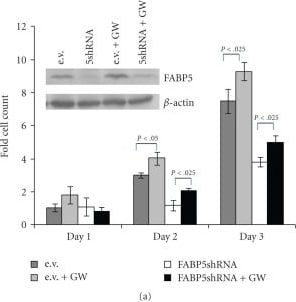
Detection of Human BTLA/CD272 by Western Blot
The FABP5/PPAR beta / delta pathway enhances prostate cancer cell proliferation and transformation. (a) PC3M cells that stably express shFABP5 were cultured in a 24 well plate (2500 cells/well) and treated with vehicle or GW 0742 (1 μM). Cells were counted at the denoted days. Data are mean ± SEM (n = 3). Inset: immunoblotting demonstrating low FABP5 level in shFABP5-expressing. (b) PC3M cells were transfected with a vector harboring PPAR beta / delta siRNA. Four days later, were cultured in a 24 well plate (2500 cells/well) and treated with vehicle or GW 0742 (1 μM). Cells were counted at the denoted days. Inset: Q-PCR analyses demonstrating low PPAR beta / delta in cells transfected with SiRNA towards the receptor. (c) Colony formation assays were conducted in the absence or presence of GW0742 (1 μM). Cells were cultured in 2% agarose for 29 days (see Materials and methods for details). Media was replenished every 4 days. Colonies were visualized by staining with 0.005% crystal violet and counted under a light microscope. Data are mean ± SEM (n = 3). Image collected and cropped by CiteAb from the following publication (https://pubmed.ncbi.nlm.nih.gov/20847935), licensed under a CC-BY license. Not internally tested by R&D Systems.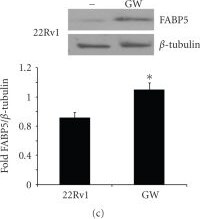
Detection of Human BTLA/CD272 by Western Blot
Activation of PPAR beta / delta results in upregulation of FABP5. (a) PC3M cells were treated with GW0742 (1 μM, 4 h). Expression of FABP5, PDK1, ADRP, and VEGF were assessed by Q-PCR. The data were normalized to the untreated control. (b, c) Denoted cells were treated with 1 μM (a) or 2 μM (b) GW0742 for 16 h. Left panels, immunoblots of FABP5 in untreated versus GW0742-treated cells. Right panel: Densitometry analyses depicting changes in FABP5 expression upon treatment with GW0742 in three independent experiments (mean ± S.D.). (d, e) PC3M cells were transfected with vectors harboring SiScramble or PPAR beta / delta siRNA. Three days later, expression of FABP5, PPAR beta / delta, and VEGF mRNA in were measured by Q-PCR (d) and FABP5 expression was assessed by immunoblot (e). (f) PC3M cells were stably transfected with an empty vector (PGIPZ), or a vector harbouring shFABP5. Expression levels of FABP5, PPAR beta / delta, and VEGF mRNA were measured by Q-PCR. *P <.05 versus nontreated controls. Image collected and cropped by CiteAb from the following publication (https://pubmed.ncbi.nlm.nih.gov/20847935), licensed under a CC-BY license. Not internally tested by R&D Systems.Applications for Mouse BTLA Antibody
Western Blot
Sample: Mouse spleen tissue and mouse lymph node tissue
Formulation, Preparation, and Storage
Purification
Reconstitution
Reconstitute at 0.2 mg/mL in sterile PBS. For liquid material, refer to CoA for concentration.
Formulation
Shipping
Stability & Storage
- 12 months from date of receipt, -20 to -70 °C as supplied.
- 1 month, 2 to 8 °C under sterile conditions after reconstitution.
- 6 months, -20 to -70 °C under sterile conditions after reconstitution.
Calculators
Background: BTLA
References
- Murphy, K. M. et al. (2006) Nat. Rev. Immunol. 6:671.
- Croft, M. (2005) Trends Immunol. 26:292.
- Watanabe, N. et al. (2003) Nat. Immunol. 4:670.
- Compaan, D. M. et al. (2005) J. Biol. Chem. 280:39553.
- Sedy, J. R. et al. (2005) Nat. Immunol. 6:90.
- Hurchla, M. A. et al. (2005) J. Immunol. 174:3377.
- Krieg, C. et al. (2007) Nat. Immunol. 8:162.
- Gavrieli, M. et al. (2003) Biochem. Biophys. Res. Commun. 312:1236.
- Chemnitz, J. M. et al. (2006) J. Immunol. 176:6603.
Long Name
Alternate Names
Gene Symbol
UniProt
Additional BTLA Products
Product Documents for Mouse BTLA Antibody
Certificate of Analysis
To download a Certificate of Analysis, please enter a lot or batch number in the search box below.
Note: Certificate of Analysis not available for kit components.
Product Specific Notices for Mouse BTLA Antibody
For research use only
Citations for Mouse BTLA Antibody
 Powered by Bioz
Customer Reviews for Mouse BTLA Antibody
There are currently no reviews for this product. Be the first to review Mouse BTLA Antibody and earn rewards!
Have you used Mouse BTLA Antibody?
Submit a review and receive an Amazon gift card!
$25/€18/£15/$25CAN/¥2500 for a review with an image
$10/€7/£6/$10CAN/¥1110 for a review without an image
Submit a review
Protocols
Find general support by application which include: protocols, troubleshooting, illustrated assays, videos and webinars.
- Cellular Response to Hypoxia Protocols
- R&D Systems Quality Control Western Blot Protocol
- Troubleshooting Guide: Western Blot Figures
- Western Blot Conditions
- Western Blot Protocol
- Western Blot Protocol for Cell Lysates
- Western Blot Troubleshooting
- Western Blot Troubleshooting Guide
- View all Protocols, Troubleshooting, Illustrated assays and Webinars