
Oncostatin M (OSM) is a member of the IL-6 family of cytokines that share the gp130 as a common signal transducing receptor subunit. Human OSM signals through two types of human OSM receptor complexes: the type I complex comprising the leukemia inhibitory factor receptor beta (LIF R beta ) and gp130, the type II complex made up of OSM receptor beta (OSM R beta ) and gp130. In contrast, mouse OSM signals only through the mouse OSM R beta and gp130 complex. Mouse OSM R beta cDNA encodes a 971 amino acid (aa) residue type I transmembrane protein which contains a 23 aa residue signal peptide, an extracellular domain of 714 aa, a transmembrane domain of 20 aa and a 214 aa cytoplasmic domain. Mouse OSM R beta alone binds mOSM with low-affinity, but forms a high-affinity binding complex in the presence of gp130. Mouse OSM R beta is 55% identical at the amino acid sequence level to human OSM R beta.
Mouse OSMR beta Antibody
R&D Systems | Catalog # AF662

Scientific images may be resized, cropped, or adjusted for brightness or contrast for presentation purposes. These updates are limited to presentation and do not affect the underlying scientific interpretation of the data. Where available, additional source data may be provided upon request.
Key Product Details
Species Reactivity
Validated:
Cited:
Applications
Validated:
Cited:
Label
Antibody Source
Product Specifications
Immunogen
Glu24-Leu738
Accession # O70458
Specificity
Clonality
Host
Isotype
Scientific Data Images for Mouse OSMR beta Antibody
Detection of Mouse OSMR beta by Western Blot
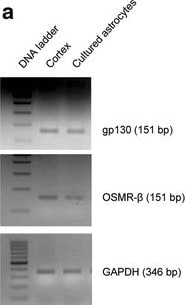
OSM down-regulates GLT-1 and GLAST expression in primary mouse cortical astrocytes. a Total mRNA purified from wild-type (C57BL/6J) mouse neonatal (P2) brain cortex as well as from cultured cortical astrocytes established from P2 brains was analyzed for expression of OSMR-beta and gp130 mRNA by reverse transcriptase PCR; GAPDH primers were used as loading control. b Cortical astrocyte cultures were treated without or with OSM (10 ng/mL) for 2, 4, 8, 12, and 24 h and analyzed for GLT-1 and GLAST mRNA levels (gene expression normalized to HPRT1) by real-time PCR. Data are normalized to untreated controls and presented as mean ± SEM; n = 3, **p < 0.01, ***p < 0.001; one-way ANOVA using Bonferroni correction. c Cortical astrocytic cultures were treated without or with OSM (10 ng/mL) for 3, 5, and 24 h and were analyzed for GLAST proteins by Western blot. Relative densitometric analysis of GLAST proteins is shown in the lower panel. Data are presented as percentage of each respective ratio between optical density value of GLAST band intensity and optical density value of the matched alpha -tubulin (which served as the loading control) band intensity; n = 3, **p < 0.01, ***p < 0.001; one-way ANOVA Image collected and cropped by CiteAb from the following open publication (https://pubmed.ncbi.nlm.nih.gov/27287400), licensed under a CC-BY license. Not internally tested by R&D Systems.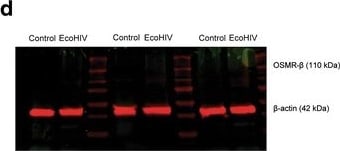
Detection of Mouse OSMR beta by Western Blot
EcoHIV induces OSM release and gp130 mRNA, but not OSMR-beta mRNA or protein, in cultured primary mouse microglia. a Shows real-time PCR analysis of HIV LTR mRNA in control and EcoHIV-infected (35,000 pg of p24, for 24 h) primary microglia. ****p < 0.0001, n = 3. b Shows ELISA analysis of secreted OSM proteins in culture supernatants collected from control and EcoHIV-infected primary microglia. *p < 0.05, n = 6. c Shows real-time PCR analysis of gp130 and OSMR-beta mRNA in control and EcoHIV-infected primary microglia. *p < 0.05, n = 3. d Shows Western blot analysis for OSMR-beta proteins in control and EcoHIV-infected primary microglial cell lysates obtained from three independent experiments. beta -Actin served as the loading control Image collected and cropped by CiteAb from the following open publication (https://pubmed.ncbi.nlm.nih.gov/27287400), licensed under a CC-BY license. Not internally tested by R&D Systems.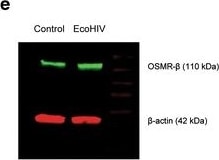
Detection of Mouse OSMR beta by Western Blot
EcoHIV neither induces OSM secretion, nor the expression of gp130 or GLAST mRNA, but stimulates the expression of GLT-1 and OSMR-beta in primary cortical astrocytes. a Shows real-time PCR analyses of HIV LTR mRNA in control and EcoHIV-infected (35,000 pg of p24, for 24 h) cortical astrocyte cultures. ****p < 0.0001, n = 3. b Shows ELISA analysis of secreted OSM proteins in culture supernatants collected from control and EcoHIV-infected primary astrocyte cultures. n = 6. c, d Shows real-time PCR analyses of GLAST and GLT-1 (c) and gp130 and OSMR-beta (d) mRNA in control and EcoHIV-infected cortical astrocyte cultures. *p < 0.05, **p < 0.01, n = 3. e Shows Western blot analyses for OSMR-beta proteins in control and EcoHIV-infected cortical astrocyte culture lysates. The left panel shows representative blot of three independent experiments. The right panel shows densitometric analysis of OSMR-beta proteins. Data are presented as percentage of each respective ratio between optical density value of OSMR-beta band (110 kDa) intensity and optical density value of the matched beta -actin (42 kDa; loading control) band intensity. *p = 0.027, n = 3; two-tailed Student’s t test Image collected and cropped by CiteAb from the following open publication (https://pubmed.ncbi.nlm.nih.gov/27287400), licensed under a CC-BY license. Not internally tested by R&D Systems.Applications for Mouse OSMR beta Antibody
Immunohistochemistry
Sample: Immersion fixed frozen sections of mouse embryo (E13.5-15.5)
Western Blot
Sample: Recombinant Mouse OSM R beta Fc Chimera (Catalog # 662-OR)
Formulation, Preparation, and Storage
Purification
Reconstitution
Reconstitute at 0.2 mg/mL in sterile PBS. For liquid material, refer to CoA for concentration.
Formulation
Shipping
Stability & Storage
- 12 months from date of receipt, -20 to -70 °C as supplied.
- 1 month, 2 to 8 °C under sterile conditions after reconstitution.
- 6 months, -20 to -70 °C under sterile conditions after reconstitution.
Calculators
Background: OSMR beta
References
- Lindberg, R.A. et al. (1998) Mol. Cell. Biol. 18:3357.
- Tanaka, M. et al. (1999) Blood 93:804.
Long Name
Alternate Names
Gene Symbol
UniProt
Additional OSMR beta Products
Product Documents for Mouse OSMR beta Antibody
Certificate of Analysis
To download a Certificate of Analysis, please enter a lot or batch number in the search box below.
Note: Certificate of Analysis not available for kit components.
Product Specific Notices for Mouse OSMR beta Antibody
For research use only
Related Research Areas
Citations for Mouse OSMR beta Antibody
 Powered by Bioz
Customer Reviews for Mouse OSMR beta Antibody
There are currently no reviews for this product. Be the first to review Mouse OSMR beta Antibody and earn rewards!
Have you used Mouse OSMR beta Antibody?
Submit a review and receive an Amazon gift card!
$25/€18/£15/$25CAN/¥2500 for a review with an image
$10/€7/£6/$10CAN/¥1110 for a review without an image
Submit a review
Protocols
Find general support by application which include: protocols, troubleshooting, illustrated assays, videos and webinars.
- Antigen Retrieval Protocol (PIER)
- Antigen Retrieval for Frozen Sections Protocol
- Appropriate Fixation of IHC/ICC Samples
- Cellular Response to Hypoxia Protocols
- Chromogenic IHC Staining of Formalin-Fixed Paraffin-Embedded (FFPE) Tissue Protocol
- Chromogenic Immunohistochemistry Staining of Frozen Tissue
- ClariTSA™ Fluorophore Kits
- Detection & Visualization of Antibody Binding
- Fluorescent IHC Staining of Frozen Tissue Protocol
- Graphic Protocol for Heat-induced Epitope Retrieval
- Graphic Protocol for the Preparation and Fluorescent IHC Staining of Frozen Tissue Sections
- Graphic Protocol for the Preparation and Fluorescent IHC Staining of Paraffin-embedded Tissue Sections
- Graphic Protocol for the Preparation of Gelatin-coated Slides for Histological Tissue Sections
- IHC Sample Preparation (Frozen sections vs Paraffin)
- Immunofluorescent IHC Staining of Formalin-Fixed Paraffin-Embedded (FFPE) Tissue Protocol
- Immunohistochemistry (IHC) and Immunocytochemistry (ICC) Protocols
- Immunohistochemistry Frozen Troubleshooting
- Immunohistochemistry Paraffin Troubleshooting
- Preparing Samples for IHC/ICC Experiments
- Preventing Non-Specific Staining (Non-Specific Binding)
- Primary Antibody Selection & Optimization
- Protocol for Heat-Induced Epitope Retrieval (HIER)
- Protocol for Making a 4% Formaldehyde Solution in PBS
- Protocol for VisUCyte™ HRP Polymer Detection Reagent
- Protocol for the Preparation & Fixation of Cells on Coverslips
- Protocol for the Preparation and Chromogenic IHC Staining of Frozen Tissue Sections
- Protocol for the Preparation and Chromogenic IHC Staining of Frozen Tissue Sections - Graphic
- Protocol for the Preparation and Chromogenic IHC Staining of Paraffin-embedded Tissue Sections
- Protocol for the Preparation and Chromogenic IHC Staining of Paraffin-embedded Tissue Sections - Graphic
- Protocol for the Preparation and Fluorescent IHC Staining of Frozen Tissue Sections
- Protocol for the Preparation and Fluorescent IHC Staining of Paraffin-embedded Tissue Sections
- Protocol for the Preparation of Gelatin-coated Slides for Histological Tissue Sections
- R&D Systems Quality Control Western Blot Protocol
- TUNEL and Active Caspase-3 Detection by IHC/ICC Protocol
- The Importance of IHC/ICC Controls
- Troubleshooting Guide: Immunohistochemistry
- Troubleshooting Guide: Western Blot Figures
- Western Blot Conditions
- Western Blot Protocol
- Western Blot Protocol for Cell Lysates
- Western Blot Troubleshooting
- Western Blot Troubleshooting Guide
- View all Protocols, Troubleshooting, Illustrated assays and Webinars