
Mouse PIR-B is a 125 kDa type I transmembrane glycoprotein with six Ig-like domains in its extracellular domain (ECD) and four ITIM-like sequences in its cytoplasmic domain. The ECD of PIR-B is highly homologous to the ECDs of multiple mouse PIR-A receptors (92‑99% amino acid sequence homology), which have short cytoplasmic tails lacking ITIM motifs. PIR-A receptors have a charged residue in their transmembrane domain that facilitates interaction with ITAM-containing adaptor molecules. Whereas PIR-A receptors deliver activation signals, PIR-B can inhibit receptor-mediated activation signaling. PIR-A and PIR-B have been shown to bind various mouse MHC class I molecules. They have been proposed to be orthologs of human leukocyte immunoglobulin-like receptors.

Scientific images may be resized, cropped, or adjusted for brightness or contrast for presentation purposes. These updates are limited to presentation and do not affect the underlying scientific interpretation of the data. Where available, additional source data may be provided upon request.
Key Product Details
Species Reactivity
Validated:
Cited:
Applications
Validated:
Cited:
Label
Antibody Source
Product Specifications
Immunogen
Gly24-Gly635
Accession # AAH26937
Specificity
Clonality
Host
Isotype
Scientific Data Images for Mouse PIR-B Antibody
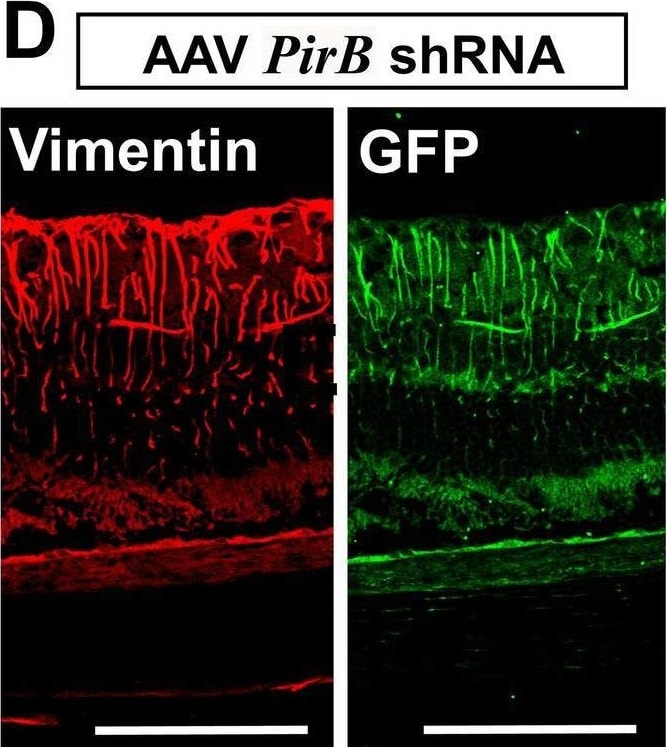
Detection of PIR-B by Immunohistochemistry
The effect of PirB knockdown in the retina by AAV PirB shRNA. A GFP (green, 488) expression in the retina transfected with AAV PirB shRNA or AAV shRNA for 21 days. red * represents the injection site, and the purple dotted line shows the area without the retinal tissue. Scale bars: 150 μm. B GFP staining in the PBS group. DAPI represents nuclear staining (blue fluorescence). Scale bar: 250 μm. C GFP (green, 488) and beta -Ш Tubulin (red, 594) fluorescent staining in the AAV PirB shRNA group. DAPI represents nuclear staining (blue). Scale bar: 250 μm. Small white arrows in c show GFP and beta -Ш Tubulin co-localization. D GFP (green, 488) and Vimentin (red, 594) fluorescent staining in the AAV PirB shRNA group. DAPI represents nuclear staining (blue). Scale bar: 250 μm. Small white arrows in d show GFP and Vimentin co-localization. E Bar charts showing PirB expression in the retina tissue. GAPDH was used as an internal reference. The ratios of gray values of target proteins to those of respective internal references are provided. The experiment was repeated three times (n = 4). Data represent the mean ± standard deviation. One-way ANOVA was performed, and Student’s t-test was used for group-pair comparisons used. **, p < 0.01 Image collected and cropped by CiteAb from the following open publication (https://pubmed.ncbi.nlm.nih.gov/34380548), licensed under a CC-BY license. Not internally tested by R&D Systems.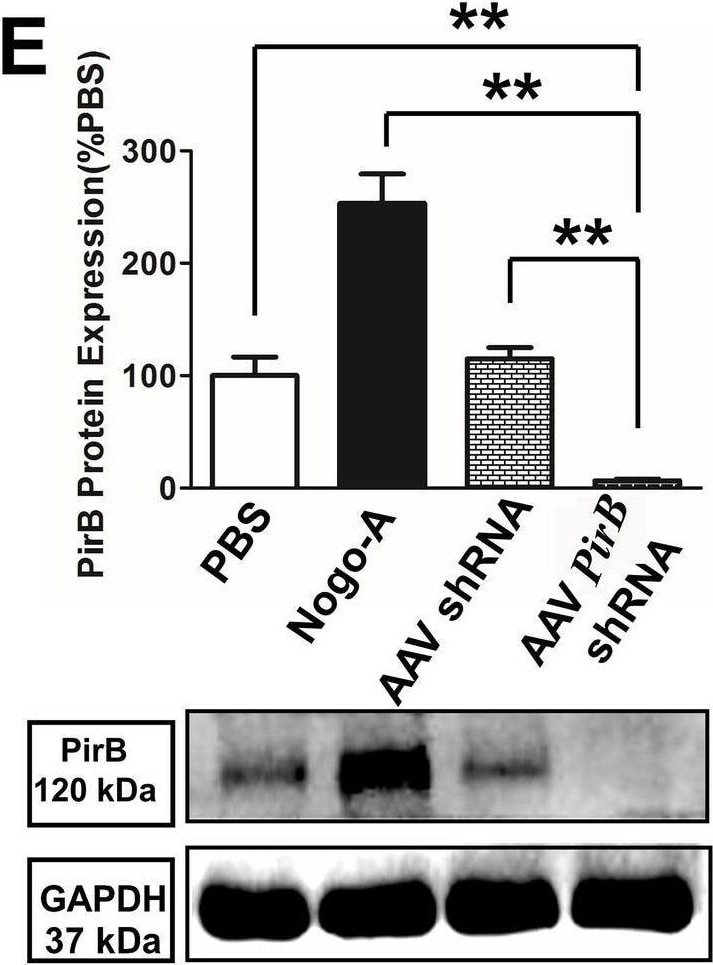
Detection of PIR-B by Western Blot
The effect of PirB knockdown in the retina by AAV PirB shRNA. A GFP (green, 488) expression in the retina transfected with AAV PirB shRNA or AAV shRNA for 21 days. red * represents the injection site, and the purple dotted line shows the area without the retinal tissue. Scale bars: 150 μm. B GFP staining in the PBS group. DAPI represents nuclear staining (blue fluorescence). Scale bar: 250 μm. C GFP (green, 488) and beta -Ш Tubulin (red, 594) fluorescent staining in the AAV PirB shRNA group. DAPI represents nuclear staining (blue). Scale bar: 250 μm. Small white arrows in c show GFP and beta -Ш Tubulin co-localization. D GFP (green, 488) and Vimentin (red, 594) fluorescent staining in the AAV PirB shRNA group. DAPI represents nuclear staining (blue). Scale bar: 250 μm. Small white arrows in d show GFP and Vimentin co-localization. E Bar charts showing PirB expression in the retina tissue. GAPDH was used as an internal reference. The ratios of gray values of target proteins to those of respective internal references are provided. The experiment was repeated three times (n = 4). Data represent the mean ± standard deviation. One-way ANOVA was performed, and Student’s t-test was used for group-pair comparisons used. **, p < 0.01 Image collected and cropped by CiteAb from the following open publication (https://pubmed.ncbi.nlm.nih.gov/34380548), licensed under a CC-BY license. Not internally tested by R&D Systems.Applications for Mouse PIR-B Antibody
Western Blot
Sample: Recombinant Mouse PIR-B
Formulation, Preparation, and Storage
Purification
Reconstitution
Reconstitute at 0.2 mg/mL in sterile PBS. For liquid material, refer to CoA for concentration.
Formulation
Shipping
Stability & Storage
- 12 months from date of receipt, -20 to -70 °C as supplied.
- 1 month, 2 to 8 °C under sterile conditions after reconstitution.
- 6 months, -20 to -70 °C under sterile conditions after reconstitution.
Calculators
Background: PIR-B
Long Name
Alternate Names
Gene Symbol
UniProt
Additional PIR-B Products
Product Documents for Mouse PIR-B Antibody
Certificate of Analysis
To download a Certificate of Analysis, please enter a lot or batch number in the search box below.
Note: Certificate of Analysis not available for kit components.
Product Specific Notices for Mouse PIR-B Antibody
For research use only
Related Research Areas
Citations for Mouse PIR-B Antibody
 Powered by Bioz
Customer Reviews for Mouse PIR-B Antibody
There are currently no reviews for this product. Be the first to review Mouse PIR-B Antibody and earn rewards!
Have you used Mouse PIR-B Antibody?
Submit a review and receive an Amazon gift card!
$25/€18/£15/$25CAN/¥2500 for a review with an image
$10/€7/£6/$10CAN/¥1110 for a review without an image
Submit a review
Protocols
Find general support by application which include: protocols, troubleshooting, illustrated assays, videos and webinars.
- Cellular Response to Hypoxia Protocols
- R&D Systems Quality Control Western Blot Protocol
- Troubleshooting Guide: Western Blot Figures
- Western Blot Conditions
- Western Blot Protocol
- Western Blot Protocol for Cell Lysates
- Western Blot Troubleshooting
- Western Blot Troubleshooting Guide
- View all Protocols, Troubleshooting, Illustrated assays and Webinars