
PC9 (Proprotein convertase subtilisin type 9; also PCSK9 and NARC-1) is a 70‑74 kDa, secreted glycoprotein member of the proteinase K subfamily of subtilases. PC9 functions as a protease that cleaves proproteins at non-basic residues. It also binds to, and promotes, the degradation of LDLR, VLDLR and ApoER2. The mouse PC9 precursor is 694 amino acid (aa) in length, and contains a signal sequence, a 14 kDa, 121 aa prodomain (aa 35‑155), and a 56‑58 kDa, 539 aa mature region (aa 156‑694). The 58 kDa mature region arises from autocatalysis in the ER, and contains a subtilisin-like catalytic domain (aa 166‑432), a modified P-domain (aa 433‑529) and a C-terminal Cys-rich region (aa 530‑694). The prosegment and mature regions remain noncovalently associated. There is one additional PC9 isoform that shows an alternative start site 13 aa upstream of the standard site coupled to a deletion of aa 18‑20. Over aa 156‑694, mouse PC9 shares 93% and 79% aa identity with rat and human PC9, respectively.
Proprotein Convertase 9/PCSK9 Antibody
R&D Systems | Catalog # AF3985

Scientific images may be resized, cropped, or adjusted for brightness or contrast for presentation purposes. These updates are limited to presentation and do not affect the underlying scientific interpretation of the data. Where available, additional source data may be provided upon request.
Key Product Details
Species Reactivity
Validated:
Cited:
Applications
Validated:
Cited:
Label
Antibody Source
Product Specifications
Immunogen
Ser156-Gln694
Accession # Q80W65
Specificity
Clonality
Host
Isotype
Scientific Data Images for Proprotein Convertase 9/PCSK9 Antibody
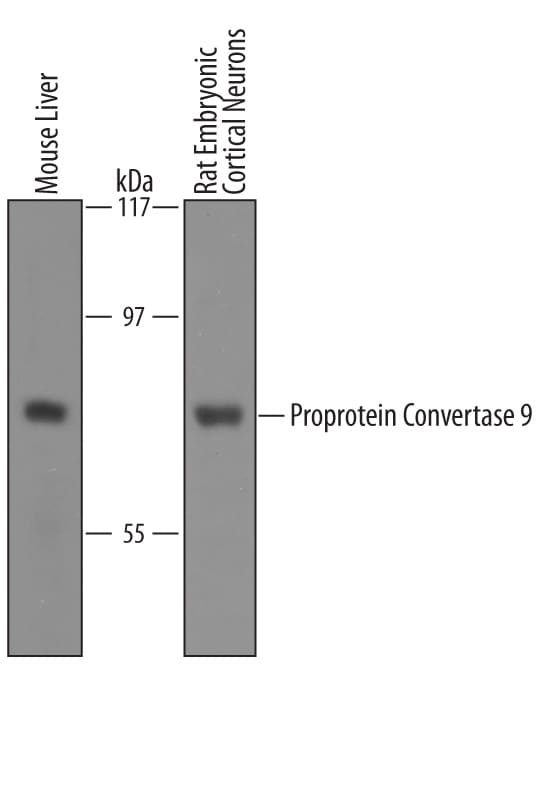
Detection of Mouse and Rat Proprotein Convertase 9/PCSK9 by Western Blot.
Western blot shows lysates of mouse liver tissue and rat embryonic cortical neuron. PVDF Membrane was probed with 1 µg/mL of Goat Anti-Mouse/Rat Proprotein Convertase 9/PCSK9 Antigen Affinity-purified Polyclonal Antibody (Catalog # AF3985) followed by HRP-conjugated Anti-Goat IgG Secondary Antibody (Catalog # HAF019). A specific band was detected for Proprotein Convertase 9/PCSK9 at approximately 74 kDa (as indicated). This experiment was conducted under reducing conditions and using Immunoblot Buffer Group 7.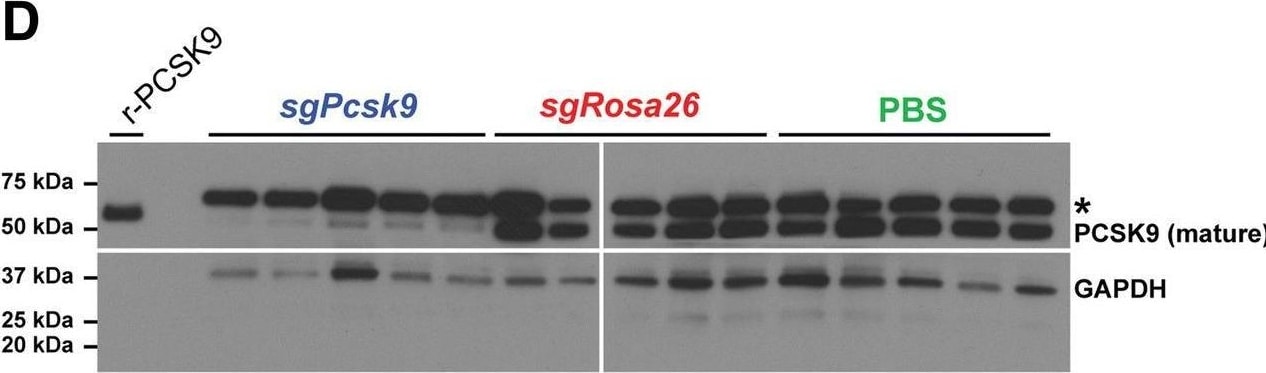
Detection of Proprotein Convertase 9/PCSK9 by Western Blot
AAV-delivery of NmeCas9 for in vivo genome editing. a Experimental outline of AAV8-sgRNA-hNmeCas9 vector tail-vein injections to target Pcsk9 (sgPcsk9) and Rosa26 (sgRosa26) in C57Bl/6 mice. Mice were sacrificed at 14 (n = 1) or 50 days (n = 5) post injection and liver tissues were harvested. Blood sera were collected at days 0, 25, and 50 post injection for cholesterol level measurement. b Serum cholesterol levels. p values are calculated by unpaired t test. cStacked histogram showing the percentage distribution of indels at Pcsk9 or Rosa26 in livers of mice, as measured by targeted deep-sequencing analyses. Data are presented as mean ± SD from five mice per cohort. d A representative anti-PCSK9 western blot using total protein collected from day 50 mouse liver homogenates. A total of 2 ng of recombinant mouse PCSK9 (r-PCSK9) was included as a mobility standard. The asterisk indicates a cross-reacting protein that is larger than the control recombinant protein Image collected and cropped by CiteAb from the following open publication (https://pubmed.ncbi.nlm.nih.gov/30231914), licensed under a CC-BY license. Not internally tested by R&D Systems.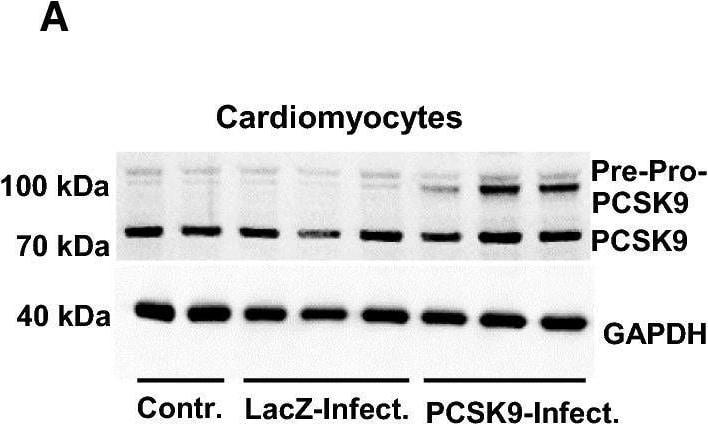
Detection of Proprotein Convertase 9/PCSK9 by Western Blot
Infection of cardiomyocytes with human PCSK9. Serum-free cultured adult rat ventricular cardiomyocytes were infected with hPCSK9. Infection of cardiomyocytes with LacZ served as control. After 24 h, load free cell shortening was measured (cells paced at 2 Hz). a Representative immunoblot indicating the successful transfection of cardiomyocytes with hPCSK9. b Quantification of Western Blot shown in (a). c Load free cell-shortening expressed as delta L/L (%), (d) contraction velocity (µm/s) (e) and relaxation velocity (µm/s) of 89 (LacZ) and 90 (PCSK9) cells (10 independent experiments with intraassay variability p > 0.05). Statistical analysis was performed by Mann–Whitney test. *p ≤ 0.05. Data are mean ± SD Image collected and cropped by CiteAb from the following open publication (https://pubmed.ncbi.nlm.nih.gov/33169229), licensed under a CC-BY license. Not internally tested by R&D Systems.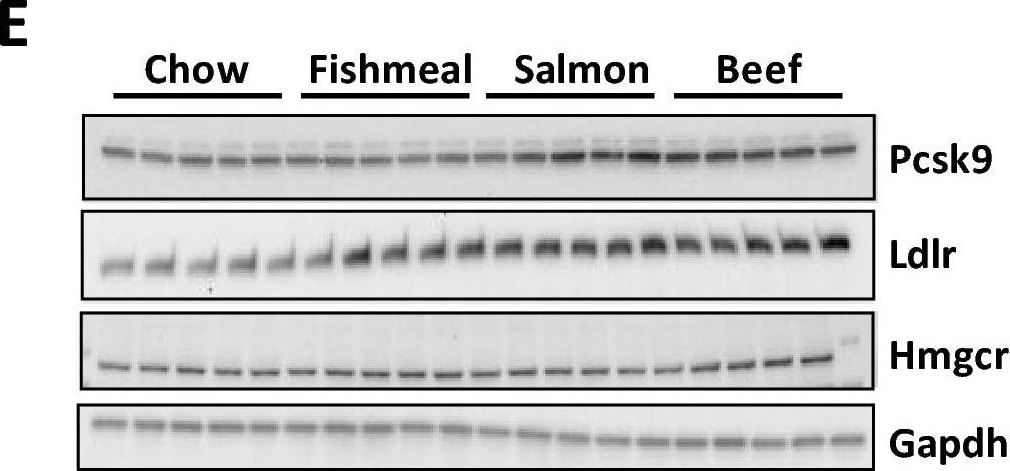
Detection of Proprotein Convertase 9/PCSK9 by Western Blot
Fishmeal feeding leads to circulating PCSK9. Expression of hepatic genes important for steroid hormone synthesis and cholesterol metabolism in mice fed fishmeal, salmon filet or beef (n = 10). a Validation RNA sequencing analysis with RT-qPCR analysis of selected genes identified as low expressed in fishmeal compared to salmon or beef (Hmgcr, Pcsk9, Fabp5, Fdsp, Chrna4). b Expression of mRNAs encoding genes regulating cholesterol synthesis (Srebf2) and lipogenesis (Srebf1c and Mlxipl/Chrebp). c Expression of cholesterol metabolite sensors (Nr1h3/LXR alpha and Nr1h2/LXR beta ), cholesterol efflux transporters (Abca1 and Abcg1) and the rate-limiting enzyme in bile acid synthesis (Cyp7a1). d Plasma PCSK9 protein levels. e–f Immunoblot analysis and relative quantification of hepatic Pcsk9, Ldlr, Hmgcr and Gapdh protein levels (n = 5). Statistical testing was done with one-way ANOVA and Tukey test for multiple comparisons. $p < 0.05 between chow and at least two other groups. *p < 0.05, *p < 0.01 between indicated groups Image collected and cropped by CiteAb from the following open publication (https://pubmed.ncbi.nlm.nih.gov/35788891), licensed under a CC-BY license. Not internally tested by R&D Systems.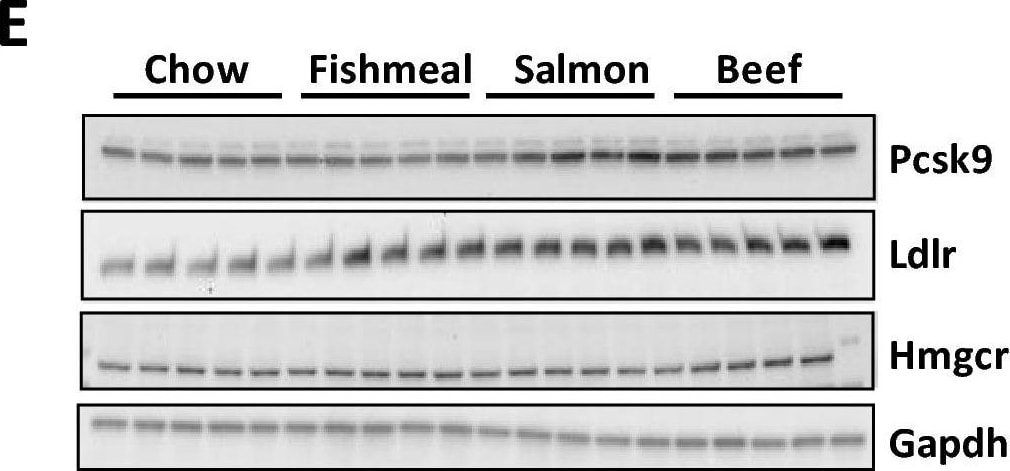
Detection of Proprotein Convertase 9/PCSK9 by Western Blot
Fishmeal feeding leads to circulating PCSK9. Expression of hepatic genes important for steroid hormone synthesis and cholesterol metabolism in mice fed fishmeal, salmon filet or beef (n = 10). a Validation RNA sequencing analysis with RT-qPCR analysis of selected genes identified as low expressed in fishmeal compared to salmon or beef (Hmgcr, Pcsk9, Fabp5, Fdsp, Chrna4). b Expression of mRNAs encoding genes regulating cholesterol synthesis (Srebf2) and lipogenesis (Srebf1c and Mlxipl/Chrebp). c Expression of cholesterol metabolite sensors (Nr1h3/LXR alpha and Nr1h2/LXR beta ), cholesterol efflux transporters (Abca1 and Abcg1) and the rate-limiting enzyme in bile acid synthesis (Cyp7a1). d Plasma PCSK9 protein levels. e–f Immunoblot analysis and relative quantification of hepatic Pcsk9, Ldlr, Hmgcr and Gapdh protein levels (n = 5). Statistical testing was done with one-way ANOVA and Tukey test for multiple comparisons. $p < 0.05 between chow and at least two other groups. *p < 0.05, *p < 0.01 between indicated groups Image collected and cropped by CiteAb from the following open publication (https://pubmed.ncbi.nlm.nih.gov/35788891), licensed under a CC-BY license. Not internally tested by R&D Systems.Applications for Proprotein Convertase 9/PCSK9 Antibody
Western Blot
Sample: Mouse liver tissue and rat embryonic cortical neurons
Reviewed Applications
Read 4 reviews rated 4.5 using AF3985 in the following applications:
Formulation, Preparation, and Storage
Purification
Reconstitution
Reconstitute at 0.2 mg/mL in sterile PBS. For liquid material, refer to CoA for concentration.
Formulation
Shipping
Stability & Storage
- 12 months from date of receipt, -20 to -70 °C as supplied.
- 1 month, 2 to 8 °C under sterile conditions after reconstitution.
- 6 months, -20 to -70 °C under sterile conditions after reconstitution.
Calculators
Background: Proprotein Convertase 9/PCSK9
Alternate Names
Gene Symbol
UniProt
Additional Proprotein Convertase 9/PCSK9 Products
- All Products for Proprotein Convertase 9/PCSK9
- Proprotein Convertase 9/PCSK9 cDNA Clones
- Proprotein Convertase 9/PCSK9 ELISA Kits
- Proprotein Convertase 9/PCSK9 Lysates
- Proprotein Convertase 9/PCSK9 Primary Antibodies
- Proprotein Convertase 9/PCSK9 Proteins and Enzymes
- Proprotein Convertase 9/PCSK9 Simple Plex
Product Documents for Proprotein Convertase 9/PCSK9 Antibody
Certificate of Analysis
To download a Certificate of Analysis, please enter a lot or batch number in the search box below.
Note: Certificate of Analysis not available for kit components.
Product Specific Notices for Proprotein Convertase 9/PCSK9 Antibody
For research use only
Related Research Areas
Citations for Proprotein Convertase 9/PCSK9 Antibody
 Powered by Bioz
Customer Reviews for Proprotein Convertase 9/PCSK9 Antibody (4)
Have you used Proprotein Convertase 9/PCSK9 Antibody?
Submit a review and receive an Amazon gift card!
$25/€18/£15/$25CAN/¥2500 for a review with an image
$10/€7/£6/$10CAN/¥1110 for a review without an image
Submit a review
Customer Images
-
Verified Customer | Posted 04/26/2017
-
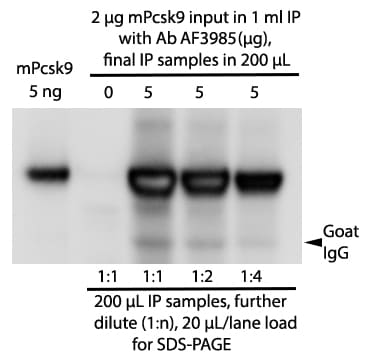
Application: ImmunoprecipitationSample Tested: Purified proteinSpecies: MouseVerified Customer | Posted 02/22/2016Purified mouse Pcsk9 was used for immunoprecipitation (IP) validation. 5 ug AF3985 per IP incubation, works very well. This Ab may be further diluted for each IP.

-
Application: Western BlotSample Tested: Primary mouse hepatocytesSpecies: MouseVerified Customer | Posted 12/19/2014
-
Application: Western BlotSample Tested: Liver homogenates sampleSpecies: MouseVerified Customer | Posted 12/19/2014
There are no reviews that match your criteria.
Protocols
Find general support by application which include: protocols, troubleshooting, illustrated assays, videos and webinars.
- Cellular Response to Hypoxia Protocols
- R&D Systems Quality Control Western Blot Protocol
- Troubleshooting Guide: Western Blot Figures
- Western Blot Conditions
- Western Blot Protocol
- Western Blot Protocol for Cell Lysates
- Western Blot Troubleshooting
- Western Blot Troubleshooting Guide
- View all Protocols, Troubleshooting, Illustrated assays and Webinars