

Scientific images may be resized, cropped, or adjusted for brightness or contrast for presentation purposes. These updates are limited to presentation and do not affect the underlying scientific interpretation of the data. Where available, additional source data may be provided upon request.
Key Product Details
Species Reactivity
Validated:
Cited:
Applications
Validated:
Cited:
Label
Antibody Source
Product Specifications
Immunogen
Specificity
Clonality
Host
Isotype
Scientific Data Images for Mouse SLPI Antibody
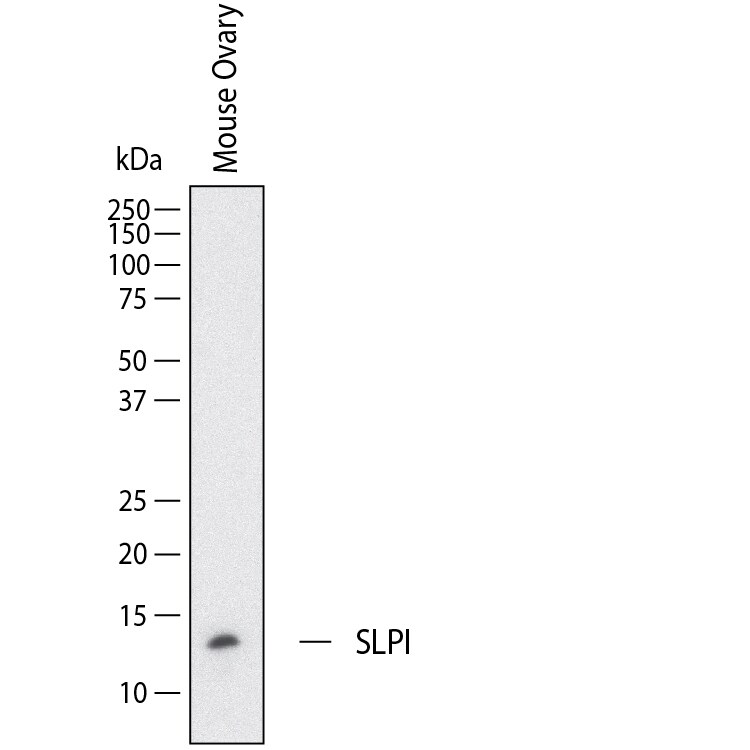
Detection of Mouse SLPI by Western Blot.
Western Blot shows lysates of mouse ovary. PVDF membrane was probed with 2 µg/ml of Goat Anti-Mouse SLPI Antigen Affinity-purified Polyclonal Antibody (Catalog # AF1735) followed by HRP-conjugated Anti-Goat IgG Secondary Antibody (Catalog # HAF017). A specific band was detected for SLPI at approximately 12 kDa (as indicated). This experiment was conducted under reducing conditions and using Western Blot Buffer Group 1.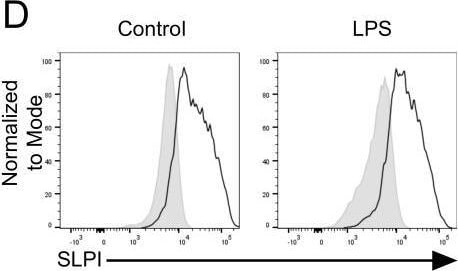
Detection of SLPI by Flow Cytometry
The impact of SLPI on local response to LPS injection. (A) Total PEC number isolated from WT and Slpi-/- mice injected with PBS or LPS for 24h. (B) Peritoneal macrophage percentage and total number as in (A). (C) Representative gating for resident macrophages in WT and Slpi-/- mice injected with PBS or LPS for 24h.(D) SLPI expression in resident peritoneal macrophages isolated from WT (black line) and Slpi-/- mice (shaded histogram) injected with PBS or LPS for 24h.(E) Fold change of geometrical MFI was compared between WT and Slpi-/- macrophages as in (D). (F) MMP-9 in supernatants of WT and Slpi-/- total PEC or peritoneal adherent cells (macrophages) isolated from PBS or LPS injected mice and stimulated with LPS (100ng/ml) or HKLM (107 cells) for 24h.WT vs Slpi-/- **p<0.01 by multiple unpaired t-test. (A, B, E) Data represent 5 to 8 mice per experimental group pooled from three independent experiments. Error bars show means ± SEM. (F) Data represent 3 to 5 mice per experimental group pooled from two independent experiments. Error bars show means ± SEM. Image collected and cropped by CiteAb from the following open publication (https://pubmed.ncbi.nlm.nih.gov/40496854), licensed under a CC-BY license. Not internally tested by R&D Systems.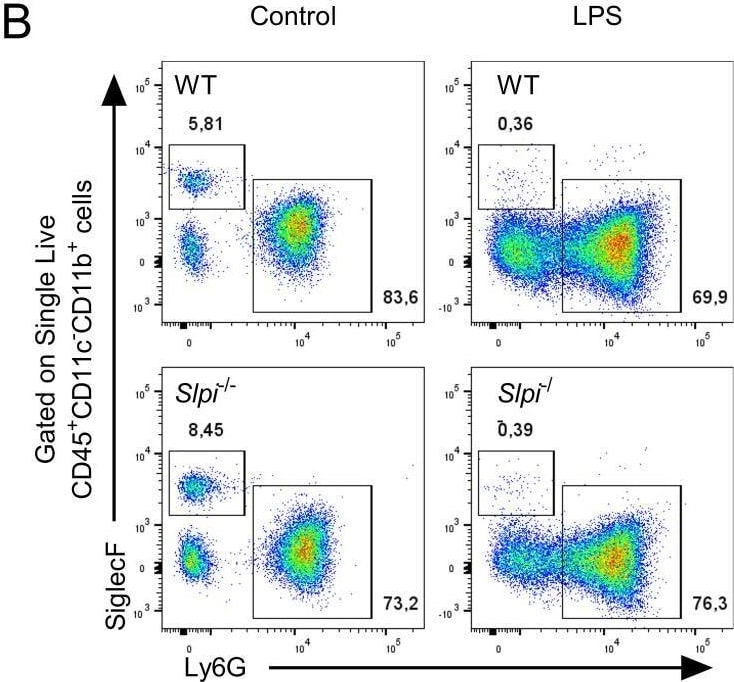
Detection of SLPI by Flow Cytometry
LPS induces changes in expression pattern of SLPI in selected immune cell populations in vivo. (A) Total blood CD45+ leukocyte number isolated from WT and Slpi-/- mice injected with PBS or LPS for 24h. (B) Representative gating for neutrophils (CD11b+Ly6G+SiglecF-), eosinophils (CD11b+Ly6G-SiglecF+) and monocytes (CD11b+Ly6C+Ly6G-) as in (A). (C) Percentage of neutrophils, eosinophils and monocytes isolated as in (A). (D) Percentage of Ly6Chi, MHC II+F4/80+ and Ly6Clow monocytes isolated as in (A). (E) Representative gating of Ly6Chi (CD11b+Ly6Chigh), MHC II+F4/80+ and Ly6Clow monocytes isolated as in (A). (F, G) SLPI expression in blood neutrophils isolated from WT (black line) and Slpi-/- mice (shaded histogram) injected with PBS or LPS for 24h.Data represented as mean ± SEM of fold change in geometrical MFI values (WT vs Slpi-/-). (H) SLPI expression in blood monocytes represented as a fold change in geometrical MFI values (WT vs Slpi-/-). (I) Representative histograms of SLPI expression in blood monocytes isolated from WT (black line) and Slpi-/- mice (shaded histogram) injected with PBS or LPS for 24h. (A, C, D, F, H) Data represent 7 to 8 mice per experimental group pooled from three independent experiments Error bars show means ± SEM. (A, C, D, F) Control vs LPS or WT vs Slpi-/- * p<0.05, **p<0.01, ***p<0.001, ****p<0.0001 by one-way ANOVA, Tukey post hoc test. (H) WT Ly6Chi monocytes vs WT Ly6Clow monocytes ****p<0.0001 by one-way ANOVA, Tukey post hoc test. Image collected and cropped by CiteAb from the following open publication (https://pubmed.ncbi.nlm.nih.gov/40496854), licensed under a CC-BY license. Not internally tested by R&D Systems.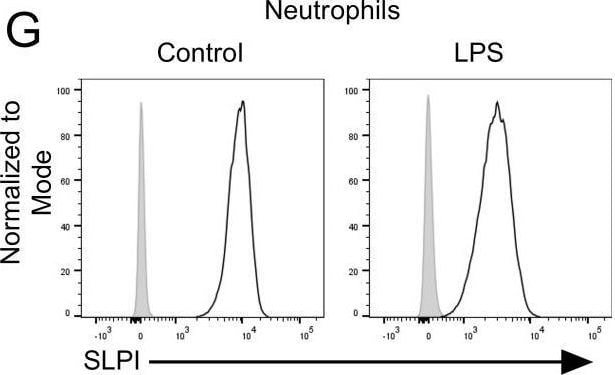
Detection of SLPI by Flow Cytometry
LPS induces changes in expression pattern of SLPI in selected immune cell populations in vivo. (A) Total blood CD45+ leukocyte number isolated from WT and Slpi-/- mice injected with PBS or LPS for 24h. (B) Representative gating for neutrophils (CD11b+Ly6G+SiglecF-), eosinophils (CD11b+Ly6G-SiglecF+) and monocytes (CD11b+Ly6C+Ly6G-) as in (A). (C) Percentage of neutrophils, eosinophils and monocytes isolated as in (A). (D) Percentage of Ly6Chi, MHC II+F4/80+ and Ly6Clow monocytes isolated as in (A). (E) Representative gating of Ly6Chi (CD11b+Ly6Chigh), MHC II+F4/80+ and Ly6Clow monocytes isolated as in (A). (F, G) SLPI expression in blood neutrophils isolated from WT (black line) and Slpi-/- mice (shaded histogram) injected with PBS or LPS for 24h.Data represented as mean ± SEM of fold change in geometrical MFI values (WT vs Slpi-/-). (H) SLPI expression in blood monocytes represented as a fold change in geometrical MFI values (WT vs Slpi-/-). (I) Representative histograms of SLPI expression in blood monocytes isolated from WT (black line) and Slpi-/- mice (shaded histogram) injected with PBS or LPS for 24h. (A, C, D, F, H) Data represent 7 to 8 mice per experimental group pooled from three independent experiments Error bars show means ± SEM. (A, C, D, F) Control vs LPS or WT vs Slpi-/- * p<0.05, **p<0.01, ***p<0.001, ****p<0.0001 by one-way ANOVA, Tukey post hoc test. (H) WT Ly6Chi monocytes vs WT Ly6Clow monocytes ****p<0.0001 by one-way ANOVA, Tukey post hoc test. Image collected and cropped by CiteAb from the following open publication (https://pubmed.ncbi.nlm.nih.gov/40496854), licensed under a CC-BY license. Not internally tested by R&D Systems.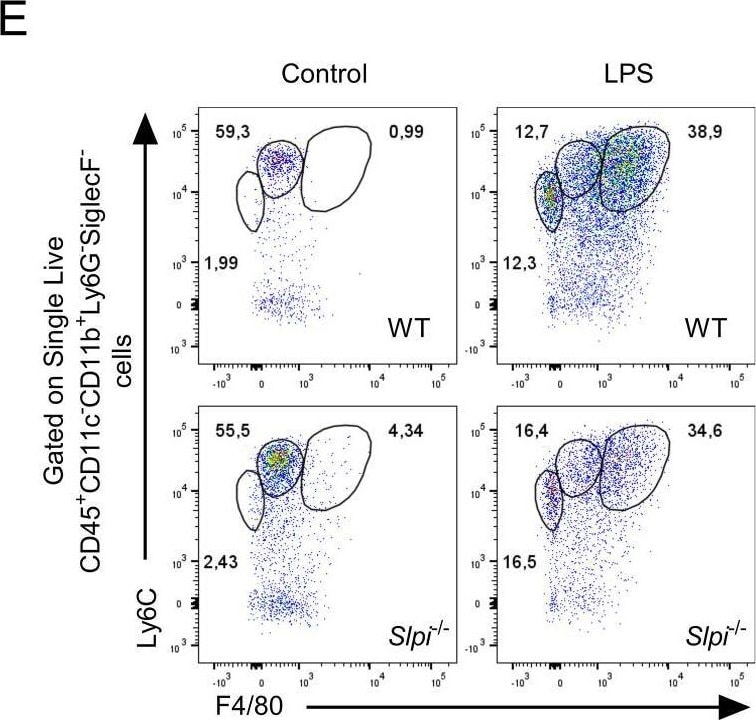
Detection of SLPI by Flow Cytometry
LPS induces changes in expression pattern of SLPI in selected immune cell populations in vivo. (A) Total blood CD45+ leukocyte number isolated from WT and Slpi-/- mice injected with PBS or LPS for 24h. (B) Representative gating for neutrophils (CD11b+Ly6G+SiglecF-), eosinophils (CD11b+Ly6G-SiglecF+) and monocytes (CD11b+Ly6C+Ly6G-) as in (A). (C) Percentage of neutrophils, eosinophils and monocytes isolated as in (A). (D) Percentage of Ly6Chi, MHC II+F4/80+ and Ly6Clow monocytes isolated as in (A). (E) Representative gating of Ly6Chi (CD11b+Ly6Chigh), MHC II+F4/80+ and Ly6Clow monocytes isolated as in (A). (F, G) SLPI expression in blood neutrophils isolated from WT (black line) and Slpi-/- mice (shaded histogram) injected with PBS or LPS for 24h.Data represented as mean ± SEM of fold change in geometrical MFI values (WT vs Slpi-/-). (H) SLPI expression in blood monocytes represented as a fold change in geometrical MFI values (WT vs Slpi-/-). (I) Representative histograms of SLPI expression in blood monocytes isolated from WT (black line) and Slpi-/- mice (shaded histogram) injected with PBS or LPS for 24h. (A, C, D, F, H) Data represent 7 to 8 mice per experimental group pooled from three independent experiments Error bars show means ± SEM. (A, C, D, F) Control vs LPS or WT vs Slpi-/- * p<0.05, **p<0.01, ***p<0.001, ****p<0.0001 by one-way ANOVA, Tukey post hoc test. (H) WT Ly6Chi monocytes vs WT Ly6Clow monocytes ****p<0.0001 by one-way ANOVA, Tukey post hoc test. Image collected and cropped by CiteAb from the following open publication (https://pubmed.ncbi.nlm.nih.gov/40496854), licensed under a CC-BY license. Not internally tested by R&D Systems.Applications for Mouse SLPI Antibody
Western Blot
Sample: Mouse ovary
Formulation, Preparation, and Storage
Purification
Reconstitution
Reconstitute at 0.2 mg/mL in sterile PBS. For liquid material, refer to CoA for concentration.
Formulation
Shipping
Stability & Storage
- 12 months from date of receipt, -20 to -70 °C as supplied.
- 1 month, 2 to 8 °C under sterile conditions after reconstitution.
- 6 months, -20 to -70 °C under sterile conditions after reconstitution.
Calculators
Background: SLPI
References
-
Zhang, D. et al. (2002) J. Biol. Chem. 277:29999.
- Taggart, C.C. et al. (2002) J. Biol. Chem. 277:33648.
Long Name
Alternate Names
Gene Symbol
Additional SLPI Products
Product Documents for Mouse SLPI Antibody
Certificate of Analysis
To download a Certificate of Analysis, please enter a lot or batch number in the search box below.
Note: Certificate of Analysis not available for kit components.
Product Specific Notices for Mouse SLPI Antibody
For research use only
Related Research Areas
Citations for Mouse SLPI Antibody
 Powered by Bioz
Customer Reviews for Mouse SLPI Antibody
There are currently no reviews for this product. Be the first to review Mouse SLPI Antibody and earn rewards!
Have you used Mouse SLPI Antibody?
Submit a review and receive an Amazon gift card!
$25/€18/£15/$25CAN/¥2500 for a review with an image
$10/€7/£6/$10CAN/¥1110 for a review without an image
Submit a review
Protocols
Find general support by application which include: protocols, troubleshooting, illustrated assays, videos and webinars.
- Cellular Response to Hypoxia Protocols
- R&D Systems Quality Control Western Blot Protocol
- Troubleshooting Guide: Western Blot Figures
- Western Blot Conditions
- Western Blot Protocol
- Western Blot Protocol for Cell Lysates
- Western Blot Troubleshooting
- Western Blot Troubleshooting Guide
- View all Protocols, Troubleshooting, Illustrated assays and Webinars