

Protein kinases are the largest class of enzymes in the human genome. These enzymes regulate almost all cellular processes by adding phosphate groups to proteins, thereby modifying the activity, localization, and overall function of their targets. Consequently, abnormal activity of kinases underlies many diseases including cancer.
Proteome Profiler Human Phospho-MAPK Array Kit
R&D Systems | Catalog # ARY002B

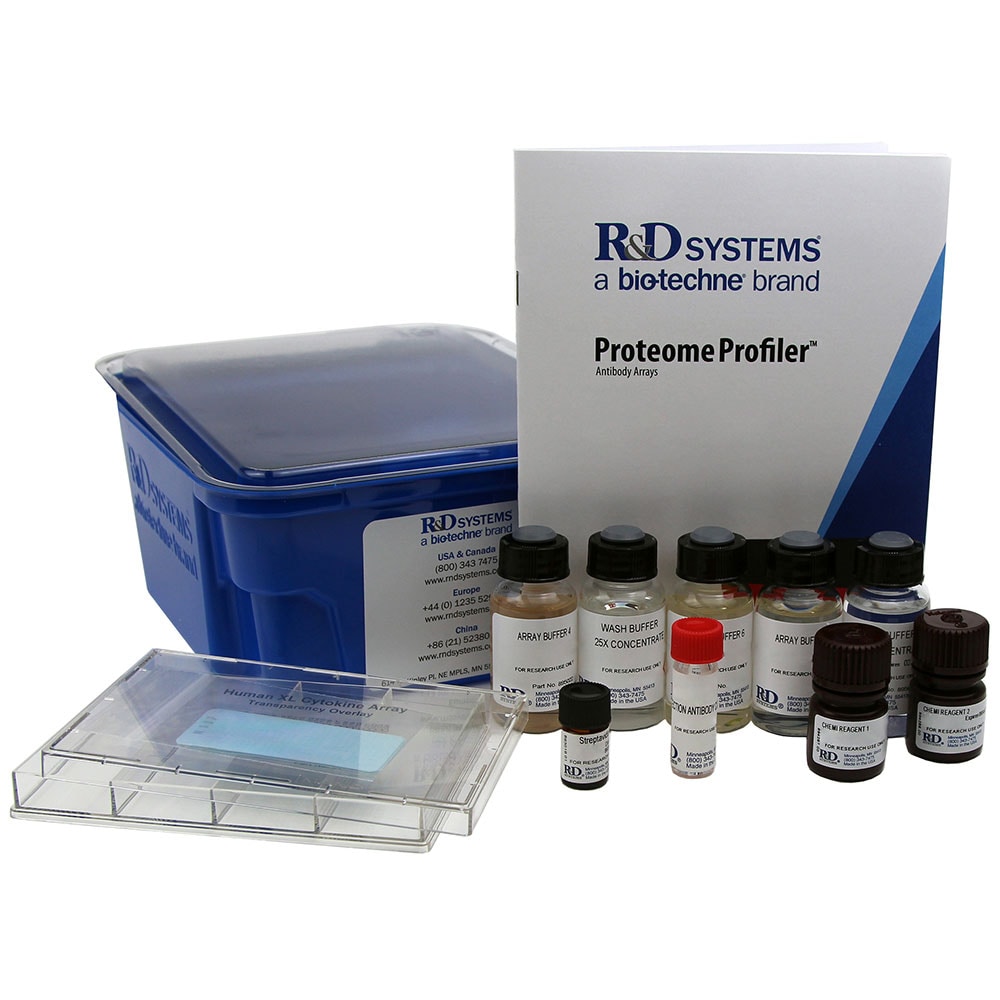
Discontinued Product
ARY002B has been discontinued.
View all Kinase Assay Kits products.
Key Product Details
Species
Human
Product Summary for Proteome Profiler Human Phospho-MAPK Array Kit
Proteome Profiler™ Human Phospho-MAPK Array Kit
A membrane-based antibody array for the parallel determination of the relative phosphorylation of human mitogen-activated protein kinases.
Contains 4 membranes - each spotted in duplicate with 26 different MAPK antibodies.
Validated for analyte detection in cell lysates.
Key Benefits
- Detects phosphorylation of 26 human kinases simultaneously
- Requires no specialized equipment
Principle of the Assay
The Proteome Profiler Human Phospho-MAPK Array Kit is a membrane-based sandwich immunoassay. Samples are mixed with a cocktail of biotinylated phospho-specific detection antibodies (Step 1) and then incubated with the array membrane which is spotted in duplicate with capture antibodies to specific target proteins (Step 2). Captured proteins are visualized using chemiluminescent detection reagents (Step 3). The signal produced is proportional to the amount phosphorylation in the bound analyte.
Why Use an Antibody Array to Detect Receptor Phosphorylation?
Determining the phosphorylation of multiple kinases in a single sample can be expensive, time consuming and can require specialized equipment. Performing multiple immunoprecipitations and Western blots requires time, labor, and reagents. The use of a multiplex antibody array to detect multiple phosphorylations in a single sample can be cost-effective and also save time and sample.
Kit Contents
- 4-Array Membranes
- 4-Well Multi-dish
- Lysis Buffer
- Array Buffers
- Wash Buffer
- Detection Antibody Cocktail
- Streptavidin-HRP
- Chemiluminescent Detection Reagents
- Transparency Overlay Template
- Detailed product datasheet with protocol
For a complete list of the kit contents and necessary materials, please see the Materials Provided/Other Supplies Required sections of the product datasheet.
| Simultaneously detect the relative phosphorylation of these of these kinases in a single sample. | ||
|---|---|---|
| Akt1 | HSP27 | p38 beta |
| Akt2 | JNK1 | p38 delta |
| Akt3 | JNK2 | p38 gamma |
| Akt pan | JNK3 | p53 |
| CREB | JNK pan | p70 S6K |
| ERK1 | MKK3 | RSK1 |
| ERK2 | MKK6 | RSK2 |
| GSK-3 alpha/beta | MSK2 | TOR |
| GSK-3 beta | p38 alpha | |
Assays for analytes represented in the Human Phospho-MAPK Array Kit
| Analyte | DuoSet® IC ELISA Development System (Total) | DuoSet® IC ELISA Development Systems (Phospho) | Cell-based ELISA Kits | Surveyor™ IC ELISA Kits |
|---|---|---|---|---|
| Akt1 (S473) | DYC1775 | DYC2289C | ||
| Akt2 (S474) | DYC2315 | |||
| Akt3 (S472) | ||||
| Akt pan (S473, S474, S472) | DYC887B | KCB887 | SUV887B | |
| CREB (S133) | DYC2510 | KCB2510 | ||
| ERK1 (T202/Y204) | DYC1940 | DYC1825 | KCB1018 | SUV1018B |
| JNK1 (T183/Y185) | ||||
| JNK2 (T183/Y185) | DYC1846 | DYC2236 | ||
| JNK3 (T221/Y223) | ||||
| JNK pan (T183/Y185, T221/Y223) | DYC1205 | DYC1387 | KCB1205 | |
| MKK3 (S218/T222) | DYC5585 | |||
| MKK6 (S207/T211) | DYC5586 | |||
| MSK2 (S360) | ||||
| p38 alpha (T180/Y182) | DYC8691B | DYC869B | KCB869 | SUV869B |
| p38 beta (T180/Y182) | KCB869 | |||
| p38 delta (T180/Y182) | DYC2124 | DYC2124 | KCB869 | |
| p38 gamma (T183/Y185) | DYC1664 | |||
| p53 (S46) | DYC1043 | DYC1489 | ||
| p70 S6K (T421/S424) | DYC8962 | DYC8965 | ||
| RSK1 (S380) | DYC892B | |||
| RSK2 (S386) | ||||
| TOR (S2448) | DYC1665 | SUV1665 |
Stability and Storage
Store the unopened kit at 2°C to 8°C. Do not use past kit expiration date.
Data Examples
 View Larger Image |
Figure 1.HeLa human cervical epithelial carcinoma cells were either untreated or exposed to 150 J/m2 of UV light followed by a 30 minute recovery period before lysis. Data shown are from a 2 minute exposure to X-ray film. |
 View Larger Image |
Figure 2. : MCF-7 human breast cancer cells were either untreated or treated with 100 ng/mL of rhIGF-I (R&D Systems, Catalog # 291-G1) for 1 hour. Cells for rhIGF-I treatment either received a 1 hour pre-treatment with the PI3K inhibitor, LY294002, or received no pre-treatment. Data shown are from a 6 minute exposure to X-ray film. |
BG01V human embryonic stem cells are licensed from ViaCyte, Inc.
Image Analysis Software
Quick Spots image analysis software
R&D Systems® now offers Quick Spots image analysis software designed specifically for your Proteome Profiler™ Arrays.
No more laborious set-up of templates in other imaging software, Quick Spots contains preloaded templates for each Proteome Profiler™ array. It knows where your results should be, and provides the data in less time and with less work.
Simplify your workflow today.
*Clicking on this button will navigate you away from the R&D Systems® website. Quick Spots image analysis software can be purchased through Western Vision Software.
Loading...
Formulation, Preparation, and Storage
Shipping
The product is shipped with polar packs. Upon receipt, store it immediately at the temperature recommended below.
Storage
Store the unopened product at 2 - 8 °C. Do not use past expiration date.
Background: Kinase Assay Kits
Additional Kinase Assay Kits Products
Product Documents for Proteome Profiler Human Phospho-MAPK Array Kit
Certificate of Analysis
To download a Certificate of Analysis, please enter a lot or batch number in the search box below.
Note: Certificate of Analysis not available for kit components.
Product Specific Notices for Proteome Profiler Human Phospho-MAPK Array Kit
For research use only
Related Research Areas
Citations for Proteome Profiler Human Phospho-MAPK Array Kit
 Powered by Bioz
Customer Reviews for Proteome Profiler Human Phospho-MAPK Array Kit (2)
4.5 out of 5
2 Customer Ratings
Have you used Proteome Profiler Human Phospho-MAPK Array Kit?
Submit a review and receive an Amazon gift card!
$25/€18/£15/$25CAN/¥2500 Yen for a review with an image
$10/€7/£6/$10CAN/¥1110 Yen for a review without an image
Submit a review
Showing
1
-
2 of
2 reviews
Showing All
Filter By:
-
Verified Customer | Posted 05/24/2019Good screening tool, would be nice if this was available for total levels and other species such as mouse.
-
Verified Customer | Posted 01/03/2017This array is an excellent tool for screening potential phospho-MAPKs and related targets. However, it would be nice that if the total level of non-phosphorylated proteins be visualized at the same time on the membrane. In this case, the phosphorylated signals can be normalized.
There are no reviews that match your criteria.
FAQs
No product specific FAQs exist for this product.
View all FAQs for Proteome Profiler Antibody ArraysLoading...