
Best Seller
Recombinant Mouse Sonic Hedgehog/Shh (C25II) N-Terminus
R&D Systems | Catalog # 464-SH
Analyzed by SEC-MALS

Loading...
Key Product Details
- R&D Systems E. coli-derived Recombinant Mouse Sonic Hedgehog/Shh (C25II) N-Terminus (464-SH)
- Quality control testing to verify active proteins with lot specific assays by in-house scientists
- All R&D Systems proteins are covered with a 100% guarantee
Source
E. coli
Accession Number
Applications
Bioactivity
Loading...
Product Specifications
Source
E. coli-derived mouse Sonic Hedgehog/Shh protein
Cys25-Gly198 (Cys25Ile-Ile), with an N-terminal Met
Cys25-Gly198 (Cys25Ile-Ile), with an N-terminal Met
Purity
>97%, by SDS-PAGE under reducing conditions and visualized by silver stain.
Endotoxin Level
<0.10 EU per 1 μg of the protein by the LAL method.
N-terminal Sequence Analysis
Met
Predicted Molecular Mass
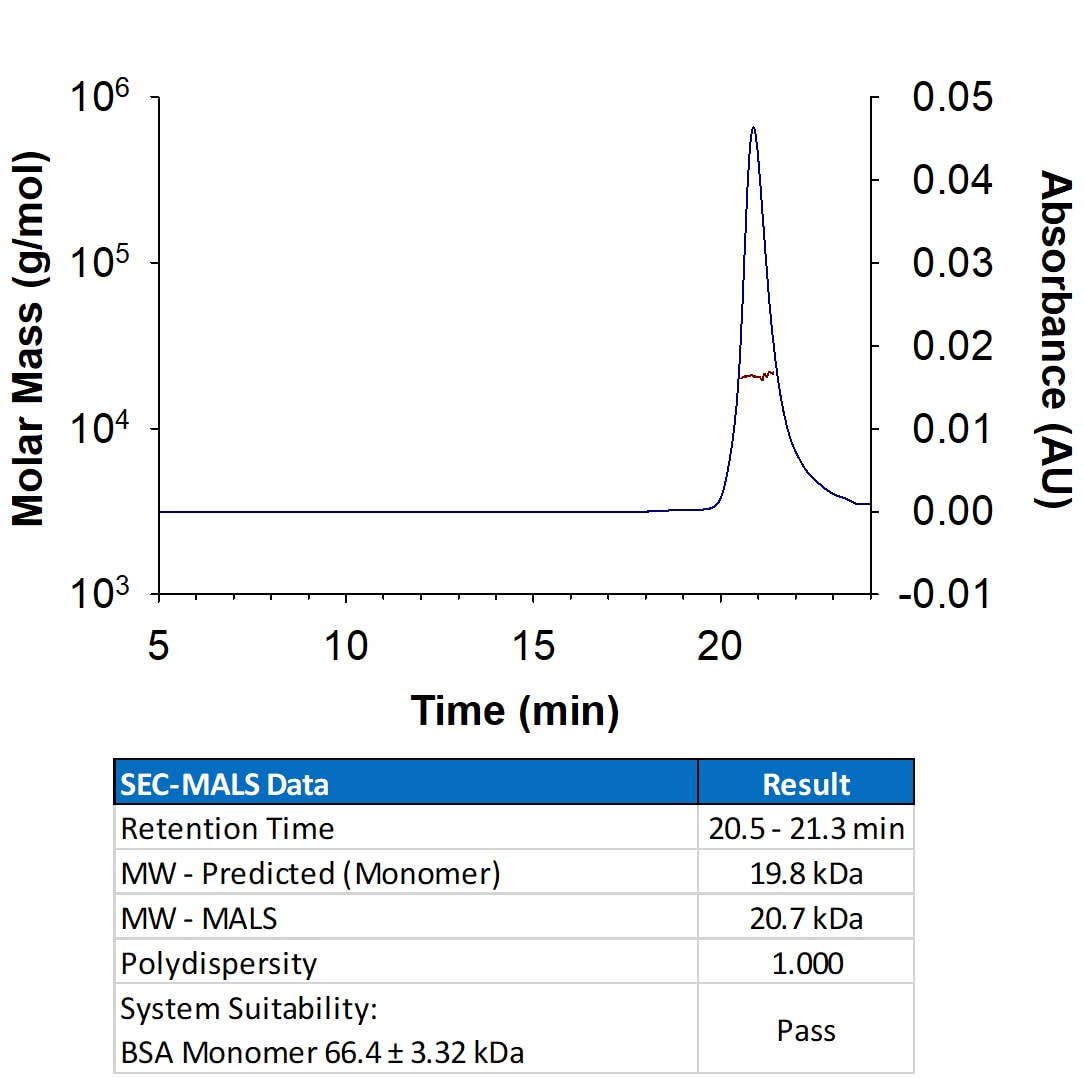
19.8 kDa
Activity
Measured by its ability to induce alkaline phosphatase production by C3H10T1/2 mouse embryonic fibroblast cells. Nakamura, T. et al. (1997) Biochem. Biophys. Res. Commun. 237:465.
The ED50 for this effect is 0.05-0.25 µg/mL.
The ED50 for this effect is 0.05-0.25 µg/mL.
Reviewed Applications
Read 2 reviews rated 5 using 464-SH in the following applications:
Scientific Data Images for Recombinant Mouse Sonic Hedgehog/Shh (C25II) N-Terminus
Recombinant Mouse Sonic Hedgehog/Shh (C25II), N-Terminus SEC-MALS
Recombinant Mouse Sonic Hedgehog/Shh (C25II), N-Terminus (Catalog # 464-SH) has a molecular weight (MW) of 20.7 kDa as analyzed by SEC-MALS, suggesting that this protein is a monomer. MW may differ from predicted MW due to post-translational modifications (PTMs) present (i.e. Glycosylation).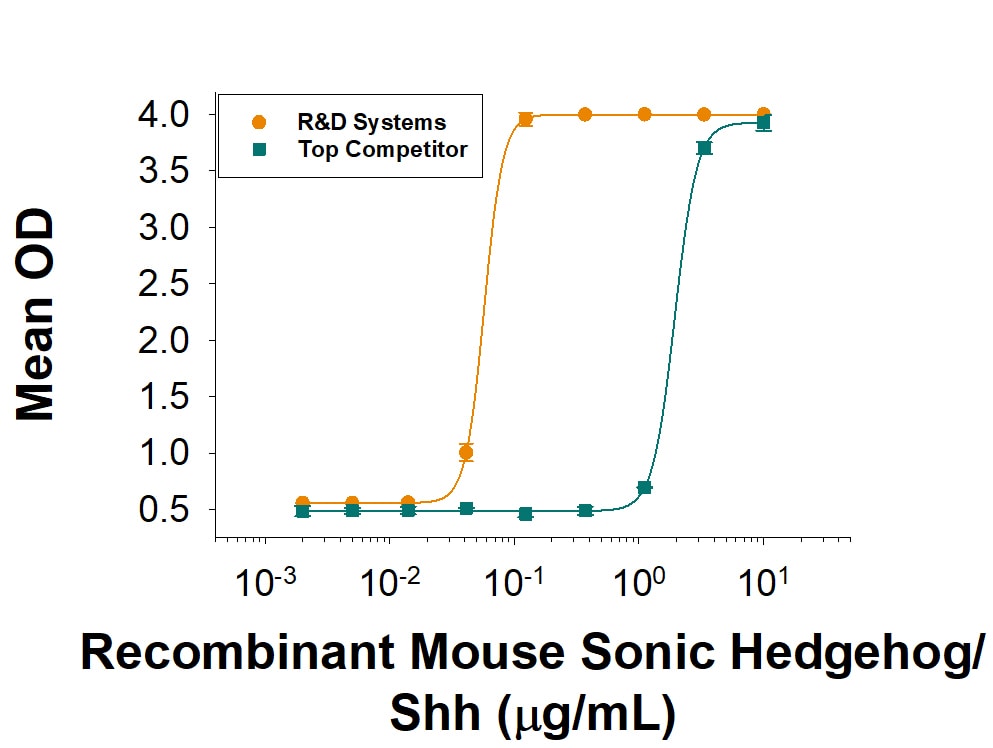
Recombinant Mouse Sonic Hedgehog/Shh (C25II) N-Terminus Bioactivity
Recombinant Mouse Sonic Hedgehog/Shh (C25Il), N-Terminus (Catalog # 464-SH) induces alkaline phosphatase production by the C3H10T1/2 mouse embryonic fibroblast cell line. The activity is more than 30-fold greater than the top competitor's Sonic Hedgehog.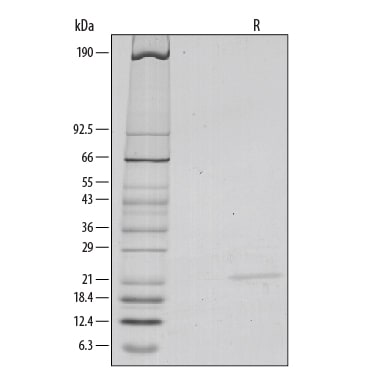
Recombinant Mouse Sonic Hedgehog/Shh (C25II) N-Terminus SDS-PAGE
1 μg/lane of Recombinant Mouse Sonic Hedgehog/Shh (C25Il), N-Terminus was resolved with SDS-PAGE under reducing (R) conditions and visualized by silver staining, showing a single band at 22 kDa.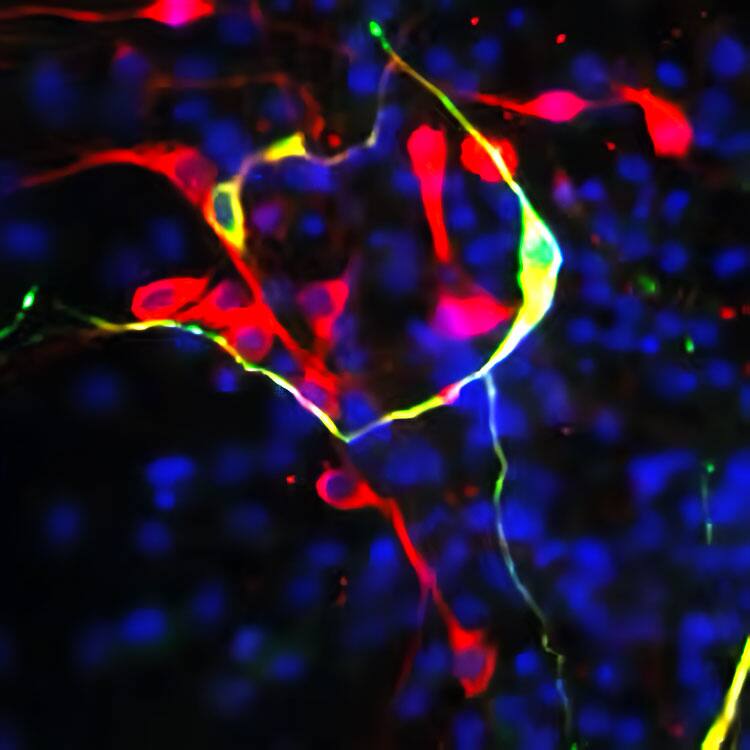
Culture and Characterization of Dopaminergic Neurons Generated from Human Pluripotent Stem Cells.
Dopaminergic neurons were generated from human pluripotent stem cells in media that included Bovine Fibronectin Protein (1030-FN) to support cell attachment and spreading, the ITS and N-2 Plus Media Supplements (AR013 and AR003, respectively) to select and enrich for neural stem cell populations, and a panel of growth factors for effective dopaminergic differentiation, including Recombinant Human FGF-basic, Recombinant Mouse FGF-8b (423-F8), and Recombinant Mouse Shh-N (Catalog # 464-SH). Cells were stained with a Mouse Anti-Human/Mouse Tyrosine Hydroxylase Monoclonal Antibody (MAB7566) followed by a NorthernLights™ 493-conjugated Donkey Anti-Mouse IgG Antigen Affinity-purified Secondary Antibody (NL009; green), and a Mouse Neuron-specific beta III Tubulin Tuj1 Monoclonal Antibody (MAB1195) followed by a NorthernLights 557-conjugated Donkey Anti-Mouse IgG Antigen Affinity-purified Secondary Antibody (NL007; red) and counterstained with DAPI (5748; blue).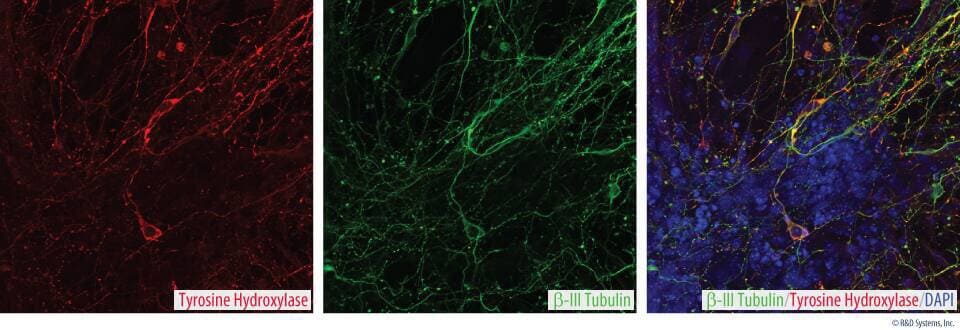
Culture and Characterization of Dopaminergic Neurons Generated from Human Pluripotent Stem Cells.
Dopaminergic neurons were generated from human pluripotent stem cells in media that included Bovine Fibronectin Protein (1030-FN) to support cell attachment and spreading, the ITS and N-2 Plus Media Supplements (AR013 and AR003, respectively), and a panel of growth factors for effective dopaminergic differentiation, including Recombinant Human FGF-basic, Recombinant Mouse FGF-8b (423-F8), and Recombinant Mouse Shh-N (Catalog # 464-SH). Tyrosine Hydroxylase was detected using a Mouse Anti-Human Tyrosine Hydroxylase Monoclonal Antibody (MAB7566). The cells were stained with the NorthernLights™ 557-conjugated Donkey Anti-Mouse IgG Antigen Affinity-purified Secondary Antibody (NL007; red). Neuron-specific beta-III Tubulin was detected using a Mouse Anti-Neuron-specific beta-III Tubulin (Clone Tuj-1) Monoclonal Antibody (MAB1195) followed by the NorthernLights™ 493-conjugated Donkey Anti-Mouse IgG Antigen Affinity-purified Secondary Antibody (NL009; green). Cells were counterstained with DAPI (5748; blue).Formulation, Preparation, and Storage
Carrier Free
What does CF mean?CF stands for Carrier Free (CF). We typically add Bovine Serum Albumin (BSA) as a carrier protein to our recombinant proteins. Adding a carrier protein enhances protein stability, increases shelf-life, and allows the recombinant protein to be stored at a more dilute concentration. The carrier free version does not contain BSA.
What formulation is right for me?In general, we advise purchasing the recombinant protein with BSA for use in cell or tissue culture, or as an ELISA standard. In contrast, the carrier free protein is recommended for applications, in which the presence of BSA could interfere.
Carrier: 464-SH
| Formulation | Lyophilized from a 0.2 μm filtered solution in NaH2PO4, NaCl and DTT with BSA as a carrier protein. |
| Reconstitution | Reconstitute at 100-200 μg/mL in sterile PBS containing at least 0.1% human or bovine serum albumin. |
| Shipping | The product is shipped at ambient temperature. Upon receipt, store it immediately at the temperature recommended below. |
| Stability & Storage | Use a manual defrost freezer and avoid repeated freeze-thaw cycles.
|
Carrier Free: 464-SH/CF
| Formulation | Lyophilized from a 0.2 μm filtered solution in NaH2PO4, NaCl and DTT. |
| Reconstitution | Reconstitute at 100-200 μg/mL in sterile PBS. |
| Shipping | The product is shipped with polar packs. Upon receipt, store it immediately at the temperature recommended below. |
| Stability & Storage | Use a manual defrost freezer and avoid repeated freeze-thaw cycles.
|
Calculators
Background: Sonic Hedgehog/Shh
N-terminal cysteine and modified by cholesterol addition at its C-terminus (6). These modifications contribute to the membrane tethering of Shh as well as its assembly into various sized multimers (6-9). Lipid modification and multimerization greatly increase Shh-N receptor binding affinity and signaling potency (5, 6, 8, 9). Monomeric and multimeric Shh can be released from the plasma membrane by the cooperative action of DISP1, SCUBE2, and TACE/ADAM17 (10-12). Modifications also extend the effective range of Shh functionality and are required for the development of protein gradients important in tissue morphogenesis (9, 13). Canonical signaling of Shh is mediated by a multicomponent receptor complex that includes Patched (PTCH1, PTCH2) and Smoothened (SMO) (14). The binding of Shh to PTCH releases the basal repression of SMO by PTCH. Shh activity can also be regulated through interactions with heparin, glypicans, and membrane-associated Hip (hedgehog interacting protein) (13, 15, 16).
References
- Briscoe, J. and P.P. Therond (2013) Mol. Cell. Biol. 14:416.
- Aviles, E.C. et al. (2013) Front. Cell. Neurosci. 7:86.
- Xie, J. et al. (2013) OncoTargets Ther. 6:1425.
- Echelard, Y. et al. (1993) Cell 75:1417.
- Zeng, X. et al. (2001) Nature 411:716.
- Feng, J. et al. (2004) Development 131:4357.
- Goetz, J.A. et al. (2006) J. Biol. Chem. 281:4087.
- Pepinsky, R.B. et al. (1998) J. Biol. Chem. 273:14037.
- Chen, M.-H. et al. (2004) Genes Dev. 18:641.
- Etheridge, L.A. et al. (2010) Development 137:133.
- Jakobs, P. et al. (2014) J. Cell Sci. 127:1726.
- Dierker, T. et al. (2009) J. Biol. Chem. 284:8013.
- Lewis, P.M. et al. (2001) Cell 105:599.
- Carpenter, D. et al. (1998) Proc. Natl. Acad. Sci. USA 95:13630.
- Filmus, J. and M. Capurro (2014) Matrix Biol. 35:248.
- Chuang, P.-T. and A.P. McMahon (1999) Nature 397:617.
Alternate Names
HHG1, HLP3, HPE3, MCOPCB5, Shh, ShhNC, SMMCI, TPTPS
Gene Symbol
SHH
UniProt
Additional Sonic Hedgehog/Shh Products
Product Documents for Recombinant Mouse Sonic Hedgehog/Shh (C25II) N-Terminus
Certificate of Analysis
To download a Certificate of Analysis, please enter a lot or batch number in the search box below.
Note: Certificate of Analysis not available for kit components.
Product Specific Notices for Recombinant Mouse Sonic Hedgehog/Shh (C25II) N-Terminus
For research use only
Citations for Recombinant Mouse Sonic Hedgehog/Shh (C25II) N-Terminus
 Powered by Bioz
Customer Reviews for Recombinant Mouse Sonic Hedgehog/Shh (C25II) N-Terminus (2)
5 out of 5
2 Customer Ratings
Have you used Recombinant Mouse Sonic Hedgehog/Shh (C25II) N-Terminus?
Submit a review and receive an Amazon gift card!
$25/€18/£15/$25CAN/¥2500 for a review with an image
$10/€7/£6/$10CAN/¥1110 for a review without an image
Submit a review
Showing
1
-
2 of
2 reviews
Showing All
Filter By:
-
Application: Stem/Immune cell maintenance or differentiationVerified Customer | Posted 05/22/2017
-
Application: Stem/Immune cell maintenance or differentiationVerified Customer | Posted 08/03/2016
There are no reviews that match your criteria.
FAQs for Recombinant Mouse Sonic Hedgehog/Shh (C25II) N-Terminus
Showing
1
-
1 of
1 FAQ
Showing All
-
Q: What is the difference between Recombinant Mouse Sonic Hedgehog Catalog # 464-SH and Catalog # 461-SH?
A: Recombinant Mouse Sonic Hedgehog, Catalog # 464-SH, possesses a N-terminal mutation that increases its potency in bioassay tests. The amino acid sequence is Cys25-Gly198 (Cys25Ile-Ile), accession number Q62226. The Cys25Ile-Ile mutation was created to match a publication that describes enhanced activity with these modifications: "http://www.ncbi.nlm.nih.gov/pubmed/11284692". Catalog # 461-SH does not possess this mutation.

