
CANT1 (soluble Calcium-Activated NucleoTidase 1; also SCAN-1, Apyrase homolog and NF kappa B-activating protein 107) is a 45-48 kDa glycoprotein member of the apyrase (ADP/ATP hydrolysing) family of molecules. It is an ER and Golgi-embedded protein that hydrolyzes UDP in a calcium-dependent manner, and appears to be involved in the regulation of protein glycosylation and folding. It is also reported that CANT1 is essential for cell proliferation. CANT1 is not ubiquitous, but is found in multiple cell types, including prostatic epithelium, fibroblasts, lymphocytes and chondrocytes. Human CANT1 is a 401 amino acid (aa) type II transmembrane glycoprotein. It contains a 44 aa N-terminal cytoplasmic region that possesses an ER retention motif (aa 38-42), and a 339 aa luminal domain (aa 63-401). CANT1 is reported to form membrane-bound disulfide-linked homodimers, and potentially forms non-covalent homodimers in a soluble (circulating) state. The soluble form is 35‑40 kDa in size, and presumably cleaved near the transmembrane segment. However, multiple splice forms are possible, and may account for the lower MWs. Two splice forms impact the extracellular region, one which contains a four aa substitution for aa 219-401, and a second that possesses a 26 aa substitution for aa 220‑401. Two additional splice forms utilize alternative start sites at Met 31 and Met165. Over aa 80-401, human CANT1 shares 89% aa sequence identity with mouse CANT1.
Human Calcium Activated Nucleotidase 1/CANT1 Antibody (861206)
R&D Systems | Catalog # MAB6720

Scientific images may be resized, cropped, or adjusted for brightness or contrast for presentation purposes. These updates are limited to presentation and do not affect the underlying scientific interpretation of the data. Where available, additional source data may be provided upon request.
Key Product Details
Species Reactivity
Applications
Label
Antibody Source
Product Specifications
Immunogen
Gly80-Ile401
Accession # Q8WVQ1
Specificity
Clonality
Host
Isotype
Scientific Data Images for Human Calcium Activated Nucleotidase 1/CANT1 Antibody (861206)
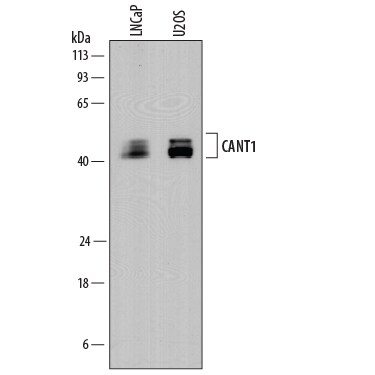
Detection of Human Calcium Activated Nucleotidase 1/CANT1 by Western Blot.
Western blot shows lysates of LNCaP human prostate cancer cell line and U2OS human osteosarcoma cell line. PVDF membrane was probed with 2 µg/mL of Mouse Anti-Human Calcium Activated Nucleotidase 1/CANT1 Monoclonal Antibody (Catalog # MAB6720) followed by HRP-conjugated Anti-Mouse IgG Secondary Antibody (Catalog # HAF018). Specific bands were detected for Calcium Activated Nucleotidase 1/CANT1 at approximately 40-45 kDa (as indicated). This experiment was conducted under reducing conditions and using Immunoblot Buffer Group 1.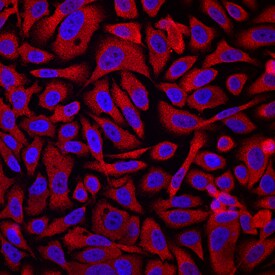
Calcium Activated Nucleotidase 1/CANT1 in PC‑3 Human Cell Line.
Calcium Activated Nucleotidase 1/CANT1 was detected in immersion fixed PC-3 human prostate cancer cell line using Mouse Anti-Human Calcium Activated Nucleotidase 1/CANT1 Monoclonal Antibody (Catalog # MAB6720) at 10 µg/mL for 3 hours at room temperature. Cells were stained using the NorthernLights™ 557-conjugated Anti-Mouse IgG Secondary Antibody (red; Catalog # NL007) and counterstained with DAPI (blue). Specific staining was localized to the perinuclear region. View our protocol for Fluorescent ICC Staining of Cells on Coverslips.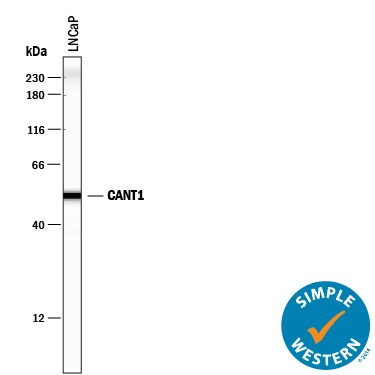
Detection of Human Calcium Activated Nucleotidase 1/CANT1 by Simple WesternTM.
Simple Western lane view shows lysates of LNCaP human prostate cancer cell line, loaded at 0.5 mg/mL. A specific band was detected for Calcium Activated Nucleotidase 1/CANT1 at approximately 52 kDa (as indicated) using 20 µg/mL of Mouse Anti-Human Calcium Activated Nucleotidase 1/CANT1 Monoclonal Antibody (Catalog # MAB6720). This experiment was conducted under reducing conditions and using the 12-230 kDa separation system. Non-specific interaction with the 230 kDa Simple Western standard may be seen with this antibody.Applications for Human Calcium Activated Nucleotidase 1/CANT1 Antibody (861206)
Immunocytochemistry
Sample: Immersion fixed PC‑3 human prostate cancer cell line
Simple Western
Sample: LNCaP human prostate cancer cell line
Western Blot
Sample: LNCaP human prostate cancer cell line and U2OS human osteosarcoma cell line
Formulation, Preparation, and Storage
Purification
Reconstitution
Sterile PBS to a final concentration of 0.5 mg/mL. For liquid material, refer to CoA for concentration.
Formulation
Shipping
Stability & Storage
- 12 months from date of receipt, -20 to -70 °C as supplied.
- 1 month, 2 to 8 °C under sterile conditions after reconstitution.
- 6 months, -20 to -70 °C under sterile conditions after reconstitution.
Calculators
Background: Calcium Activated Nucleotidase 1/CANT1
Long Name
Alternate Names
Gene Symbol
UniProt
Additional Calcium Activated Nucleotidase 1/CANT1 Products
Product Documents for Human Calcium Activated Nucleotidase 1/CANT1 Antibody (861206)
Certificate of Analysis
To download a Certificate of Analysis, please enter a lot or batch number in the search box below.
Note: Certificate of Analysis not available for kit components.
Product Specific Notices for Human Calcium Activated Nucleotidase 1/CANT1 Antibody (861206)
For research use only
Related Research Areas
Citations for Human Calcium Activated Nucleotidase 1/CANT1 Antibody (861206)
 Powered by Bioz
Customer Reviews for Human Calcium Activated Nucleotidase 1/CANT1 Antibody (861206)
There are currently no reviews for this product. Be the first to review Human Calcium Activated Nucleotidase 1/CANT1 Antibody (861206) and earn rewards!
Have you used Human Calcium Activated Nucleotidase 1/CANT1 Antibody (861206)?
Submit a review and receive an Amazon gift card!
$25/€18/£15/$25CAN/¥2500 for a review with an image
$10/€7/£6/$10CAN/¥1110 for a review without an image
Submit a review
Protocols
Find general support by application which include: protocols, troubleshooting, illustrated assays, videos and webinars.
- Appropriate Fixation of IHC/ICC Samples
- Cellular Response to Hypoxia Protocols
- ClariTSA™ Fluorophore Kits
- Detection & Visualization of Antibody Binding
- ICC Cell Smear Protocol for Suspension Cells
- ICC Immunocytochemistry Protocol Videos
- ICC for Adherent Cells
- Immunocytochemistry (ICC) Protocol
- Immunocytochemistry Troubleshooting
- Immunofluorescence of Organoids Embedded in Cultrex Basement Membrane Extract
- Immunohistochemistry (IHC) and Immunocytochemistry (ICC) Protocols
- Preparing Samples for IHC/ICC Experiments
- Preventing Non-Specific Staining (Non-Specific Binding)
- Primary Antibody Selection & Optimization
- Protocol for VisUCyte™ HRP Polymer Detection Reagent
- Protocol for the Fluorescent ICC Staining of Cell Smears - Graphic
- Protocol for the Fluorescent ICC Staining of Cultured Cells on Coverslips - Graphic
- Protocol for the Preparation and Fluorescent ICC Staining of Cells on Coverslips
- Protocol for the Preparation and Fluorescent ICC Staining of Non-adherent Cells
- Protocol for the Preparation and Fluorescent ICC Staining of Stem Cells on Coverslips
- Protocol for the Preparation of a Cell Smear for Non-adherent Cell ICC - Graphic
- R&D Systems Quality Control Western Blot Protocol
- TUNEL and Active Caspase-3 Detection by IHC/ICC Protocol
- The Importance of IHC/ICC Controls
- Troubleshooting Guide: Western Blot Figures
- Western Blot Conditions
- Western Blot Protocol
- Western Blot Protocol for Cell Lysates
- Western Blot Troubleshooting
- Western Blot Troubleshooting Guide
- View all Protocols, Troubleshooting, Illustrated assays and Webinars