
CTLA-4 (cytotoxic T-lymphocyte associated protein‑4, designated CD152), is a type I transmembrane T cell inhibitory molecule that is a member of the Ig superfamily (1, 2). Human or mouse CTLA-4 cDNA encodes 223 amino acids (aa) including a 35 aa signal sequence, a 126 aa extracellular domain (ECD) with one Ig-like V-type domain, a 21 aa transmembrane (TM) sequence, and a 41 aa cytoplasmic sequence. It is found as a covalent homodimer of 41-43 kDa (2) Within the ECD, human CTLA-4 shares 68%, 71% and 83‑86% aa sequence identity with mouse, rat and porcine/bovine/rabbit/feline/canine CTLA-4, respectively. A 174 aa form that lacks TM and cytoplasmic sequences (sCTLA-4) is possibly secreted (3-5). Isoforms of 56-79 aa that mainly contain parts of the cytoplasmic domain are reported. In mouse, an isoform lacking the Ig-like domain has ligand-independent inhibitory activity and is termed liCTLA-4 (6). CD28, which is structurally related to CTLA-4, is constitutively expressed on naïve T cells and promotes T cell activation when engaged by B7-2 on antigen-presenting cells (APC) within the immunological synapse (IS) (1, 7, 8). In contrast, CTLA-4 is recruited from intracellular vesicles to the IS beginning 1-2 days after T cell activation (2, 7, 8). It forms a linear lattice with B7-1 on APC, inducing negative regulatory signals and ending T cell activation (9). Abatacept, a therapeutic human CTLA-4-Ig fusion protein (trade name Orencia), competes with CD28 for B7-1 and B7-2 binding and has been used to antagonize T cell activation in autoimmune conditions and to enhance transplant survival (10). Mice deleted for CTLA-4 show no abnormalities until after birth, but then develop lethal autoimmune reactions due to continued T cell activation and poor control by regulatory T cells, which constitutively express CTLA-4 in wild-type mice and humans (11-13).
Human CTLA-4 Antibody (2188B)
R&D Systems | Catalog # MAB3253

Scientific images may be resized, cropped, or adjusted for brightness or contrast for presentation purposes. These updates are limited to presentation and do not affect the underlying scientific interpretation of the data. Where available, additional source data may be provided upon request.
Key Product Details
Species Reactivity
Applications
Label
Antibody Source
Product Specifications
Immunogen
Ala37-Phe162
Accession # P16410
Specificity
Clonality
Host
Isotype
Scientific Data Images for Human CTLA-4 Antibody (2188B)
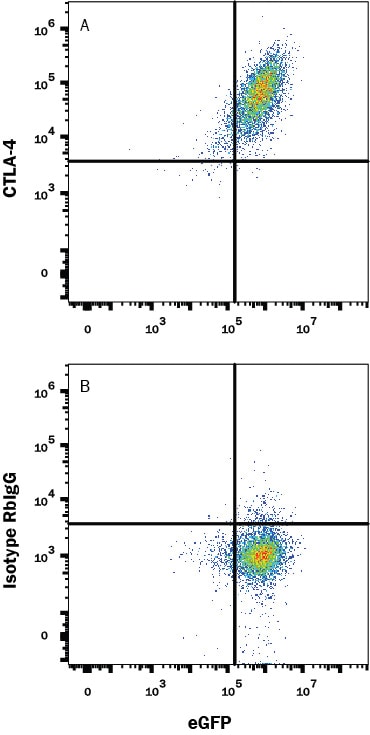
Detection of CTLA‑4 in NS0 Mouse Cell Line Transfected with Human CTLA-4 and eGFP by Flow Cytometry.
NS0 mouse myeloma cell line transfected with human CTLA-4 and eGFP was stained with (A) Rabbit Anti-Human CTLA-4 Monoclonal Antibody (Catalog # MAB3253) or (B) Normal Rabbit IgG Control Antibody (Catalog # MAB1050) followed by APC-conjugated Goat anti-Rabbit IgG Secondary Antibody (Catalog # F0111). View our protocol for Staining Membrane-associated Proteins.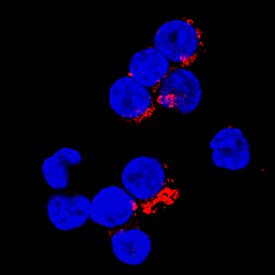
CTLA‑4 in Human PBMCs.
CTLA-4 was detected in immersion fixed human peripheral blood mononuclear cells (PBMCs) stimulated with PHA using Rabbit Anti-Human CTLA-4 Monoclonal Antibody (Catalog # MAB3253) at 8 µg/mL for 3 hours at room temperature. Cells were stained using the NorthernLights™ 557-conjugated Anti-Rabbit IgG Secondary Antibody (red; Catalog # NL004) and counterstained with DAPI (blue). Specific staining was localized to cytoplasm. View our protocol for Fluorescent ICC Staining of Non-adherent Cells.Applications for Human CTLA-4 Antibody (2188B)
CyTOF-ready
Flow Cytometry
Sample: NS0 Mouse Cell Line Transfected with Human CTLA-4 and eGFP
Immunocytochemistry
Sample: Immersion fixed human peripheral blood mononuclear cells (PBMCs) stimulated with PHA
Flow Cytometry Panel Builder
Bio-Techne Knows Flow Cytometry
Save time and reduce costly mistakes by quickly finding compatible reagents using the Panel Builder Tool.
Advanced Features
- Spectra Viewer - Custom analysis of spectra from multiple fluorochromes
- Spillover Popups - Visualize the spectra of individual fluorochromes
- Antigen Density Selector - Match fluorochrome brightness with antigen density

Formulation, Preparation, and Storage
Purification
Reconstitution
Reconstitute at 0.5 mg/mL in sterile PBS. For liquid material, refer to CoA for concentration.
Formulation
Shipping
Stability & Storage
- 12 months from date of receipt, -20 to -70 °C as supplied.
- 1 month, 2 to 8 °C under sterile conditions after reconstitution.
- 6 months, -20 to -70 °C under sterile conditions after reconstitution.
Calculators
Background: CTLA-4
References
- Harper, K. et al. (1991) J. Immunol. 147:1037.
- Teft, W.A. et al. (2006) Annu. Rev. Immunol. 24:65.
- Magistrelli, G. et al. (1999) Eur. J. Immunol. 29:3596.
- Tector, M. et al. (2009) BMC Immunol. 10:51.
- Oaks, M.K. and K.M. Hallett (2000) J. Immunol. 164:5015.
- Vijayakrishnan, L. et al. (2004) Immunity 20:563.
- Pentcheva-Hoang, T. et al. (2004) Immunity 21:401.
- Jansson, A. et al. (2005) J. Immunol 175:1575.
- Darlington, P.J. et al. (2005) J. Immunol. 175:996.
- Platt, A.M. et al. (2010) J. Immunol. 185:1558.
- Wing, K. et al. (2008) Science 322:271.
- Friedline, R.H. et al. (2009) J. Exp. Med. 206:421.
- Jain, N. et al. (2010) Proc. Natl. Acad. Sci. USA 107:1524.
Long Name
Alternate Names
Gene Symbol
UniProt
Additional CTLA-4 Products
Product Documents for Human CTLA-4 Antibody (2188B)
Certificate of Analysis
To download a Certificate of Analysis, please enter a lot or batch number in the search box below.
Note: Certificate of Analysis not available for kit components.
Product Specific Notices for Human CTLA-4 Antibody (2188B)
For research use only
Customer Reviews for Human CTLA-4 Antibody (2188B)
There are currently no reviews for this product. Be the first to review Human CTLA-4 Antibody (2188B) and earn rewards!
Have you used Human CTLA-4 Antibody (2188B)?
Submit a review and receive an Amazon gift card!
$25/€18/£15/$25CAN/¥2500 for a review with an image
$10/€7/£6/$10CAN/¥1110 for a review without an image
Submit a review
Protocols
Find general support by application which include: protocols, troubleshooting, illustrated assays, videos and webinars.
- 7-Amino Actinomycin D (7-AAD) Cell Viability Flow Cytometry Protocol
- Appropriate Fixation of IHC/ICC Samples
- Cellular Response to Hypoxia Protocols
- ClariTSA™ Fluorophore Kits
- Detection & Visualization of Antibody Binding
- Extracellular Membrane Flow Cytometry Protocol
- Flow Cytometry Protocol for Cell Surface Markers
- Flow Cytometry Protocol for Staining Membrane Associated Proteins
- Flow Cytometry Staining Protocols
- Flow Cytometry Troubleshooting Guide
- ICC Cell Smear Protocol for Suspension Cells
- ICC Immunocytochemistry Protocol Videos
- ICC for Adherent Cells
- Immunocytochemistry (ICC) Protocol
- Immunocytochemistry Troubleshooting
- Immunofluorescence of Organoids Embedded in Cultrex Basement Membrane Extract
- Immunohistochemistry (IHC) and Immunocytochemistry (ICC) Protocols
- Intracellular Flow Cytometry Protocol Using Alcohol (Methanol)
- Intracellular Flow Cytometry Protocol Using Detergents
- Intracellular Nuclear Staining Flow Cytometry Protocol Using Detergents
- Intracellular Staining Flow Cytometry Protocol Using Alcohol Permeabilization
- Intracellular Staining Flow Cytometry Protocol Using Detergents to Permeabilize Cells
- Preparing Samples for IHC/ICC Experiments
- Preventing Non-Specific Staining (Non-Specific Binding)
- Primary Antibody Selection & Optimization
- Propidium Iodide Cell Viability Flow Cytometry Protocol
- Protocol for Liperfluo
- Protocol for VisUCyte™ HRP Polymer Detection Reagent
- Protocol for the Characterization of Human Th22 Cells
- Protocol for the Characterization of Human Th9 Cells
- Protocol for the Fluorescent ICC Staining of Cell Smears - Graphic
- Protocol for the Fluorescent ICC Staining of Cultured Cells on Coverslips - Graphic
- Protocol for the Preparation and Fluorescent ICC Staining of Cells on Coverslips
- Protocol for the Preparation and Fluorescent ICC Staining of Non-adherent Cells
- Protocol for the Preparation and Fluorescent ICC Staining of Stem Cells on Coverslips
- Protocol for the Preparation of a Cell Smear for Non-adherent Cell ICC - Graphic
- Protocol: Annexin V and PI Staining by Flow Cytometry
- Protocol: Annexin V and PI Staining for Apoptosis by Flow Cytometry
- TUNEL and Active Caspase-3 Detection by IHC/ICC Protocol
- The Importance of IHC/ICC Controls
- Troubleshooting Guide: Fluorokine Flow Cytometry Kits
- View all Protocols, Troubleshooting, Illustrated assays and Webinars