
Dopamine receptor D2 (DRD2) is localized to human striatum, motor cortex and neocortex. It is a highly conserved seven transmembrane receptor member of the G-protein coupled receptor 1 family, with three known isoforms. In the striatum, DRD2 suppresses voluntary activity in the striatopallidal pathway, and polymorphisms in this gene are associated with alcohol addiction, smoking behavior, schizophrenia, food addiction and post-traumatic stress disorder as well as myoclonus dystonia. DRD2 has been shown to heterodimerize with DDR4 and 5-HT2A receptors, and traffics between the plasma membrane and intracellular pools and this localization can be modulated by several drugs. DRD2 is localized to human striatum, motor cortex and neocortex.
Human Dopamine D2 R/DRD2 Antibody (960710)
R&D Systems | Catalog # MAB9266

Scientific images may be resized, cropped, or adjusted for brightness or contrast for presentation purposes. These updates are limited to presentation and do not affect the underlying scientific interpretation of the data. Where available, additional source data may be provided upon request.
Key Product Details
Species Reactivity
Validated:
Human
Cited:
Human, Primate - Macaca fascicularis (Crab-eating Monkey or Cynomolgus Macaque), Primate - Macaca mulatta (Rhesus Macaque), Primate - Saimiri sciureus (Common Squirrel Monkey)
Applications
Validated:
Immunohistochemistry
Cited:
Immunohistochemistry, Immunocytochemistry
Label
Unconjugated
Antibody Source
Monoclonal Mouse IgG1 Clone # 960710
Loading...
Product Specifications
Immunogen
Human DRD2 synthetic peptide
Accession # P14416
Accession # P14416
Specificity
Detects human Dopamine D2 R/DRD2 in direct ELISAs.
Clonality
Monoclonal
Host
Mouse
Isotype
IgG1
Scientific Data Images for Human Dopamine D2 R/DRD2 Antibody (960710)
Dopamine D2 R/DRD2 in Human Brain.
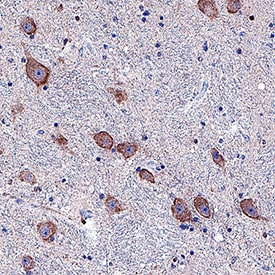
Dopamine D2 R/DRD2 was detected in immersion fixed paraffin-embedded sections of human brain (striatum) using Mouse Anti-Human Dopamine D2 R/DRD2 Monoclonal Antibody (Catalog # MAB9266) at 5 µg/mL for 1 hour at room temperature followed by incubation with the Anti-Mouse IgG VisUCyte™ HRP Polymer Antibody (Catalog # VC001). Tissue was stained using DAB (brown) and counterstained with hematoxylin (blue). Specific staining was localized to neuronal cell membranes and cytoplasm. View our protocol for Chromogenic IHC Staining of Paraffin-embedded Tissue Sections.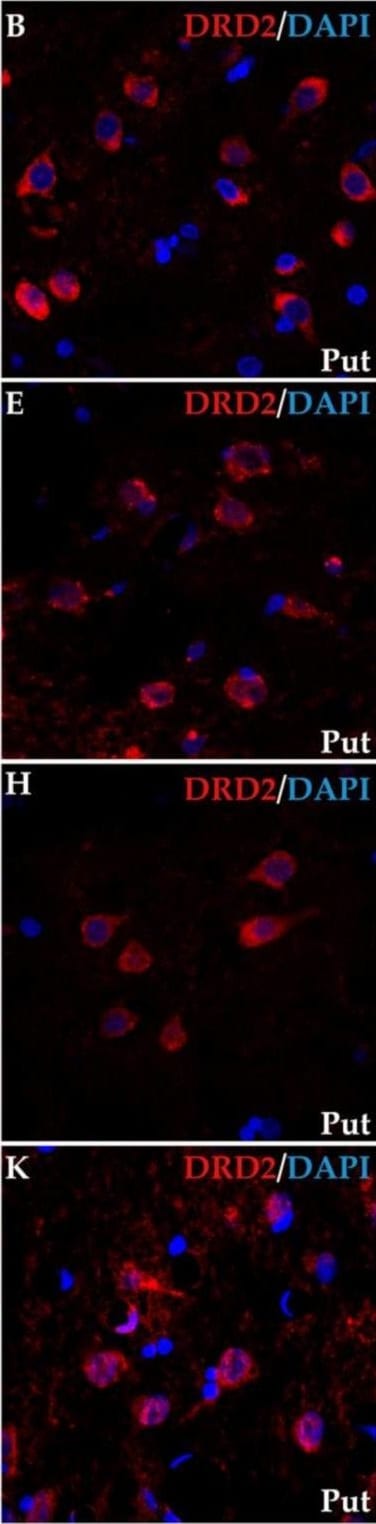
Detection of Human Dopamine D2R/DRD2 by Immunocytochemistry/ Immunofluorescence
Expression of MCT8 and OATP1C1 in D2-MSN (indirect pathway medium-sized spiny neurons) in human and macaque striatum. Representative confocal microscope compositions from double-stained sections for MCT8 (green) or OATP1C1 (green) and for the D2-MSN marker DRD2 (red) in the putamen. Merged images (right side) show the colocalization of the two signals. Coexpression of MCT8 and DRD2 is observed in human (A–C) and macaque (D–F) striatum. Coexpression of OATP1C1 and DRD2 is observed in human (G–I) and macaque (J–L) striatum. Counterstaining with DAPI (blue) shows nuclei of all cells. Note that in humans, the MCT8 signals are located mainly at the cell membrane, while in macaques, they are also located in the cytoplasm. D2-MSN: D2 receptor-expressing medium-sized spiny neurons; DRD2: Dopamine receptor type 2; Put: putamen. Scale bar = 50 μm. Image collected and cropped by CiteAb from the following open publication (https://pubmed.ncbi.nlm.nih.gov/37298594), licensed under a CC-BY license. Not internally tested by R&D Systems.Applications for Human Dopamine D2 R/DRD2 Antibody (960710)
Application
Recommended Usage
Immunohistochemistry
5-25 µg/mL
Sample: Immersion fixed paraffin-embedded sections of human brain (striatum)
Sample: Immersion fixed paraffin-embedded sections of human brain (striatum)
Formulation, Preparation, and Storage
Purification
Protein A or G purified from hybridoma culture supernatant
Reconstitution
Reconstitute at 0.5 mg/mL in sterile PBS. For liquid material, refer to CoA for concentration.
Loading...
Formulation
Lyophilized from a 0.2 μm filtered solution in PBS with Trehalose. *Small pack size (SP) is supplied either lyophilized or as a 0.2 µm filtered solution in PBS.
Shipping
Lyophilized product is shipped at ambient temperature. Liquid small pack size (-SP) is shipped with polar packs. Upon receipt, store immediately at the temperature recommended below.
Stability & Storage
Use a manual defrost freezer and avoid repeated freeze-thaw cycles.
- 12 months from date of receipt, -20 to -70 °C as supplied.
- 1 month, 2 to 8 °C under sterile conditions after reconstitution.
- 6 months, -20 to -70 °C under sterile conditions after reconstitution.
Calculators
Background: Dopamine D2 R/DRD2
Long Name
Dopamine D2 Receptor
Alternate Names
D2DR, D2R, Dopamine D2R, DRD2
Gene Symbol
DRD2
UniProt
Additional Dopamine D2 R/DRD2 Products
Product Documents for Human Dopamine D2 R/DRD2 Antibody (960710)
Certificate of Analysis
To download a Certificate of Analysis, please enter a lot or batch number in the search box below.
Note: Certificate of Analysis not available for kit components.
Product Specific Notices for Human Dopamine D2 R/DRD2 Antibody (960710)
For research use only
Related Research Areas
Citations for Human Dopamine D2 R/DRD2 Antibody (960710)
 Powered by Bioz
Customer Reviews for Human Dopamine D2 R/DRD2 Antibody (960710)
There are currently no reviews for this product. Be the first to review Human Dopamine D2 R/DRD2 Antibody (960710) and earn rewards!
Have you used Human Dopamine D2 R/DRD2 Antibody (960710)?
Submit a review and receive an Amazon gift card!
$25/€18/£15/$25CAN/¥2500 for a review with an image
$10/€7/£6/$10CAN/¥1110 for a review without an image
Submit a review
Protocols
Find general support by application which include: protocols, troubleshooting, illustrated assays, videos and webinars.
- Antigen Retrieval Protocol (PIER)
- Antigen Retrieval for Frozen Sections Protocol
- Appropriate Fixation of IHC/ICC Samples
- Cellular Response to Hypoxia Protocols
- Chromogenic IHC Staining of Formalin-Fixed Paraffin-Embedded (FFPE) Tissue Protocol
- Chromogenic Immunohistochemistry Staining of Frozen Tissue
- ClariTSA™ Fluorophore Kits
- Detection & Visualization of Antibody Binding
- Fluorescent IHC Staining of Frozen Tissue Protocol
- Graphic Protocol for Heat-induced Epitope Retrieval
- Graphic Protocol for the Preparation and Fluorescent IHC Staining of Frozen Tissue Sections
- Graphic Protocol for the Preparation and Fluorescent IHC Staining of Paraffin-embedded Tissue Sections
- Graphic Protocol for the Preparation of Gelatin-coated Slides for Histological Tissue Sections
- IHC Sample Preparation (Frozen sections vs Paraffin)
- Immunofluorescent IHC Staining of Formalin-Fixed Paraffin-Embedded (FFPE) Tissue Protocol
- Immunohistochemistry (IHC) and Immunocytochemistry (ICC) Protocols
- Immunohistochemistry Frozen Troubleshooting
- Immunohistochemistry Paraffin Troubleshooting
- Preparing Samples for IHC/ICC Experiments
- Preventing Non-Specific Staining (Non-Specific Binding)
- Primary Antibody Selection & Optimization
- Protocol for Heat-Induced Epitope Retrieval (HIER)
- Protocol for Making a 4% Formaldehyde Solution in PBS
- Protocol for VisUCyte™ HRP Polymer Detection Reagent
- Protocol for the Preparation & Fixation of Cells on Coverslips
- Protocol for the Preparation and Chromogenic IHC Staining of Frozen Tissue Sections
- Protocol for the Preparation and Chromogenic IHC Staining of Frozen Tissue Sections - Graphic
- Protocol for the Preparation and Chromogenic IHC Staining of Paraffin-embedded Tissue Sections
- Protocol for the Preparation and Chromogenic IHC Staining of Paraffin-embedded Tissue Sections - Graphic
- Protocol for the Preparation and Fluorescent IHC Staining of Frozen Tissue Sections
- Protocol for the Preparation and Fluorescent IHC Staining of Paraffin-embedded Tissue Sections
- Protocol for the Preparation of Gelatin-coated Slides for Histological Tissue Sections
- TUNEL and Active Caspase-3 Detection by IHC/ICC Protocol
- The Importance of IHC/ICC Controls
- Troubleshooting Guide: Immunohistochemistry
- View all Protocols, Troubleshooting, Illustrated assays and Webinars
Loading...