

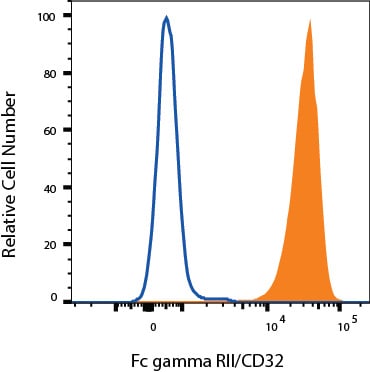

Receptors for the Fc region of IgG (Fc gamma R) are members of the Ig superfamily that function in the activation or inhibition of immune responses. Three classes of human Fc gamma Rs: RI (CD64), RII (CD32), and RIII (CD16), which generate multiple isoforms, are recognized (1 - 3). The activating-type receptor either has or associates non-covalently with an accessory subunit (FcR gamma or zeta chain) that has an immunoreceptor tyrosine-based activation motif (ITAM) in its cytoplasmic domain. In contrast, the inhibitory receptor (Fc gamma RIIB) has a built-in immunoreceptor tyrosine-based inhibitory motif (ITIM) in its own cytoplasmic domain. Fc gamma RI is a
high-affinity receptor that binds monomeric IgG, both Fc gamma RII and RIII are low-affinity receptors that bind aggregated or immune complexed IgG (IC).
Three genes for human Fc gamma RII (A, B, and C) and one for mouse (Fc gamma RIIB), encoding type I transmembrane proteins with ITAM motifs (Fc gamma RII A and C) or ITIM motifs (Fc gamma RIIB) in their cytoplasmic domains, have been identified (1 - 3). The extracellular domain of human Fc gamma RIIA shares approximately 90% amino acid sequence homology with human Fc gamma RIIB and Fc gamma RIIC. Fc gamma RIIA is expressed on many immune cell types (macrophage, neutrophil, eosinophils, platelets, dendritic cells and Langerhan cells) where inhibitory ITIM-bearing receptors may also be coexpressed and co-engaged by specific ligands. Signaling through Fc gamma RIIA results in the initiation of inflammatory responses (cytolysis, phagocytosis, degranulation and cytokine production) that can be modulated by signals from the inhibitory receptors. The strength of the signal is dependent on the ratio of expression of the activating and inhibitory receptors. Besides IC, Fc gamma RII A also binds C-reactive protein (CRP) (4, 5). Two allelic variants (R167 and H167) of Fc gamma RIIA that differ in their ability to ligate human IgG2 or CRP exist. The H167 allele has been found to have a protective effect against lupus nephritis.
 Powered by Bioz
