
KGF (keratinocyte growth factor), also known as FGF-7 (fibroblast growth factor-7), is one of 22 known members of the mouse FGF family of secreted proteins that plays a key role in development, morphogenesis, angiogenesis, wound healing, and tumorigenesis (1‑4). KGF expression is restricted to cells of mesenchymal origin. When secreted, it acts as a paracrine growth factor for nearby epithelial cells (1). KGF speeds wound healing by being dramatically upregulated in response to damage to skin or internal structures that results in high local concentrations of inflammatory mediators such as IL-1 and TNF-alpha. (2, 5). KGF promotes cell migration and invasion, and mediates melanocyte transfer to keratinocytes upon UVB radiation (6, 7). It has been used ectopically to avoid chemotherapy-induced oral mucositis in patients with hematological malignancies (1). Deletion of KGF affects kidney development, producing abnormally small ureteric buds and fewer nephrons (8). It also impedes hair follicle differentiation (9). The 194 amino acid (aa) KGF precursor contains a 31 aa signal sequence and, like all other FGFs, an ~120 aa beta -trefoil scaffold that includes receptor- and heparin-binding sites. KGF signals only through the IIIb splice form of the tyrosine kinase receptor, FGF R2 (FGF R2-IIIb/KGF R) (10). Receptor dimerization requires an octameric or larger heparin or heparin sulfate proteoglycan (11). FGF-10, also called KGF2, shares 51% aa identity and similar function to KGF, but shows more limited expression than KGF and uses an additional receptor, FGF R2-IIIc (12). Following receptor engagement, KGF is typically degraded, while FGF-10 is recycled (12). Mature human KGF, which is active across species, shares 98% aa sequence identity with bovine, equine, ovine, and canine, 96% with mouse and porcine, and 92% with rat KGF, respectively.
Human KGF/FGF-7 Antibody (29522)
R&D Systems | Catalog # MAB251

Scientific images may be resized, cropped, or adjusted for brightness or contrast for presentation purposes. These updates are limited to presentation and do not affect the underlying scientific interpretation of the data. Where available, additional source data may be provided upon request.
Key Product Details
Species Reactivity
Validated:
Cited:
Applications
Validated:
Cited:
Label
Antibody Source
Product Specifications
Immunogen
Cys32-Thr194
Accession # P21781
Specificity
Clonality
Host
Isotype
Endotoxin Level
Scientific Data Images for Human KGF/FGF-7 Antibody (29522)
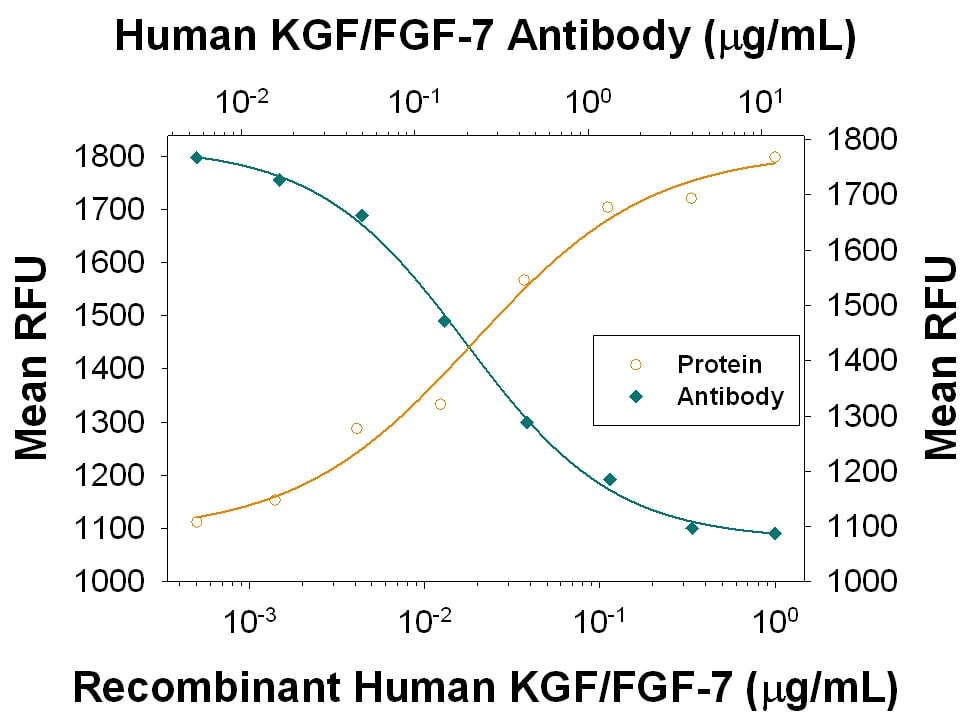
Cell Proliferation Induced by KGF/FGF‑7 and Neutralization by Human KGF/FGF‑7 Antibody.
Recombinant Human KGF/FGF-7 (Catalog # 251-KG) stimulates proliferation in the 4MBr-5 rhesus monkey epithelial cell line in a dose-dependent manner (orange line), as measured by Resazurin (Catalog # AR002). Proliferation elicited by Recombinant Human KGF/FGF-7 (100 ng/mL) is neutralized (green line) by increasing concentrations of Mouse Anti-Human KGF/FGF-7 Monoclonal Antibody (Catalog # MAB251). The ND50 is typically 0.1-0.5 µg/mL.
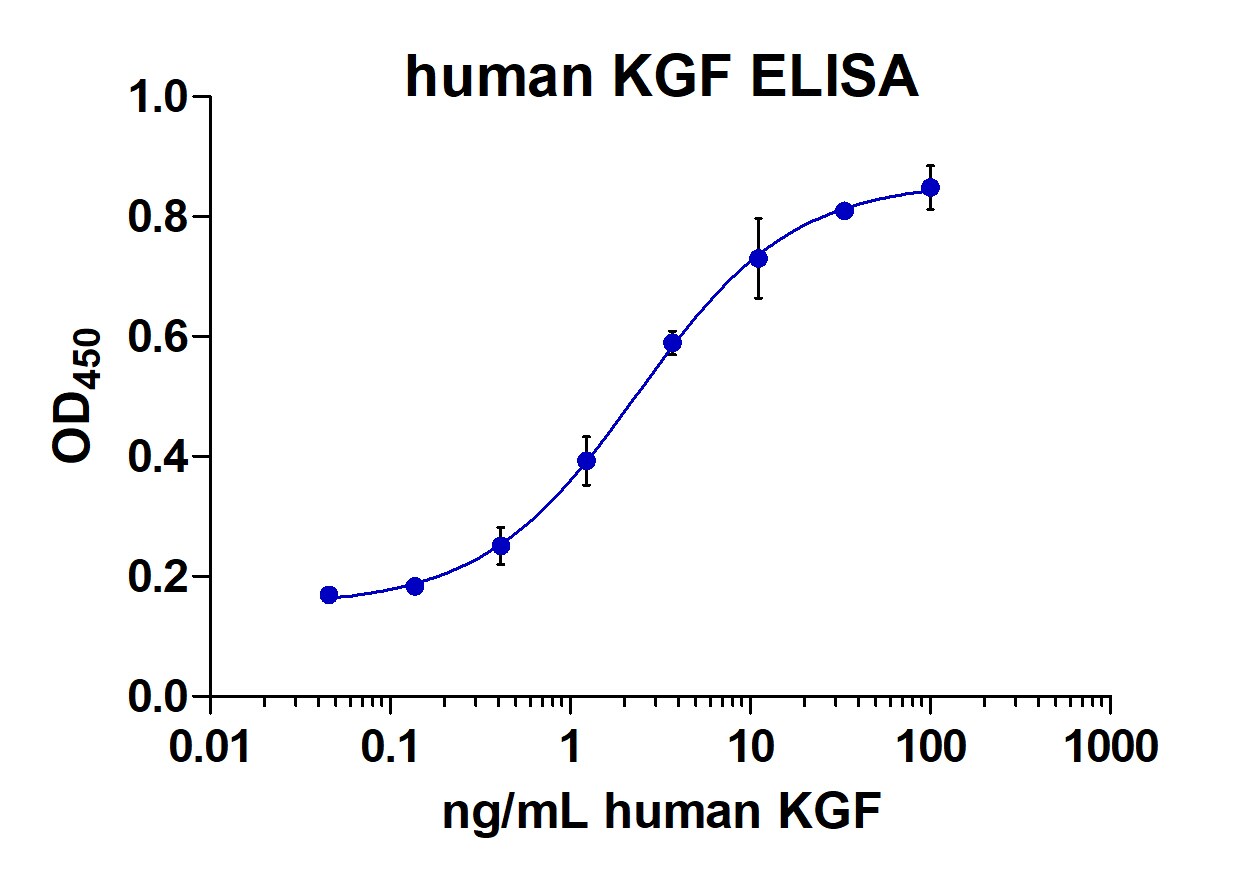
Human KGF / FGF-7 ELISA Standard Curve
Recombinant Human KGF/FGF‑7 (Catalog # 251-KG) was serially diluted and captured by Mouse Anti-Human KGF/FGF‑7 Monoclonal Antibody (Catalog # MAB251) coated on a Clear Polystyrene Microplate (Catalog # DY990). Goat Anti-Human KGF/FGF‑7 Antigen Affinity-purified Polyclonal Antibody (Catalog # AF-251-NA) was biotinylated and incubated with the protein captured on the plate. Detection of the standard curve was achieved by incubating Streptavidin-HRP (Catalog # DY998)Applications for Human KGF/FGF-7 Antibody (29522)
Neutralization
Human KGF/FGF-7 Sandwich Immunoassay
Reviewed Applications
Read 1 review rated 4 using MAB251 in the following applications:
Formulation, Preparation, and Storage
Purification
Reconstitution
Reconstitute at 0.5 mg/mL in sterile PBS. For liquid material, refer to CoA for concentration.
Formulation
Shipping
Stability & Storage
- 12 months from date of receipt, -20 to -70 °C as supplied.
- 1 month, 2 to 8 °C under sterile conditions after reconstitution.
- 6 months, -20 to -70 °C under sterile conditions after reconstitution.
Calculators
Background: KGF/FGF-7
References
- Finch, P.W. and J.S. Rubin (2006) J. Natl. Cancer Inst. 98:812.
- Werner, S. et al. (2007) J. Invest. Dermatol. 127:998.
- Werner, S. (1998) Cytokine Growth Factor Rev. 9:153.
- Mason, I.J. et al. (1994) Mech. Dev. 45:15.
- Geer, D.J. et al. (2005) Am. J. Pathol. 167:1575.
- Niu, J. et al. (2007) J. Biol. Chem. 282:6001.
- Cardinali, G. et al. (2005) J. Invest. Dermatol. 125:1190.
- Qiao, J. et al. (1999) Development 126:547.
- Guo, L. et al. (1996) Genes Dev. 10:165.
- de Georgi, V. et al. (2007) Dermatol. Clin. 25:477.
- Hsu, Y-R. et al. (1999) Biochemistry 38:2523.
- Belleudi, F. et al. (2007) Traffic 8:1854.
Long Name
Alternate Names
Gene Symbol
UniProt
Additional KGF/FGF-7 Products
Product Documents for Human KGF/FGF-7 Antibody (29522)
Certificate of Analysis
To download a Certificate of Analysis, please enter a lot or batch number in the search box below.
Note: Certificate of Analysis not available for kit components.
Product Specific Notices for Human KGF/FGF-7 Antibody (29522)
For research use only
Related Research Areas
Citations for Human KGF/FGF-7 Antibody (29522)
 Powered by Bioz
Customer Reviews for Human KGF/FGF-7 Antibody (29522) (1)
Have you used Human KGF/FGF-7 Antibody (29522)?
Submit a review and receive an Amazon gift card!
$25/€18/£15/$25CAN/¥2500 for a review with an image
$10/€7/£6/$10CAN/¥1110 for a review without an image
Submit a review
Customer Images
-
Application: ELISASample Tested: Recombinant proteinSpecies: HumanVerified Customer | Posted 12/06/2017

There are no reviews that match your criteria.
Associated Pathways
