
phospho-JNK (T183/Y185) Antibody
R&D Systems | Catalog # AF1205


Scientific images may be resized, cropped, or adjusted for brightness or contrast for presentation purposes. These updates are limited to presentation and do not affect the underlying scientific interpretation of the data. Where available, additional source data may be provided upon request.
Key Product Details
Validated by
Species Reactivity
Validated:
Cited:
Applications
Validated:
Cited:
Label
Antibody Source
Product Specifications
Immunogen
Specificity
Clonality
Host
Isotype
Scientific Data Images for phospho-JNK (T183/Y185) Antibody
Detection of Human and Mouse Phospho-JNK (T183/Y185) by Western Blot.
Western blot shows lysates of HEK293 human embryonic kidney cell line and NIH-3T3 mouse embryonic fibroblast cell line untreated (-) or treated (+) with 100 J/m2UV-C for 30 minutes. PVDF membrane was probed with 0.5 µg/mL of Rabbit Anti-Human/Mouse/Rat Phospho-JNK (T183/Y185) Antigen Affinity-purified Polyclonal Antibody (Catalog # AF1205), followed by HRP-conjugated Anti-Rabbit IgG Secondary Antibody (Catalog # HAF008). Specific bands were detected for Phospho-JNK (T183/Y185) at approximately 46 and 54 kDa (as indicated). This experiment was conducted under reducing conditions and using Immunoblot Buffer Group 6.
JNK in Human Breast Cancer Tissue.
JNK phosphorylated at T183/Y185 was detected in immersion fixed paraffin-embedded sections of human breast cancer tissue using Rabbit Anti-Human/Mouse/Rat Phospho-JNK (T183/Y185) Antigen Affinity-purified Polyclonal Antibody (Catalog # AF1205) at 15 µg/mL overnight at 4 °C. Tissue was stained using the Anti-Rabbit HRP-DAB Cell & Tissue Staining Kit (brown; Catalog # CTS005) and counterstained with hematoxylin (blue). View our protocol for Chromogenic IHC Staining of immersion fixed paraffin-embedded Tissue Sections.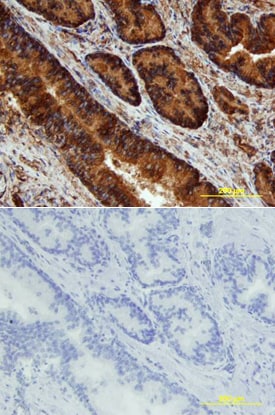
JNK in Human Prostate.
JNK phosphorylated at T183/Y185 was detected in immersion fixed paraffin-embedded sections of human prostate array using Rabbit Anti-Human/Mouse/Rat Phospho-JNK (T183/Y185) Antigen Affinity-purified Polyclonal Antibody (Catalog # AF1205) at 15 µg/mL overnight at 4 °C. Tissue was stained using the Anti-Rabbit HRP-DAB Cell & Tissue Staining Kit (brown; Catalog # CTS005) and counterstained with hematoxylin (blue). Lower panel shows a lack of labeling if primary antibodies are omitted and tissue is stained only with secondary antibody followed by incubation with detection reagents. View our protocol for Chromogenic IHC Staining of Paraffin-embedded Tissue Sections.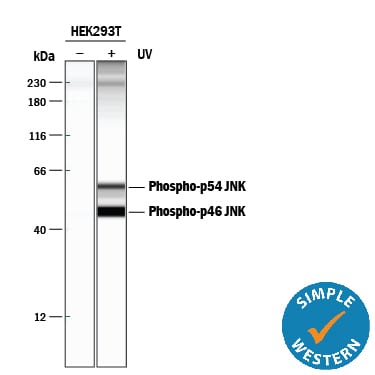
Detection of Human Phospho-JNK (T183/Y185) by Simple WesternTM.
Simple Western lane view shows lysates of HEK293T human embryonic kidney cell line untreated (-) or treated (+) with 100 J/m2ultraviolet light (UV) for 30 minutes, loaded at 0.2 mg/mL. Specific bands were detected for Phospho-JNK (T183/Y185) at approximately 56 and 46 kDa (as indicated) using 5 µg/mL of Rabbit Anti-Human/Mouse/Rat Phospho-JNK (T183/Y185) Antigen Affinity-purified Polyclonal Antibody (Catalog # AF1205). This experiment was conducted under reducing conditions and using the 12-230 kDa separation system.*Non-specific interaction with the 230 kDa Simple Western standard may be seen with this antibody.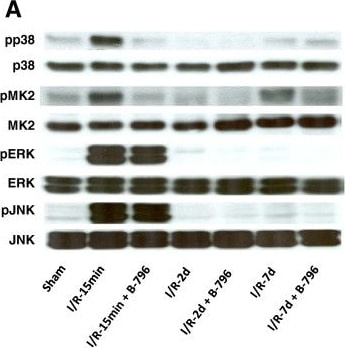
Detection of Mouse JNK1/2/3 by Western Blot
Effect of p38MAPK (p38) inhibition on intracellular signaling following IR. Rats were pretreated with the carrier DMSO or BIRB796 (B-796) (5 mg/kg BW) for 1 hour and subjected to 1 hour of renal ischemia followed by different time points of reperfusion (15 min, 2 days, 7 days). Kidneys were harvested at given time points of reperfusion and total tissue lysates were used to determine activation pattern of MAPKs (p38MAPK, JNK, ERK) and the downstream target of p38MAPK (MK2) by phosphorylation specific antibodies. A representative immunoblot (A) and summary graphs (B, C) are shown. Results are given as mean ± SEM (n = 3). ** p < 0.01, ***p < 0.001 vs. sham-operated group; §p < 0.01, #p < 0.001 vs. IR-15 min group. Image collected and cropped by CiteAb from the following open publication (https://pubmed.ncbi.nlm.nih.gov/24423080), licensed under a CC-BY license. Not internally tested by R&D Systems.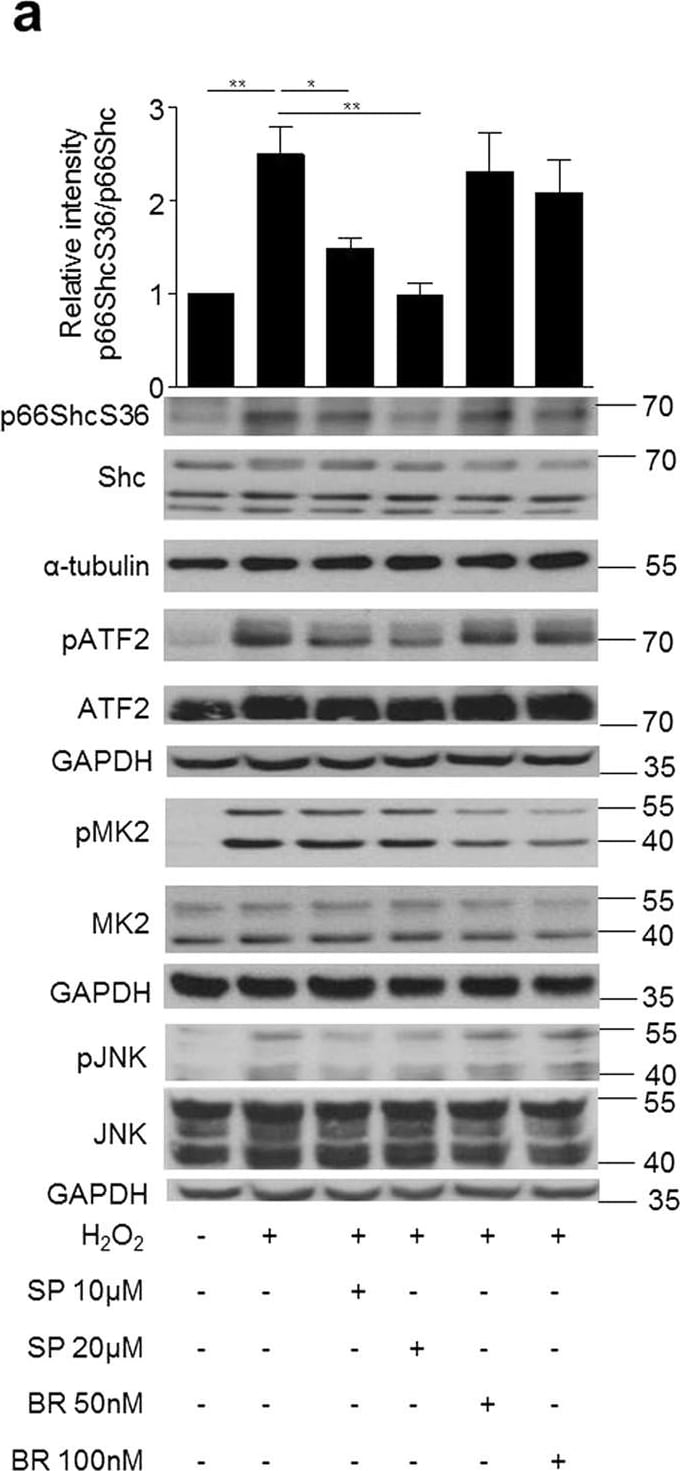
Detection of Mouse JNK1/2/3 by Western Blot
Inhibition of JNK kinases prevents p66ShcS36 phosphorylation under oxidative stress.MEFs were treated with H2O2 (a) (1 mM, 30 min) or exposed to HR (hypoxia 90 min, reoxygenation 15 min) (b). Cell lysates were probed with the antibodies indicated to assess p66Shc phosphorylation at S36. Representative Western blots (individual experiment performed under the same experimental conditions and run on the same gel) and summary graphs from at least three independent experiments are shown. Signal intensity of control samples was arbitrarily set at 1. Mitochondrial ROS production was measured in p66Shc+/+ and p66Shc−/− MEFs after prooxidant treatment as described in Material and Methods (n ≥ 4) (c) and phospho gamma H2AX was detected by immunoblotting (d, lower panel) and summary graph is shown in above panel. SP: SP600125, JNK inhibitor, and BR: BR796, p38 inhibitor were applied 1 h prior to stress application. Original blot shown in (b) have been cropped and the full length blots are shown in the Supplementary Figure S1b Statistical analysis was performed using t-test or ANOVA (*p < 0.05 **p < 0.01, ***p < 0.001). Image collected and cropped by CiteAb from the following open publication (https://pubmed.ncbi.nlm.nih.gov/26868434), licensed under a CC-BY license. Not internally tested by R&D Systems.
Detection of Mouse JNK1/2/3 by Western Blot
The impact of high glucose conditions on various down-stream signaling pathways.The status of various signaling pathways in retinal AC under various glucose conditions was determined as described in Methods. Levels of active Src (A), Akt (B), ERK (C), p38 (D), JNK1 (E), Fyn (F) and p65 (G) in retinal AC under different glucose conditions were determined by Western blot analysis from equal amounts of cell lysates. The total level for each protein is shown in the lower part of each panel. The quantitative assessment of the data for each blot is shown below the blot. Data are presented as mean ± SEM. n = 3; *p<0.05 (NG vs. HG and NG vs. NG+L-Glu). Levels of active Fyn (F) in retinal AC under different glucose conditions was determined by Western blot analysis of immunoprecipitates from equal amounts of retinal AC lysates. Image collected and cropped by CiteAb from the following open publication (https://dx.plos.org/10.1371/journal.pone.0103148), licensed under a CC-BY license. Not internally tested by R&D Systems.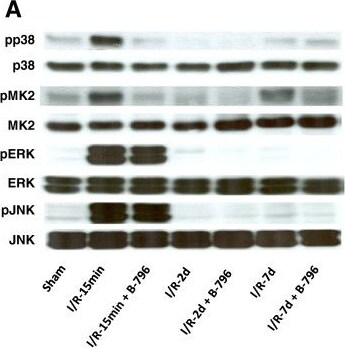
Detection of Mouse JNK1/2/3 by Western Blot
Effect of p38MAPK (p38) inhibition on intracellular signaling following IR. Rats were pretreated with the carrier DMSO or BIRB796 (B-796) (5 mg/kg BW) for 1 hour and subjected to 1 hour of renal ischemia followed by different time points of reperfusion (15 min, 2 days, 7 days). Kidneys were harvested at given time points of reperfusion and total tissue lysates were used to determine activation pattern of MAPKs (p38MAPK, JNK, ERK) and the downstream target of p38MAPK (MK2) by phosphorylation specific antibodies. A representative immunoblot (A) and summary graphs (B, C) are shown. Results are given as mean ± SEM (n = 3). ** p < 0.01, ***p < 0.001 vs. sham-operated group; §p < 0.01, #p < 0.001 vs. IR-15 min group. Image collected and cropped by CiteAb from the following open publication (https://pubmed.ncbi.nlm.nih.gov/24423080), licensed under a CC-BY license. Not internally tested by R&D Systems.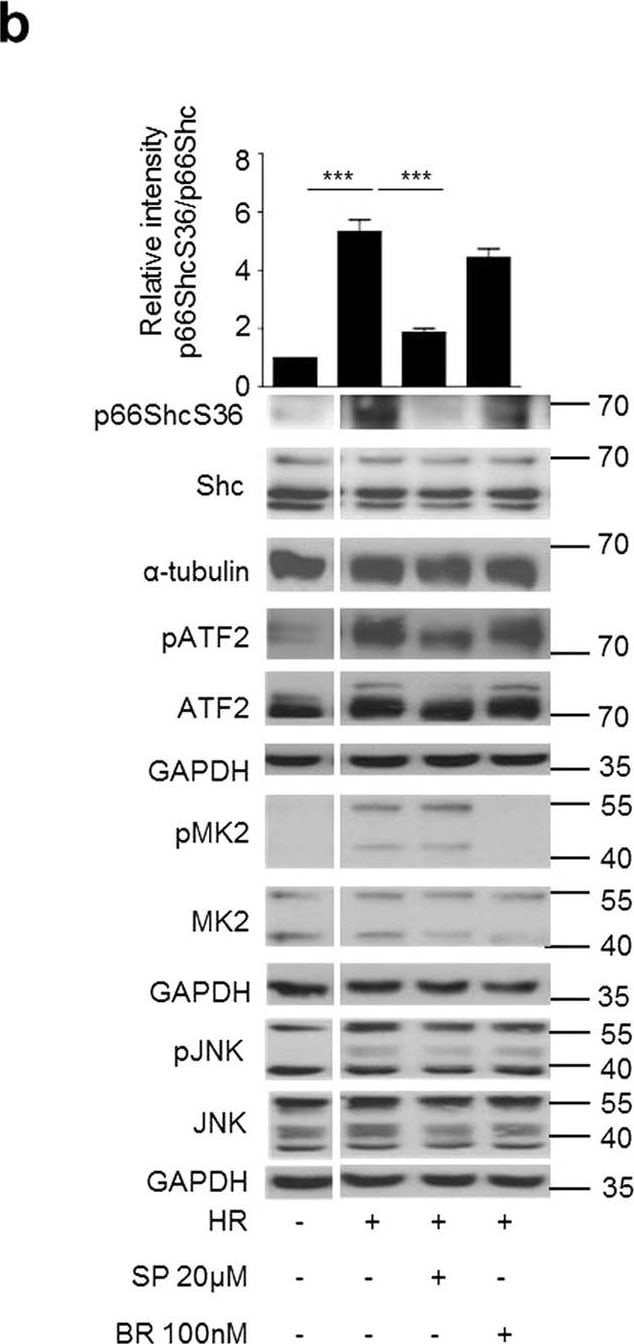
Detection of Mouse JNK1/2/3 by Western Blot
Inhibition of JNK kinases prevents p66ShcS36 phosphorylation under oxidative stress.MEFs were treated with H2O2 (a) (1 mM, 30 min) or exposed to HR (hypoxia 90 min, reoxygenation 15 min) (b). Cell lysates were probed with the antibodies indicated to assess p66Shc phosphorylation at S36. Representative Western blots (individual experiment performed under the same experimental conditions and run on the same gel) and summary graphs from at least three independent experiments are shown. Signal intensity of control samples was arbitrarily set at 1. Mitochondrial ROS production was measured in p66Shc+/+ and p66Shc−/− MEFs after prooxidant treatment as described in Material and Methods (n ≥ 4) (c) and phospho gamma H2AX was detected by immunoblotting (d, lower panel) and summary graph is shown in above panel. SP: SP600125, JNK inhibitor, and BR: BR796, p38 inhibitor were applied 1 h prior to stress application. Original blot shown in (b) have been cropped and the full length blots are shown in the Supplementary Figure S1b Statistical analysis was performed using t-test or ANOVA (*p < 0.05 **p < 0.01, ***p < 0.001). Image collected and cropped by CiteAb from the following open publication (https://pubmed.ncbi.nlm.nih.gov/26868434), licensed under a CC-BY license. Not internally tested by R&D Systems.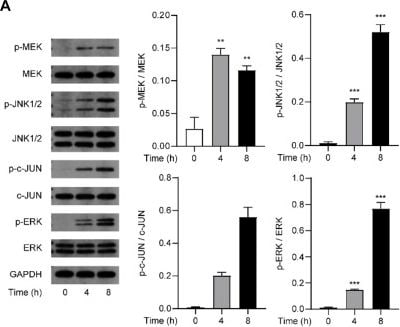
Detection of Phospho-JNK (T183/Y185) by Western Blot
Activation of ERK1/2 signaling was necessary for venlafaxine-induced apoptosis. (A) Representative western-blot bands and quantification of the MAPK signal molecules abundances in MV3 cells treated with venlafaxine (10 μM) for 0–8 h (B) MV3 cells were treated with vehicle, JNK1/2 inhibitor SP600125 and MERK/ERK inhibitor PD98059 for 72 h. Cell viability were measured by CCK-8 kits at 72 h (C) MV3 cells were transfected with siRNA control, JNK1/2 siRNA, and ERK siRNA for 72 h. Cell viability were measured by CCK-8 kits at 72 h (D,E) Representative western-blot bands and quantification of Nur77 abundances in MV3 cells treated with venlafaxine (10 μM) for 8 h, or transfected with siRNA control, JNK1/2 siRNA, and ERK siRNA for 20 h (F) MV3 cells were immunostained with Bcl-2 and Nur77 antibodies and visualized by confocal microscopy. N = 3, *, p <.05, **, <.01, ***, p <.001 vs. control. Image collected and cropped by CiteAb from the following open publication (https://pubmed.ncbi.nlm.nih.gov/36686679), licensed under a CC-BY license. Not internally tested by R&D Systems.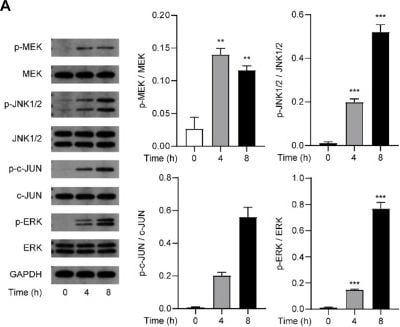
Detection of Phospho-JNK (T183/Y185) by Western Blot
Activation of ERK1/2 signaling was necessary for venlafaxine-induced apoptosis. (A) Representative western-blot bands and quantification of the MAPK signal molecules abundances in MV3 cells treated with venlafaxine (10 μM) for 0–8 h (B) MV3 cells were treated with vehicle, JNK1/2 inhibitor SP600125 and MERK/ERK inhibitor PD98059 for 72 h. Cell viability were measured by CCK-8 kits at 72 h (C) MV3 cells were transfected with siRNA control, JNK1/2 siRNA, and ERK siRNA for 72 h. Cell viability were measured by CCK-8 kits at 72 h (D,E) Representative western-blot bands and quantification of Nur77 abundances in MV3 cells treated with venlafaxine (10 μM) for 8 h, or transfected with siRNA control, JNK1/2 siRNA, and ERK siRNA for 20 h (F) MV3 cells were immunostained with Bcl-2 and Nur77 antibodies and visualized by confocal microscopy. N = 3, *, p <.05, **, <.01, ***, p <.001 vs. control. Image collected and cropped by CiteAb from the following open publication (https://pubmed.ncbi.nlm.nih.gov/36686679), licensed under a CC-BY license. Not internally tested by R&D Systems.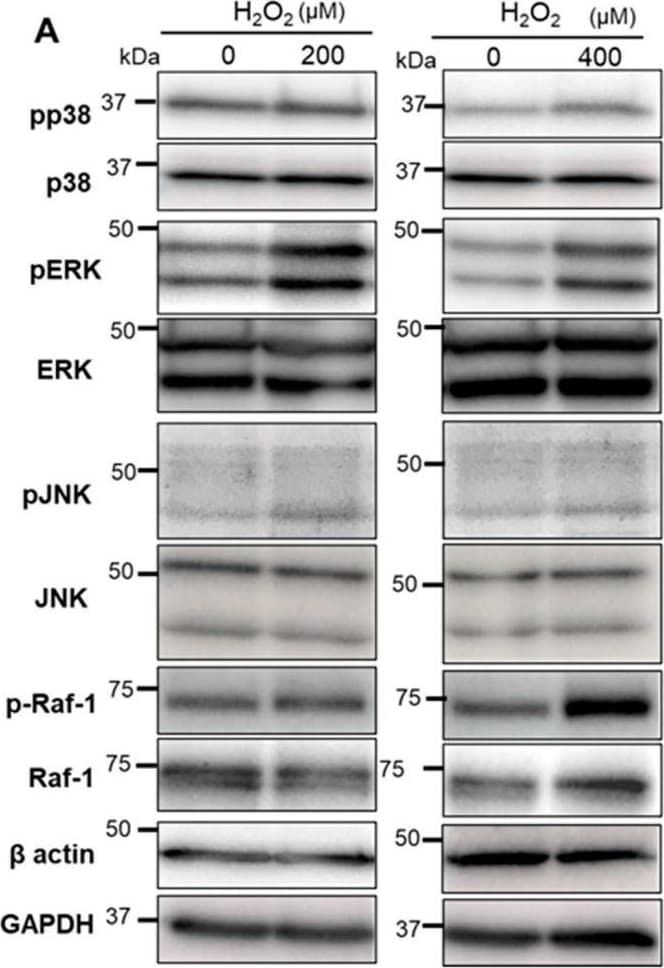
Detection of Rat Phospho-JNK (T183/Y185) by Western Blot
Evaluation of the phosphorylation of MAPK family members and Raf-1 in Bag-1-overexpressing NP cells. Western blot analysis (A) and quantification (B,C) of the phosphorylated forms of p38, ERK, JNK, and Raf-1 in NP cells treated with or without H2O2 for 30 min. Data are the means ± SD n = 3, * p < 0.05. (D) Comparison of the expression of pERK in NP cells (NP) and Bag-1-overexpressing NP cells (Bag) without H2O2 treatment. Data are the means ± SD n = 3, * p < 0.05. Image collected and cropped by CiteAb from the following open publication (https://www.mdpi.com/2227-9059/11/3/863), licensed under a CC-BY license. Not internally tested by R&D Systems.Applications for phospho-JNK (T183/Y185) Antibody
Immunohistochemistry
Sample: Immersion fixed paraffin-embedded sections of human prostate cancer tissue and human breast cancer tissue
Simple Western
Sample: HEK293T human embryonic kidney cell line treated with ultraviolet light (UV)
Western Blot
Sample: UV-C-treated HEK293 human embryonic kidney cell line and NIH‑3T3 mouse embryonic fibroblast cell line
Reviewed Applications
Read 4 reviews rated 3.5 using AF1205 in the following applications:
Formulation, Preparation, and Storage
Purification
Reconstitution
Reconstitute at 0.2 mg/mL in sterile PBS. For liquid material, refer to CoA for concentration.
Formulation
Shipping
Stability & Storage
- 12 months from date of receipt, -20 to -70 °C as supplied.
- 1 month, 2 to 8 °C under sterile conditions after reconstitution.
- 6 months, -20 to -70 °C under sterile conditions after reconstitution.
Calculators
Background: JNK
Long Name
Alternate Names
Additional JNK Products
Product Documents for phospho-JNK (T183/Y185) Antibody
Certificate of Analysis
To download a Certificate of Analysis, please enter a lot or batch number in the search box below.
Note: Certificate of Analysis not available for kit components.
Product Specific Notices for phospho-JNK (T183/Y185) Antibody
For research use only
Citations for phospho-JNK (T183/Y185) Antibody
 Powered by Bioz
Customer Reviews for phospho-JNK (T183/Y185) Antibody (4)
Have you used phospho-JNK (T183/Y185) Antibody?
Submit a review and receive an Amazon gift card!
$25/€18/£15/$25CAN/¥2500 for a review with an image
$10/€7/£6/$10CAN/¥1110 for a review without an image
Submit a review
Customer Images
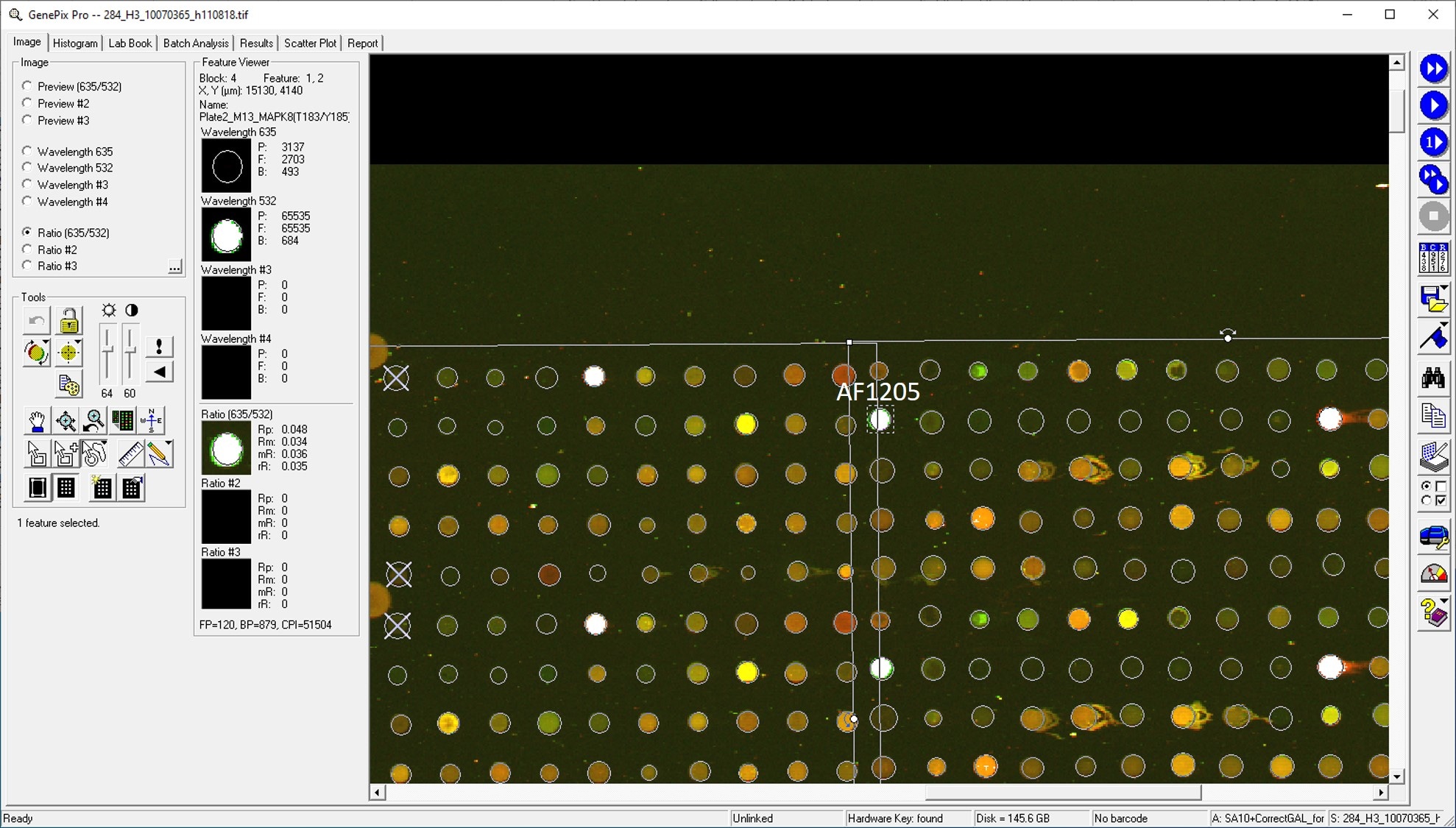
-
Application: MicroarraysSample Tested: EDTA PlasmaSpecies: HumanVerified Customer | Posted 01/14/2021

-
Application: MicroarraysSample Tested: EDTA PlasmaSpecies: HumanVerified Customer | Posted 11/14/2018
-
Application: MicroarraySample Tested: EDTA PlasmaSpecies: HumanVerified Customer | Posted 10/31/2018
-
Application: Western BlotSample Tested: MEF whole cell lysate, PC3 Whole Cell Lysate (Human prostate cancer cell) and HDFa whole cell lysateSpecies: Human and MouseVerified Customer | Posted 05/04/2017We obtained bands at predicted molecular weight for both human (PC3, HDFa) as well as mouse (MEF) samples. However, at recommended concentrations the signal was quite weak using ECL substrate. Perhaps they work better using substrates with higher sensitivity.
There are no reviews that match your criteria.
Protocols
Find general support by application which include: protocols, troubleshooting, illustrated assays, videos and webinars.
- Antigen Retrieval Protocol (PIER)
- Antigen Retrieval for Frozen Sections Protocol
- Appropriate Fixation of IHC/ICC Samples
- Cellular Response to Hypoxia Protocols
- Chromogenic IHC Staining of Formalin-Fixed Paraffin-Embedded (FFPE) Tissue Protocol
- Chromogenic Immunohistochemistry Staining of Frozen Tissue
- ClariTSA™ Fluorophore Kits
- Detection & Visualization of Antibody Binding
- Fluorescent IHC Staining of Frozen Tissue Protocol
- Graphic Protocol for Heat-induced Epitope Retrieval
- Graphic Protocol for the Preparation and Fluorescent IHC Staining of Frozen Tissue Sections
- Graphic Protocol for the Preparation and Fluorescent IHC Staining of Paraffin-embedded Tissue Sections
- Graphic Protocol for the Preparation of Gelatin-coated Slides for Histological Tissue Sections
- IHC Sample Preparation (Frozen sections vs Paraffin)
- Immunofluorescent IHC Staining of Formalin-Fixed Paraffin-Embedded (FFPE) Tissue Protocol
- Immunohistochemistry (IHC) and Immunocytochemistry (ICC) Protocols
- Immunohistochemistry Frozen Troubleshooting
- Immunohistochemistry Paraffin Troubleshooting
- Preparing Samples for IHC/ICC Experiments
- Preventing Non-Specific Staining (Non-Specific Binding)
- Primary Antibody Selection & Optimization
- Protocol for Heat-Induced Epitope Retrieval (HIER)
- Protocol for Making a 4% Formaldehyde Solution in PBS
- Protocol for VisUCyte™ HRP Polymer Detection Reagent
- Protocol for the Preparation & Fixation of Cells on Coverslips
- Protocol for the Preparation and Chromogenic IHC Staining of Frozen Tissue Sections
- Protocol for the Preparation and Chromogenic IHC Staining of Frozen Tissue Sections - Graphic
- Protocol for the Preparation and Chromogenic IHC Staining of Paraffin-embedded Tissue Sections
- Protocol for the Preparation and Chromogenic IHC Staining of Paraffin-embedded Tissue Sections - Graphic
- Protocol for the Preparation and Fluorescent IHC Staining of Frozen Tissue Sections
- Protocol for the Preparation and Fluorescent IHC Staining of Paraffin-embedded Tissue Sections
- Protocol for the Preparation of Gelatin-coated Slides for Histological Tissue Sections
- R&D Systems Quality Control Western Blot Protocol
- TUNEL and Active Caspase-3 Detection by IHC/ICC Protocol
- The Importance of IHC/ICC Controls
- Troubleshooting Guide: Immunohistochemistry
- Troubleshooting Guide: Western Blot Figures
- Western Blot Conditions
- Western Blot Protocol
- Western Blot Protocol for Cell Lysates
- Western Blot Troubleshooting
- Western Blot Troubleshooting Guide
- View all Protocols, Troubleshooting, Illustrated assays and Webinars