
The p53-inducible ribonucleotide reductase (p53R2) shares similarity with the R2 subunit of ribonucleotide reductase. Both function to provide dNTPs for DNA synthesis. p53R2 is induced in response to genotoxic stress, whereas the R2 functions under homeostatic conditions. When the expression of p53R2 is decreased, cells exhibit decreased ribonucleotide reductase activity, DNA repair activity, and cellular survival in response to genotoxins.


Scientific images may be resized, cropped, or adjusted for brightness or contrast for presentation purposes. These updates are limited to presentation and do not affect the underlying scientific interpretation of the data. Where available, additional source data may be provided upon request.
Key Product Details
Species Reactivity
Validated:
Human
Cited:
Human
Applications
Validated:
Western Blot
Cited:
Western Blot
Label
Unconjugated
Antibody Source
Polyclonal Goat IgG
Loading...
Product Specifications
Immunogen
E. coli-derived recombinant human p53R2
Met1-Lys180
Accession # Q7LG56
Met1-Lys180
Accession # Q7LG56
Specificity
Detects human p53R2 in Western blots.
Clonality
Polyclonal
Host
Goat
Isotype
IgG
Scientific Data Images for Human p53R2 Antibody
Detection of Human p53R2 by Western Blot.
Western blot shows lysates of HEK293 human embryonic kidney cell line and U2OS human osteosarcoma cell line. PVDF membrane was probed with 1 µg/mL of Human p53R2 Antigen Affinity-purified Polyclonal Antibody (Catalog # AF3788) followed by HRP-conjugated Anti-Goat IgG Secondary Antibody (Catalog # HAF017). A specific band was detected for p53R2 at approximately 45 kDa (as indicated). This experiment was conducted using Immunoblot Buffer Group 1.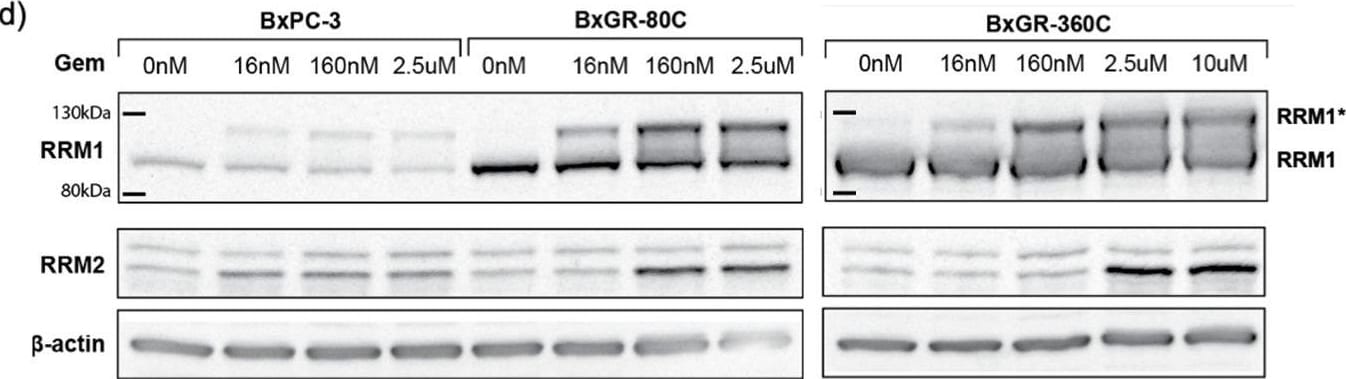
Detection of p53R2 by Western Blot
Gemcitabine resistance is driven by RRM1 overexpression. A) Quantification of relative RRM1 mRNA abundance following shRNA-mediated knock-down in BxPC3, BxGR-80C and BxGR-360C cells. Three independent RNA samples analyzed per cell type. b) Relative gemcitabine IC50 values following RRM1 knock-down, normalized to the control for each subclone. c) Correlation between relative RRM1 mRNA abundance and absolute gemcitabine (GEM) IC50 for all RRM1 knock-down cells and controls. d) Western blotting of dose-dependent induction of an RRM1 band with the apparent mass of 110–120 kDa (RRM1*) and RRM2 in gemcitabine treated cells. a-b) Statistical significance tested using one-way ANOVA with Tukey’s multiple comparison test. Error-bars indicate standard error of the mean. Image collected and cropped by CiteAb from the following open publication (https://pubmed.ncbi.nlm.nih.gov/35617275), licensed under a CC-BY license. Not internally tested by R&D Systems.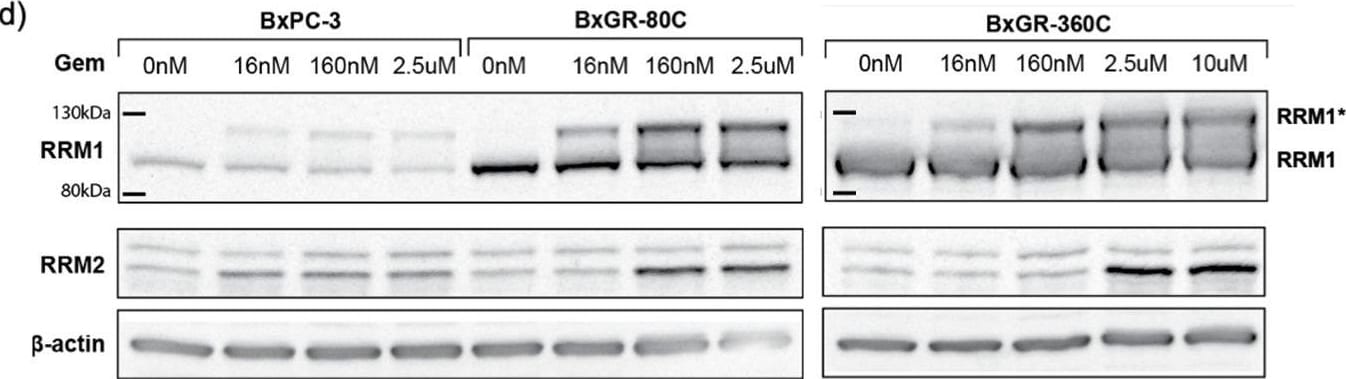
Detection of p53R2 by Western Blot
Gemcitabine resistance is driven by RRM1 overexpression. A) Quantification of relative RRM1 mRNA abundance following shRNA-mediated knock-down in BxPC3, BxGR-80C and BxGR-360C cells. Three independent RNA samples analyzed per cell type. b) Relative gemcitabine IC50 values following RRM1 knock-down, normalized to the control for each subclone. c) Correlation between relative RRM1 mRNA abundance and absolute gemcitabine (GEM) IC50 for all RRM1 knock-down cells and controls. d) Western blotting of dose-dependent induction of an RRM1 band with the apparent mass of 110–120 kDa (RRM1*) and RRM2 in gemcitabine treated cells. a-b) Statistical significance tested using one-way ANOVA with Tukey’s multiple comparison test. Error-bars indicate standard error of the mean. Image collected and cropped by CiteAb from the following open publication (https://pubmed.ncbi.nlm.nih.gov/35617275), licensed under a CC-BY license. Not internally tested by R&D Systems.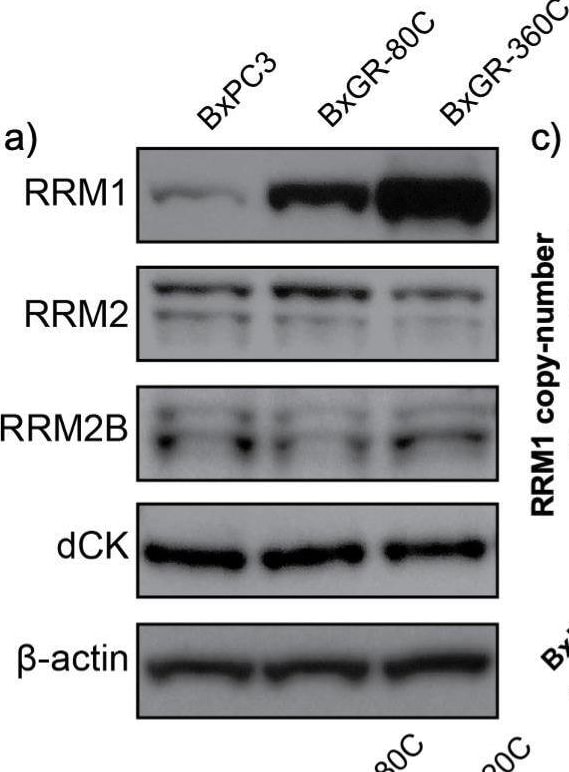
Detection of p53R2 by Western Blot
Confirmation of protein-level overexpression and copy number alteration in gemcitabine resistant sub-clones. A-b) Western blotting analysis of RRM1, RRM2, RRM2B and deoxycytidine kinase (dCK) in BxPC3 and derived subclones BxGR-80C, BxGR-120C and BxGR-360C. c) RRM1 TaqMan Copy Number Analysis of BxPC3 and derived BxGR-80C and BxGR-360C subclones. HUVEC cells used as diploid reference control. Three independent DNA samples analyzed per cell type d) Estimation of relative RRM1 mRNA abundance in BxGR-80C and BxGR-360C relative to BxPC3 cells. e) Estimation of RRM1 protein abundance in BxGR-80C and BxGR-360C relative to BxPC3 cells. f) Correlation between RRM1 copy-number, RRM1 mRNA and protein abundance for BxPC3, BxGR-80C and BxGR-360C cells. Solid lines are linear regressions, r2 is the coefficient of determination. g-h) Western blotting of E-cadherin, STIM1 and RhoG in BxPC3 and gemcitabine resistant subclones. c-e) Statistical significance performed using one-way ANOVA with Tukey’s multiple comparison test. Error-bars indicate standard error of the mean and n indicates independent samples. Image collected and cropped by CiteAb from the following open publication (https://pubmed.ncbi.nlm.nih.gov/35617275), licensed under a CC-BY license. Not internally tested by R&D Systems.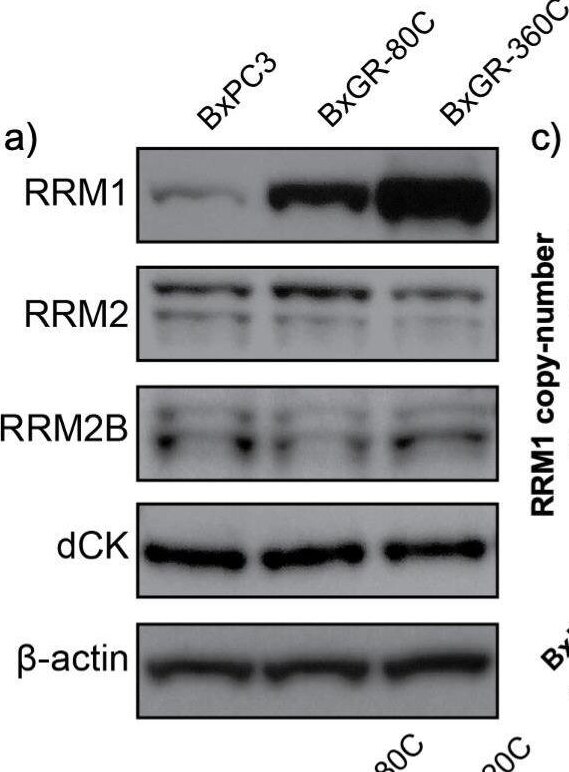
Detection of p53R2 by Western Blot
Confirmation of protein-level overexpression and copy number alteration in gemcitabine resistant sub-clones. A-b) Western blotting analysis of RRM1, RRM2, RRM2B and deoxycytidine kinase (dCK) in BxPC3 and derived subclones BxGR-80C, BxGR-120C and BxGR-360C. c) RRM1 TaqMan Copy Number Analysis of BxPC3 and derived BxGR-80C and BxGR-360C subclones. HUVEC cells used as diploid reference control. Three independent DNA samples analyzed per cell type d) Estimation of relative RRM1 mRNA abundance in BxGR-80C and BxGR-360C relative to BxPC3 cells. e) Estimation of RRM1 protein abundance in BxGR-80C and BxGR-360C relative to BxPC3 cells. f) Correlation between RRM1 copy-number, RRM1 mRNA and protein abundance for BxPC3, BxGR-80C and BxGR-360C cells. Solid lines are linear regressions, r2 is the coefficient of determination. g-h) Western blotting of E-cadherin, STIM1 and RhoG in BxPC3 and gemcitabine resistant subclones. c-e) Statistical significance performed using one-way ANOVA with Tukey’s multiple comparison test. Error-bars indicate standard error of the mean and n indicates independent samples. Image collected and cropped by CiteAb from the following open publication (https://pubmed.ncbi.nlm.nih.gov/35617275), licensed under a CC-BY license. Not internally tested by R&D Systems.Applications for Human p53R2 Antibody
Application
Recommended Usage
Western Blot
1 µg/mL
Sample: HEK293 human embryonic kidney cell line and U2OS human osteosarcoma cell line
Sample: HEK293 human embryonic kidney cell line and U2OS human osteosarcoma cell line
Formulation, Preparation, and Storage
Purification
Antigen Affinity-purified
Reconstitution
Reconstitute at 0.2 mg/mL in sterile PBS. For liquid material, refer to CoA for concentration.
Loading...
Formulation
Lyophilized from a 0.2 μm filtered solution in PBS with Trehalose. *Small pack size (SP) is supplied either lyophilized or as a 0.2 µm filtered solution in PBS.
Shipping
Lyophilized product is shipped at ambient temperature. Liquid small pack size (-SP) is shipped with polar packs. Upon receipt, store immediately at the temperature recommended below.
Stability & Storage
Use a manual defrost freezer and avoid repeated freeze-thaw cycles.
- 12 months from date of receipt, -20 to -70 °C as supplied.
- 1 month, 2 to 8 °C under sterile conditions after reconstitution.
- 6 months, -20 to -70 °C under sterile conditions after reconstitution.
Calculators
Background: p53R2
Alternate Names
RRM2B
Gene Symbol
RRM2B
UniProt
Additional p53R2 Products
Product Documents for Human p53R2 Antibody
Certificate of Analysis
To download a Certificate of Analysis, please enter a lot or batch number in the search box below.
Note: Certificate of Analysis not available for kit components.
Product Specific Notices for Human p53R2 Antibody
For research use only
Related Research Areas
Citations for Human p53R2 Antibody
 Powered by Bioz
Customer Reviews for Human p53R2 Antibody
There are currently no reviews for this product. Be the first to review Human p53R2 Antibody and earn rewards!
Have you used Human p53R2 Antibody?
Submit a review and receive an Amazon gift card!
$25/€18/£15/$25CAN/¥2500 for a review with an image
$10/€7/£6/$10CAN/¥1110 for a review without an image
Submit a review
Protocols
Find general support by application which include: protocols, troubleshooting, illustrated assays, videos and webinars.
- Cellular Response to Hypoxia Protocols
- R&D Systems Quality Control Western Blot Protocol
- Troubleshooting Guide: Western Blot Figures
- Western Blot Conditions
- Western Blot Protocol
- Western Blot Protocol for Cell Lysates
- Western Blot Troubleshooting
- Western Blot Troubleshooting Guide
- View all Protocols, Troubleshooting, Illustrated assays and Webinars
Loading...