

Scientific images may be resized, cropped, or adjusted for brightness or contrast for presentation purposes. These updates are limited to presentation and do not affect the underlying scientific interpretation of the data. Where available, additional source data may be provided upon request.
Key Product Details
Species Reactivity
Validated:
Cited:
Applications
Validated:
Cited:
Label
Antibody Source
Product Specifications
Immunogen
Asn49-Ser162
Accession # P40933
Specificity
Clonality
Host
Isotype
Endotoxin Level
Scientific Data Images for IL-15 Antibody (34505)
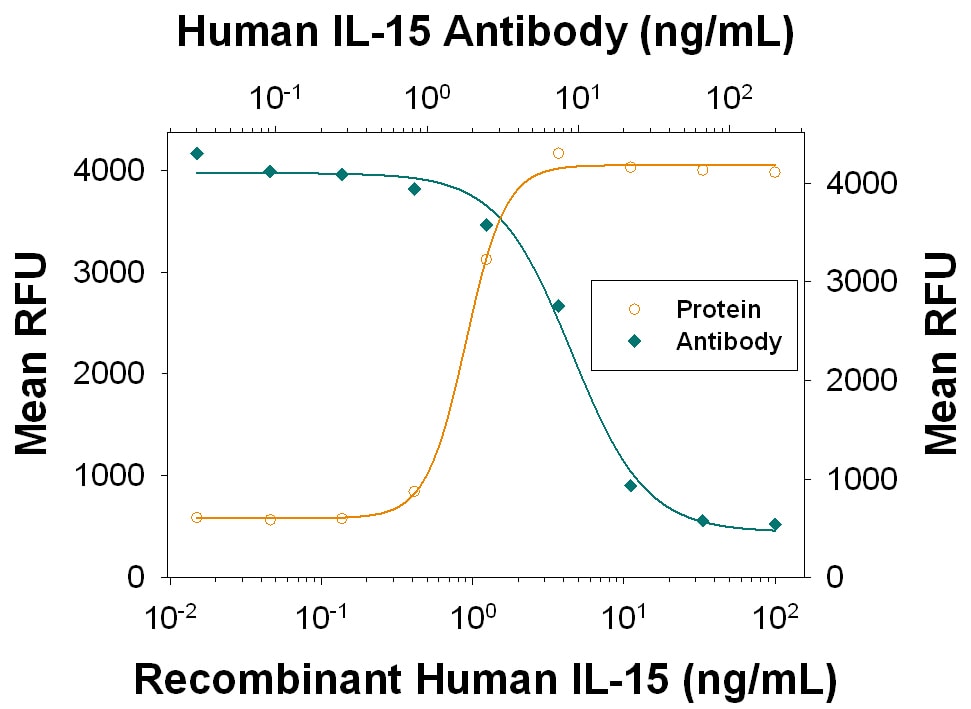
Cell Proliferation Induced by IL‑15 and Neutralization by Human IL‑15 Antibody.
Recombinant Human IL-15 (Catalog # 247-ILB) induces proliferation in the MO7e human megakaryocytic leukemic cell line in a dose-dependent manner (orange line), as measured by the Resazurin (Catalog # AR002). Proliferation elicited by Recombinant Human IL-15 (3 ng/mL) is neutralized (green line) by increasing concentrations of Mouse Anti-Human/Primate IL-15 Monoclonal Antibody (Catalog # MAB647). The ND50 is typically 4-20 ng/mL.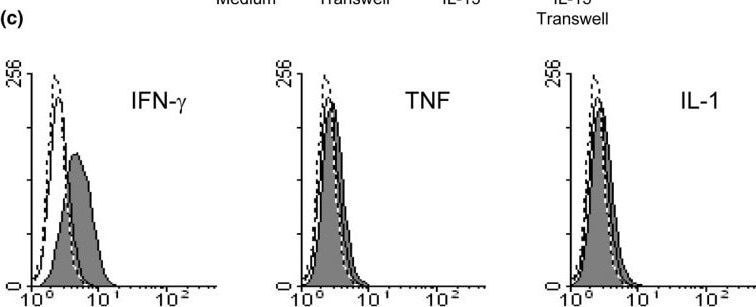
Detection of Human IL-15 by Flow Cytometry
Reciprocal activation between NK&THP-1 cells, the role of IL-15&IFN-gamma. (c) IFN-gamma increases IL-15 membrane expression in THP-1 cells. Cells incubated with IFN-gamma (100 ng/ml), TNF (100 ng/ml) or IL-1 (100 ng/ml) for 24 hours&then the membrane-bound IL-15 (mIL-15) was measured by indirect immunofluorescence&flow cytometry. A representative experiment of the five performed is shown. Grey histograms represent mIL-15 on stimulated THP-1 cells, solid-line histograms represent basal mIL-15 expression,&the dotted-line histogram is the negative control. Image collected & cropped by CiteAb from the following open publication (https://arthritis-research.biomedcentral.com/articles/10.1186/ar1955), licensed under a CC-BY license. Not internally tested by R&D Systems.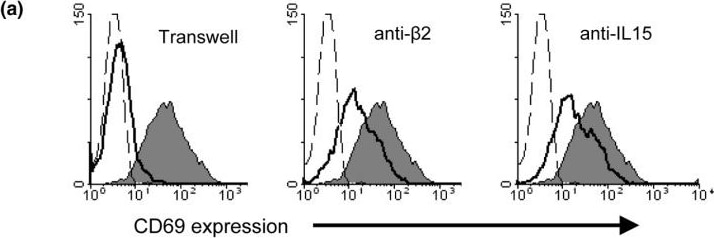
Detection of Human IL-15 by Flow Cytometry
Reciprocal activation between NK&THP-1 cells, the role of IL-15&IFN-gamma. (a) IL-15& beta 2 integrins are involved in the intercellular contact with THP-1 cells that induces the expression of CD69 in natural killer (NK) cells. Peripheral blood lymphocytes (PBL) co-cultured with THP-1 cells (10:1 ratio of PBL to THP-1) for 24 hours in medium alone or in the presence of an anti-beta 2 integrin mAb (Lia3/2) or an anti-IL-15 mAb (MAB647). As a control, both cell lines separated by a 0.4 μm pore transwell. A representative experiment of the five performed is shown. The histograms represent the CD69 expression in CD56+ cells in the medium (grey histogram in all panels) or under the different conditions (solid black line in each panel); a negative control is also shown (dotted histogram in all panels). Image collected & cropped by CiteAb from the following open publication (https://arthritis-research.biomedcentral.com/articles/10.1186/ar1955), licensed under a CC-BY license. Not internally tested by R&D Systems.
Human IL-15 ELISA Standard Curve
Human IL-15 was serially diluted and captured by Mouse Anti-Human/Primate IL‑15 Monoclonal Antibody (Catalog # MAB647) coated on a Clear Polystyrene Microplate (Catalog # DY990). Mouse Anti-Human IL‑15 Monoclonal Antibody (Catalog # MAB247) was biotinylated and incubated with the protein captured on the plate. Detection of the standard curve was achieved by incubating Streptavidin-HRP (Catalog # DY998)Applications for IL-15 Antibody (34505)
Neutralization
Human/Primate IL-15 Sandwich Immunoassay
Reviewed Applications
Read 2 reviews rated 5 using MAB647 in the following applications:
Formulation, Preparation, and Storage
Purification
Reconstitution
Reconstitute at 0.5 mg/mL in sterile PBS. For liquid material, refer to CoA for concentration.
Formulation
Shipping
Stability & Storage
- 12 months from date of receipt, -20 to -70 °C as supplied.
- 1 month, 2 to 8 °C under sterile conditions after reconstitution.
- 6 months, -20 to -70 °C under sterile conditions after reconstitution.
Calculators
Background: IL-15
References
- Grabstein, K. et al. (1994) Science 264:965.
- Budagian, V. et al. (2006) Cytokine Growth Factor Rev. 17:259.
- Ma, A. et al. (2006) Annu. Rev. Immunol. 24:657.
- Tagaya, Y. et al. (1997) Proc. Natl. Acad. Sci. USA 94:14444.
- Giri, J.G. et al. (1995) EMBO 14:3654.
- Giri, J. et al. (1994) EMBO J. 13:2822.
- Duitman, E.H. et al. (2008) Mol. Cell. Biol. 28:4851.
- Dubois, S. et al. (2002) Immunity 17:537.
- Stonier, S.W. and K.S. Schluns (2010) Immunol. Lett. 127:85.
- Burkett, P.R. et al. (2004) J. Exp. Med. 200:825.
- Budagian, V. et al. (2004) J. Biol. Chem. 279:40368.
- Mortier, E. et al. (2004) J. Immunol. 173:1681.
- Bulanova, E. et al. (2007) J. Biol. Chem. 282:13167.
- Budagian, V. et al. (2004) J. Biol. Chem. 279:42192.
- Neely, G.G. et al. (2004) J. Immunol. 172:4225.
Long Name
Alternate Names
Entrez Gene IDs
Gene Symbol
UniProt
Additional IL-15 Products
Product Documents for IL-15 Antibody (34505)
Certificate of Analysis
To download a Certificate of Analysis, please enter a lot or batch number in the search box below.
Note: Certificate of Analysis not available for kit components.
Product Specific Notices for IL-15 Antibody (34505)
For research use only
Citations for IL-15 Antibody (34505)
 Powered by Bioz
Customer Reviews for IL-15 Antibody (34505) (2)
Have you used IL-15 Antibody (34505)?
Submit a review and receive an Amazon gift card!
$25/€18/£15/$25CAN/¥2500 for a review with an image
$10/€7/£6/$10CAN/¥1110 for a review without an image
Submit a review
Customer Images
-
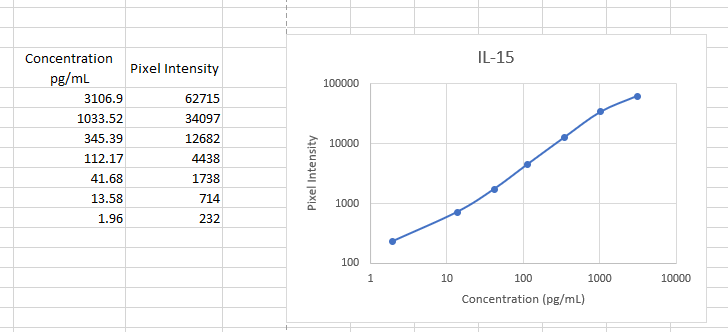
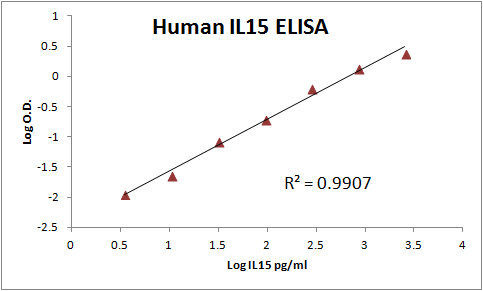
Application: ELISASample Tested: SerumSpecies: PrimateVerified Customer | Posted 11/28/2022Used as an ELISA Capture IgG

-
Application: ELISASample Tested: Serum and PlasmaSpecies: HumanVerified Customer | Posted 11/20/2017This antibody was used as the solid phase molecule in an ELISA for IL15. The BAM247 antibody was used as the liquid phase molecule.
There are no reviews that match your criteria.


