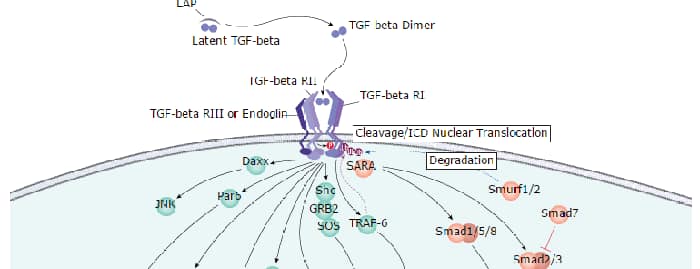
Most cell types express three sizes of receptors for TGF-beta. These are designated Type I (53 kDa), Type II (70-85 kDa), and Type III (250-350 kDa). The Type I receptor is a membrane-bound serine/threonine kinase that apparently requires the presence of the Type II receptor to bind TGF-beta. The Type II receptor is also a membrane-bound serine/threonine kinase that binds TGF-beta 1 and TGF-beta 3 with high affinity and TGF-beta 2 with a much lower affinity. The Type I and Type II receptors together form a heterodimeric signaling complex that is essential for the transduction of the anti-proliferative signals of TGF-beta. The Type III receptor is a transmembrane proteoglycan with a large extracellular domain and a 43 amino acid residue cytoplasmic domain. The cytoplasmic domain of the Type III receptor lacks an obvious signaling motif and the receptor may not be involved directly in signal transduction. The Type III receptor binds TGF-beta 2 with the highest affinity. Other TGF-beta isoforms also bind the Type III receptor, but with lower affinities. Cellular responsiveness to TGF-beta 2 appears to be dependent on the presence of the Type III receptor which can interact with the signaling receptor complex. In addition to the transmembrane Type III receptor, a soluble form of the receptor is secreted by some cell types. The physiological role of this soluble receptor remains to be determined. The recombinant TGF-beta soluble receptor Type III binds the TGF-beta isoforms differentially in solution and exhibits TGF-beta antagonistic activities in vitro.
Human TGF-beta RIII Antibody (31349)
R&D Systems | Catalog # MAB242


Key Product Details
Species Reactivity
Validated:
Cited:
Applications
Validated:
Cited:
Label
Antibody Source
Product Specifications
Immunogen
Gly21-Asp781
Accession # AAA67061
Specificity
Clonality
Host
Isotype
Applications for Human TGF-beta RIII Antibody (31349)
Western Blot
Sample: Recombinant Human TGF-beta RIII (Catalog # 242-R3)
under non-reducing conditions only
Formulation, Preparation, and Storage
Purification
Reconstitution
Reconstitute at 0.5 mg/mL in sterile PBS. For liquid material, refer to CoA for concentration.
Formulation
Shipping
Stability & Storage
- 12 months from date of receipt, -20 to -70 °C as supplied.
- 1 month, 2 to 8 °C under sterile conditions after reconstitution.
- 6 months, -20 to -70 °C under sterile conditions after reconstitution.
Calculators
Background: TGF-beta RIII
Long Name
Alternate Names
Gene Symbol
UniProt
Additional TGF-beta RIII Products
Product Documents for Human TGF-beta RIII Antibody (31349)
Certificate of Analysis
To download a Certificate of Analysis, please enter a lot or batch number in the search box below.
Note: Certificate of Analysis not available for kit components.
Product Specific Notices for Human TGF-beta RIII Antibody (31349)
For research use only
Citations for Human TGF-beta RIII Antibody (31349)
 Powered by Bioz
Customer Reviews for Human TGF-beta RIII Antibody (31349)
There are currently no reviews for this product. Be the first to review Human TGF-beta RIII Antibody (31349) and earn rewards!
Have you used Human TGF-beta RIII Antibody (31349)?
Submit a review and receive an Amazon gift card!
$25/€18/£15/$25CAN/¥2500 for a review with an image
$10/€7/£6/$10CAN/¥1110 for a review without an image
Submit a review
Protocols
Find general support by application which include: protocols, troubleshooting, illustrated assays, videos and webinars.
- Cellular Response to Hypoxia Protocols
- R&D Systems Quality Control Western Blot Protocol
- Troubleshooting Guide: Western Blot Figures
- Western Blot Conditions
- Western Blot Protocol
- Western Blot Protocol for Cell Lysates
- Western Blot Troubleshooting
- Western Blot Troubleshooting Guide
- View all Protocols, Troubleshooting, Illustrated assays and Webinars
FAQs for Human TGF-beta RIII Antibody (31349)
-
Q: What epitope does this antibody detect?
A: We have not done epitope mapping, but the antibody was raised against the extracellular domain of recombinant human TGF -beta RIII, Gly 21-Asp781, accession # AAA67061. The antibody will react with the antigen in this region.