
Collectins are a family of Ca++-dependent, C-type lectins that contain a collagenous domain and function as recognition molecules for molecular patterns found on pathogens (1‑4). Collectin placenta 1 (CL-P1), also known as collectin sub-family member 12 and scavenger receptor with C-type lectin type I (SRCL), is a 140 kDa member of the collectin family of glycoproteins. With two exceptions, all collectins are secreted. CL-P1 is the only collectin known to be membrane bound, while CL‑L1 (collectin liver-1) is the only known cytoplasmic collectin (1). Mouse CL-P1 is synthesized as a 742 amino acid (aa) type II transmembrane glycoprotein that includes an N-terminal 39 aa cytoplasmic domain, an 18 aa transmembrane segment, and a 685 aa C-terminal extracellular domain. The short cytoplasmic domain contains an internalization motif (Y-K-R-F), while the ECD is complex, demonstrating a coiled-coil segment, a Ser-Thr rich region, a collagen-like structure, and a C‑type lectin/carbohydrate recognition domain (CRD) (5, 6). Unlike human CL-P1, no splice variants of mouse CL-P1 have been described (5, 7). Trimerization of CL‑P1 is mediated by its collagen-like and coiled-coil helical domains (1, 6). Within the ECD, mouse CL-P1 shares 88%, 89%, 92%, and 98% aa sequence identity with bovine, canine, human, and rat CL-P1, respectively. The CRD shares 23‑27% aa sequence identity with the CRD of collectins CL-L1, collectin sub-family member 11, MBL, SP-A1, and SP-D. Notably, this CRD recognizes galactose and fucose within the context of asialo-orosomucoids associated with the Lewisx epitope (8, 9). CL‑P1 is expressed in vascular endothelial cells and may play a role in bacterial recognition or as a scavenger receptor for desialylated glycoproteins (6, 8).
Mouse CL-P1/COLEC12 Antibody
R&D Systems | Catalog # AF3130

Scientific images may be resized, cropped, or adjusted for brightness or contrast for presentation purposes. These updates are limited to presentation and do not affect the underlying scientific interpretation of the data. Where available, additional source data may be provided upon request.
Key Product Details
Species Reactivity
Validated:
Cited:
Applications
Validated:
Cited:
Label
Antibody Source
Product Specifications
Immunogen
Ala101-Leu742
Accession # Q8K4Q8
Specificity
Clonality
Host
Isotype
Endotoxin Level
Scientific Data Images for Mouse CL-P1/COLEC12 Antibody
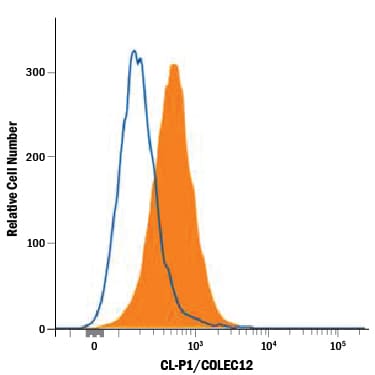
Detection of CL‑P1/COLEC12 in J774A.1 Mouse Cell Line by Flow Cytometry.
J774A.1 mouse reticulum cell sarcoma macrophage cell line was stained with Goat Anti-Mouse CL-P1/COLEC12 Antigen Affinity-purified Polyclonal Antibody (Catalog # AF3130, filled histogram) or isotype control antibody (Catalog # AB-108-C, open histogram), followed by Allophycocyanin-conjugated Anti-Goat IgG Secondary Antibody (Catalog # F0108).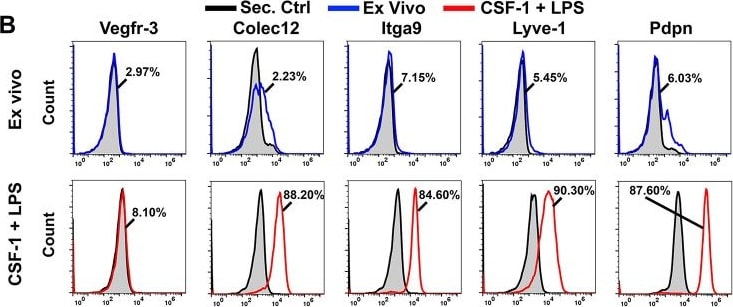
Detection of CL-P1/COLEC12 by Flow Cytometry
CSF-1/TLR4 induced differentiation promotes endothelial progenitors with predominant lymphatic phenotype.(A) Schematic of the protocol used to differentiate BM cells by sequential activation of CSF-1 and TLR4 pathways. (B) Representative histograms demonstrating expression of lymphatic specific targets Vegfr-3, Colec12, Itga9, Lyve-1, and Pdpn in freshly-isolated BM cells (upper panel, Ex-vivo, blue line) and cells differentiated with CSF-1 and LPS (lower panel, red line). Numbers pointing to blue and red lines indicate the percentage of marker-positive cells. Secondary controls are shown by the grey area outlined by black line in each panel. (C) The mean percentage of positive cells and (D) MFI (x103) of BM cells expressing LEC markers. (E) Representative histograms demonstrating the percentage of Ex-vivo (blue line) and differentiated (red line) cells positive for blood vascular endothelial markers Vegfr-1, CD105, and Vegfr-2. Secondary controls are shown by the grey area outlined by black line in each panel. (F) The mean percentage of positive cells and (G) MFI (x103) of various endothelial markers in ex-vivo and differentiated cells. Black bars indicate statistical significance determined by Student’s t-test with P-values shown by *<0.05, **<0.01, and ***<0.001. All experiments were performed in duplicate and reproduced three times. Image collected and cropped by CiteAb from the following open publication (https://pubmed.ncbi.nlm.nih.gov/38640116), licensed under a CC-BY license. Not internally tested by R&D Systems.Applications for Mouse CL-P1/COLEC12 Antibody
Blockade of Receptor-ligand Interaction
CyTOF-ready
Flow Cytometry
Sample: J774A.1 mouse reticulum cell sarcoma macrophage cell line
Western Blot
Sample: Recombinant Mouse CL-P1/COLEC12 (Catalog # 3130-CL)
Flow Cytometry Panel Builder
Bio-Techne Knows Flow Cytometry
Save time and reduce costly mistakes by quickly finding compatible reagents using the Panel Builder Tool.
Advanced Features
- Spectra Viewer - Custom analysis of spectra from multiple fluorochromes
- Spillover Popups - Visualize the spectra of individual fluorochromes
- Antigen Density Selector - Match fluorochrome brightness with antigen density

Formulation, Preparation, and Storage
Purification
Reconstitution
Reconstitute at 0.2 mg/mL in sterile PBS. For liquid material, refer to CoA for concentration.
Formulation
Shipping
Stability & Storage
- 12 months from date of receipt, -20 to -70 °C as supplied.
- 1 month, 2 to 8 °C under sterile conditions after reconstitution.
- 6 months, -20 to -70 °C under sterile conditions after reconstitution.
Calculators
Background: CL-P1/COLEC12
References
- van de Wetering, J.K. et al. (2004) Eur. J. Biochem. 271:1229.
- Holmskov, U. et al. (2003) Annu. Rev. Immunol. 21:547.
- Hoppe, H-J. and K. Reid (1994) Protein Sci. 3:1143.
- Hickling, T.P. et al. (2004) J. Leukoc. Biol. 75:27.
- Nakamura, K. et al. (2001) Biochim. Biophys. Acta 1522:53.
- Ohtani, K. et al. (2001) J. Biol. Chem. 276:44222.
- Nakamura, K. et al. (2001) Biochem. Biophys. Res. Commun. 280:1028.
- Coombs, P.J. et al. (2005) J. Biol. Chem. 280:22993.
- Yoshida, T. et al. (2003) J. Biochem. 133:271.
Long Name
Alternate Names
Gene Symbol
UniProt
Additional CL-P1/COLEC12 Products
Product Documents for Mouse CL-P1/COLEC12 Antibody
Certificate of Analysis
To download a Certificate of Analysis, please enter a lot or batch number in the search box below.
Note: Certificate of Analysis not available for kit components.
Product Specific Notices for Mouse CL-P1/COLEC12 Antibody
For research use only
Related Research Areas
Citations for Mouse CL-P1/COLEC12 Antibody
 Powered by Bioz
Customer Reviews for Mouse CL-P1/COLEC12 Antibody
There are currently no reviews for this product. Be the first to review Mouse CL-P1/COLEC12 Antibody and earn rewards!
Have you used Mouse CL-P1/COLEC12 Antibody?
Submit a review and receive an Amazon gift card!
$25/€18/£15/$25CAN/¥2500 for a review with an image
$10/€7/£6/$10CAN/¥1110 for a review without an image
Submit a review
Protocols
Find general support by application which include: protocols, troubleshooting, illustrated assays, videos and webinars.
- 7-Amino Actinomycin D (7-AAD) Cell Viability Flow Cytometry Protocol
- Cellular Response to Hypoxia Protocols
- Extracellular Membrane Flow Cytometry Protocol
- Flow Cytometry Protocol for Cell Surface Markers
- Flow Cytometry Protocol for Staining Membrane Associated Proteins
- Flow Cytometry Staining Protocols
- Flow Cytometry Troubleshooting Guide
- Intracellular Flow Cytometry Protocol Using Alcohol (Methanol)
- Intracellular Flow Cytometry Protocol Using Detergents
- Intracellular Nuclear Staining Flow Cytometry Protocol Using Detergents
- Intracellular Staining Flow Cytometry Protocol Using Alcohol Permeabilization
- Intracellular Staining Flow Cytometry Protocol Using Detergents to Permeabilize Cells
- Propidium Iodide Cell Viability Flow Cytometry Protocol
- Protocol for Liperfluo
- Protocol for the Characterization of Human Th22 Cells
- Protocol for the Characterization of Human Th9 Cells
- Protocol: Annexin V and PI Staining by Flow Cytometry
- Protocol: Annexin V and PI Staining for Apoptosis by Flow Cytometry
- R&D Systems Quality Control Western Blot Protocol
- Troubleshooting Guide: Fluorokine Flow Cytometry Kits
- Troubleshooting Guide: Western Blot Figures
- Western Blot Conditions
- Western Blot Protocol
- Western Blot Protocol for Cell Lysates
- Western Blot Troubleshooting
- Western Blot Troubleshooting Guide
- View all Protocols, Troubleshooting, Illustrated assays and Webinars