
CXADR (Coxsackie and Adenovirus Receptor), also known as CAR, is a 46 kDa type I transmembrane glycoprotein that belongs to the CTX family of the Ig superfamily (1‑3). CXADR has received attention as a receptor that facilitates gene transfer mediated by most adenoviruses (1, 2). It is also an adhesion molecule within junctional complexes, notably between epithelial cells lining body cavities and within myocardial intercalated discs (1, 2, 4). CXADR is essential for normal cardiac development in the mouse (7). It is expressed throughout brain neuroepithelium during development, but mainly in ependymal cells in the adult (4‑6). The 365 amino acid (aa) mouse CXADR contains a 19 aa signal sequence, a 218 aa extracellular domain (ECD) with a V-type (D1) and a C2-type (D2) Ig-like domain, a 21 aa transmembrane segment and a 107 aa intracellular domain. D1 is thought to be responsible for homodimer formation in trans within tight junctions (2). The fiber knob of adenoviruses attaches at a similar site, and evidence suggests that disruption of tight junctions facilitates virus binding (1, 2). A PDZ binding motif at the C‑terminus interacts with several cytoplasmic junctional proteins (1). The ECD of mouse CXADR shares 97%, 90%, 89%, 89% and 88% aa sequence identity with the corresponding regions of rat, human, bovine, porcine and canine CXADR, respectively. An alternately spliced isoform (CXADR2) that diverges in the C‑terminal 15 aa shows the same expression pattern, but may show different subcellular localization (4, 8). Transcription of other splice variants has been detected, but not their translation. A secreted form identified in serum and pleural fluid can block viral infection (9).
Mouse CXADR Antibody
R&D Systems | Catalog # AF2654

Scientific images may be resized, cropped, or adjusted for brightness or contrast for presentation purposes. These updates are limited to presentation and do not affect the underlying scientific interpretation of the data. Where available, additional source data may be provided upon request.
Key Product Details
Species Reactivity
Validated:
Cited:
Applications
Validated:
Cited:
Label
Antibody Source
Product Specifications
Immunogen
Leu20-Gly237
Accession # P97792
Specificity
Clonality
Host
Isotype
Scientific Data Images for Mouse CXADR Antibody
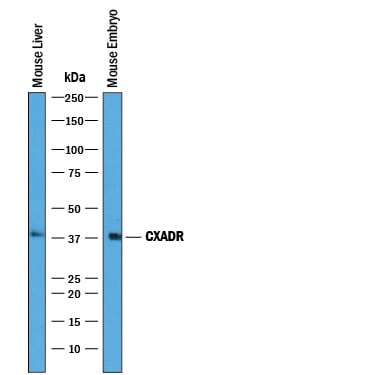
Detection of Mouse CXADR by Western Blot.
Western blot shows lysates of mouse liver tissue and mouse embryo tissue. PVDF membrane was probed with 0.25 µg/mL of Goat Anti-Mouse CXADR Antigen Affinity-purified Polyclonal Antibody (Catalog # AF2654) followed by HRP-conjugated Anti-Goat IgG Secondary Antibody (Catalog # HAF019). A specific band was detected for CXADR at approximately 40 kDa (as indicated). This experiment was conducted under reducing conditions and using Immunoblot Buffer Group 1.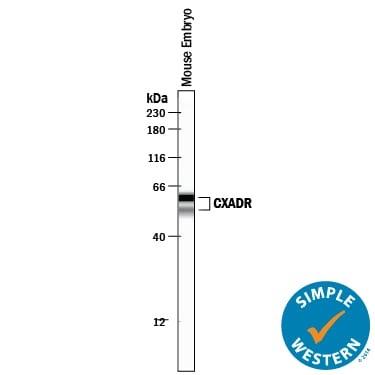
Detection of Mouse CXADR by Simple WesternTM.
Simple Western lane view shows lysates of mouse embryo tissue, loaded at 0.2 mg/mL. Specific bands were detected for CXADR at approximately 60 and 53 kDa (as indicated) using 12.5 µg/mL of Goat Anti-Mouse CXADR Antigen Affinity-purified Polyclonal Antibody (Catalog # AF2654) followed by 1:50 dilution of HRP-conjugated Anti-Goat IgG Secondary Antibody (Catalog # HAF109). This experiment was conducted under reducing conditions and using the 12-230 kDa separation system.Applications for Mouse CXADR Antibody
Immunohistochemistry
Sample: Immersion fixed frozen sections of mouse embryo (E15.5)
Simple Western
Sample: Mouse embryo tissue
Western Blot
Sample: Mouse liver tissue and mouse embryo tissue
Formulation, Preparation, and Storage
Purification
Reconstitution
Reconstitute at 0.2 mg/mL in sterile PBS. For liquid material, refer to CoA for concentration.
Formulation
Shipping
Stability & Storage
- 12 months from date of receipt, -20 to -70 °C as supplied.
- 1 month, 2 to 8 °C under sterile conditions after reconstitution.
- 6 months, -20 to -70 °C under sterile conditions after reconstitution.
Calculators
Background: CXADR
References
- Coyne, C.B. and J.M. Bergelson (2005) Adv. Drug Deliv. Rev. 57:869.
- Philipson, L. and R.F. Pettersson (2004) Curr. Top. Microbiol. Immunol. 273:87.
- Tomko, R.P. et al. (1997) Proc. Natl. Acad. Sci. USA 94:3352.
- Raschperger, E. et al. (2006) Exp. Cell Res. 312:1566.
- Hotta, Y. et al. (2003) Dev. Brain Res. 143:1.
- Hauwel, M. et al. (2005) Brain Res. Rev. 48:265.
- Chen, J. et al. (2006) Circ. Res. 98:923.
- Mirza, M. et al. (2006) Exp. Cell Res. 312:817.
- Bernal, R.M. et al. (2002) Clin. Cancer Res. 8:1915.
Long Name
Alternate Names
Gene Symbol
UniProt
Additional CXADR Products
Product Documents for Mouse CXADR Antibody
Certificate of Analysis
To download a Certificate of Analysis, please enter a lot or batch number in the search box below.
Note: Certificate of Analysis not available for kit components.
Product Specific Notices for Mouse CXADR Antibody
For research use only
Related Research Areas
Citations for Mouse CXADR Antibody
 Powered by Bioz
Customer Reviews for Mouse CXADR Antibody
There are currently no reviews for this product. Be the first to review Mouse CXADR Antibody and earn rewards!
Have you used Mouse CXADR Antibody?
Submit a review and receive an Amazon gift card!
$25/€18/£15/$25CAN/¥2500 for a review with an image
$10/€7/£6/$10CAN/¥1110 for a review without an image
Submit a review
Protocols
Find general support by application which include: protocols, troubleshooting, illustrated assays, videos and webinars.
- Antigen Retrieval Protocol (PIER)
- Antigen Retrieval for Frozen Sections Protocol
- Appropriate Fixation of IHC/ICC Samples
- Cellular Response to Hypoxia Protocols
- Chromogenic IHC Staining of Formalin-Fixed Paraffin-Embedded (FFPE) Tissue Protocol
- Chromogenic Immunohistochemistry Staining of Frozen Tissue
- ClariTSA™ Fluorophore Kits
- Detection & Visualization of Antibody Binding
- Fluorescent IHC Staining of Frozen Tissue Protocol
- Graphic Protocol for Heat-induced Epitope Retrieval
- Graphic Protocol for the Preparation and Fluorescent IHC Staining of Frozen Tissue Sections
- Graphic Protocol for the Preparation and Fluorescent IHC Staining of Paraffin-embedded Tissue Sections
- Graphic Protocol for the Preparation of Gelatin-coated Slides for Histological Tissue Sections
- IHC Sample Preparation (Frozen sections vs Paraffin)
- Immunofluorescent IHC Staining of Formalin-Fixed Paraffin-Embedded (FFPE) Tissue Protocol
- Immunohistochemistry (IHC) and Immunocytochemistry (ICC) Protocols
- Immunohistochemistry Frozen Troubleshooting
- Immunohistochemistry Paraffin Troubleshooting
- Preparing Samples for IHC/ICC Experiments
- Preventing Non-Specific Staining (Non-Specific Binding)
- Primary Antibody Selection & Optimization
- Protocol for Heat-Induced Epitope Retrieval (HIER)
- Protocol for Making a 4% Formaldehyde Solution in PBS
- Protocol for VisUCyte™ HRP Polymer Detection Reagent
- Protocol for the Preparation & Fixation of Cells on Coverslips
- Protocol for the Preparation and Chromogenic IHC Staining of Frozen Tissue Sections
- Protocol for the Preparation and Chromogenic IHC Staining of Frozen Tissue Sections - Graphic
- Protocol for the Preparation and Chromogenic IHC Staining of Paraffin-embedded Tissue Sections
- Protocol for the Preparation and Chromogenic IHC Staining of Paraffin-embedded Tissue Sections - Graphic
- Protocol for the Preparation and Fluorescent IHC Staining of Frozen Tissue Sections
- Protocol for the Preparation and Fluorescent IHC Staining of Paraffin-embedded Tissue Sections
- Protocol for the Preparation of Gelatin-coated Slides for Histological Tissue Sections
- R&D Systems Quality Control Western Blot Protocol
- TUNEL and Active Caspase-3 Detection by IHC/ICC Protocol
- The Importance of IHC/ICC Controls
- Troubleshooting Guide: Immunohistochemistry
- Troubleshooting Guide: Western Blot Figures
- Western Blot Conditions
- Western Blot Protocol
- Western Blot Protocol for Cell Lysates
- Western Blot Troubleshooting
- Western Blot Troubleshooting Guide
- View all Protocols, Troubleshooting, Illustrated assays and Webinars