
VLDL R is a 105 kDa type I integral membrane protein that belongs to the LDL receptor family. It plays a significant role in lipid metabolism and in nervous system development and function (1, 2). Mouse VLDL R has a 770 amino acid (aa) extracellular domain (ECD) and a 54 aa cytoplasmic region. The ECD contains eight LDLR class A repeats, three EGF-like repeats, six LDLR class B repeats, and a juxtamembrane region that is rich in O-linked glycosylation (3, 4). The cytoplasmic domain contains one NPXY internalization motif. VLDL R is predominantly expressed in striated muscle, adipose tissue, brain, and endothelial cells lining capillaries and small arterioles (3-6). VLDL R participates in the tissue uptake of fatty acids from plasma by mediating the internalization of ApoE-containing lipoparticles (i.e. VLDL, beta ‑VLDL, and chylomicron remnants) (5, 7). VLDL R binds and internalizes lipoprotein lipase (LPL) and mediates its transport from the basolateral to the lumenal face of endothelial cells (6, 8). VLDL R knockout mice are characterized by reduced LPL activity, reduced serum triglyceride clearance, and a resistance to developing obesity (7, 9, 10). VLDL R influences breast cancer cell motility by mediating the uptake of uPAR-PAI1 complexes (6, 11). Lipoprotein accumulation via macrophage VLDL R is instrumental in promoting the formation of atherosclerotic plaques (12). In the nervous system, VLDL R and ApoE R2 interactions with Reelin are critical for neuronal migration and positioning in the developing brain (13). VLDL R also functions in adult hippocampal synapse maturation, synaptic plasticity, and memory formation (14, 15). The ECD of mouse VLDL R shares 95% aa sequence identity with human and rat VLDL R. Within shared regions, mouse VLDL R shares 55% and 53% aa sequence identity with ApoE R2 and LDL R, respectively.
Mouse VLDLR Antibody
R&D Systems | Catalog # AF2258

Scientific images may be resized, cropped, or adjusted for brightness or contrast for presentation purposes. These updates are limited to presentation and do not affect the underlying scientific interpretation of the data. Where available, additional source data may be provided upon request.
Key Product Details
Species Reactivity
Validated:
Cited:
Applications
Validated:
Cited:
Label
Antibody Source
Product Specifications
Immunogen
Thr25-Ala798
Accession # AAA59384
Specificity
Clonality
Host
Isotype
Scientific Data Images for Mouse VLDLR Antibody
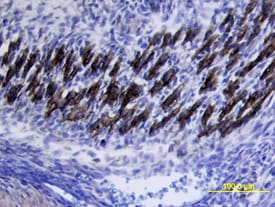
VLDL R in Mouse Embryo.
VLDL R was detected in immersion fixed frozen sections of mouse embryo using Mouse VLDL R Antigen Affinity-purified Polyclonal Antibody (Catalog # AF2258) at 15 µg/mL overnight at 4 °C. Tissue was stained using the Anti-Goat HRP-DAB Cell & Tissue Staining Kit (brown; Catalog # CTS008) and counter-stained with hematoxylin (blue). View our protocol for Chromogenic IHC Staining of Frozen Tissue Sections.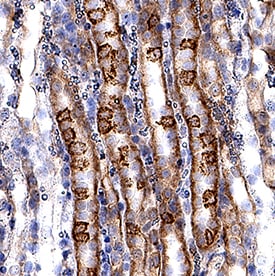
VLDL R in Mouse Kidney.
VLDL R was detected in perfusion fixed frozen sections of mouse kidney using Goat Anti-Mouse VLDL R Antigen Affinity-purified Polyclonal Antibody (Catalog # AF2258) at 3 µg/mL for 1 hour at room temperature followed by incubation with the Anti-Goat IgG VisUCyte™ HRP Polymer Antibody (Catalog # VC004). Tissue was stained using DAB (brown) and counterstained with hematoxylin (blue). Specific staining was localized to cell membranes of convoluted tubules. View our protocol for IHC Staining with VisUCyte HRP Polymer Detection Reagents.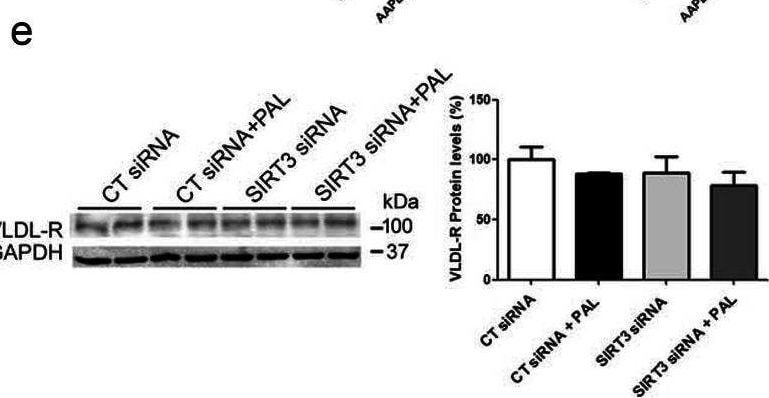
Detection of VLDLR by Western Blot
The increase in CD36 levels caused by lipids in Sirt3-deficient hepatocytes is mediated by Nrf2. VLDLR mRNA abundance (a) and protein levels of VLDLR and NQO1, an Nrf-2-target gene, (b) were assessed in Huh-7 cells incubated with fatty acid free-BSA or BSA-palmitate (0.3 mM) and exposed to either vehicle or the Sirt3 inhibitor AAPBO (100 μM) for 16 h. a, p < 0.05 vs. CT. b, p < 0.05 vs. CT cells incubated with palmitate. c, p < 0.05 vs. CT cells treated with AAPBO. c, fatty acid uptake in Huh-7 cells incubated with fatty acid free-BSA or BSA-palmitate (0.3 mM) and exposed to either vehicle or the Sirt3 inhibitor AAPBO (100 μM) for 16 h was measured by the uptake of BODIPY-C16. a, p < 0.05 vs. CT. b, p < 0.05 vs. CT cells incubated with palmitate. c, p < 0.05 vs. CT cells treated with AAPBO. mRNA abundance (d) and protein levels of VLDLR (e) in Huh-7 cells transfected with control (CT) or SIRT3 siRNA and incubated in the presence or absence 0.3 mM palmitate (Pal) for 24 h. Protein levels of CD36 (f), NQO1 (g) and PPAR gamma (h) in Huh-7 cells transfected with control (CT) or SIRT3 siRNA and incubated in the presence or absence 0.3 mM palmitate (Pal) or the Nrf2 inhibitor ML385 (10 μM) for 24 h. a, p < 0.05 vs. CT siRNA cells. b, p < 0.05 vs. CT siRNA cells incubated with palmitate. c, p < 0.05 vs. SIRT3 siRNA cells. d, p < 0.05 vs. CT siRNA cells incubated with palmitate and ML385 Image collected and cropped by CiteAb from the following open publication (https://pubmed.ncbi.nlm.nih.gov/32912335), licensed under a CC-BY license. Not internally tested by R&D Systems.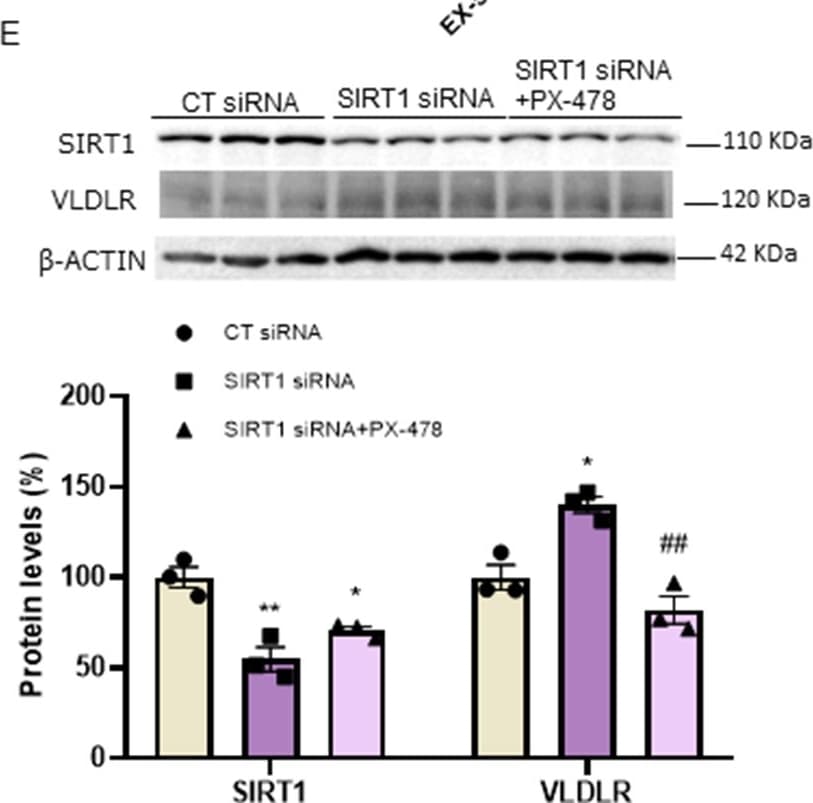
Detection of Mouse VLDLR by Western Blot
SIRT1 inhibition increases VLDLR levels and VLDL uptake in human Huh-7 cells. (A) mRNA and (B) immunoblot analysis of VLDLR in human Huh-7 cells in the absence (control, CT) or presence of 10 µM EX-527 for 24 h. Immunoblot analysis of (C) VLDLR and (D) VLDL uptake in human Huh-7 cells in the absence (control, CT) or presence of 10 µM EX-527, or in the presence of both 10 µM EX-527 and 20 µM PX-478 for 24 h. (E) Immunoblot analysis of SIRT1 and VLDLR in Huh-7 cells transfected with control siRNA or SIRT1 siRNA in the absence or presence of 20 µM PX-478. Data are presented as the mean ± SEM. Significant differences were established by Student’s t-test or one-way ANOVA with Tukey’s post-hoc test. *p < 0.05 and **p < 0.01 vs. CT. #p < 0.05, ##p < 0.01, and ###p < 0.001 vs. EX-527 or SIRT1 siRNA. n = 3 or 4 per group Image collected and cropped by CiteAb from the following open publication (https://pubmed.ncbi.nlm.nih.gov/38807218), licensed under a CC-BY license. Not internally tested by R&D Systems.Applications for Mouse VLDLR Antibody
Immunohistochemistry
Sample: Immersion fixed frozen sections of mouse embryo (E13.5-15.5) and perfusion fixed frozen sections of mouse kidney
Western Blot
Sample: Recombinant Mouse VLDL R (Catalog # 2258-VL)
Formulation, Preparation, and Storage
Purification
Reconstitution
Reconstitute at 0.2 mg/mL in sterile PBS. For liquid material, refer to CoA for concentration.
Formulation
Shipping
Stability & Storage
- 12 months from date of receipt, -20 to -70 °C as supplied.
- 1 month, 2 to 8 °C under sterile conditions after reconstitution.
- 6 months, -20 to -70 °C under sterile conditions after reconstitution.
Calculators
Background: VLDLR
References
- Qiu, S. et al. (2006) Neurobiol. Learn. Mem. 85:16.
- May, P. et al. (2005) Cell. Mol. Life Sci. 62:2325.
- Gafvels, M.E. et al. (1994) Endocrinology 135:387.
- Oka, K. et al. (1994) Eur. J. Biochem. 224:975.
- Wyne, K.L. et al. (1996) Arterioscler. Thromb. Vasc. Biol. 16:407.
- Argraves, K.M. et al. (1995) J. Biol. Chem. 270:26550.
- Goudriaan, J.R. et al. (2001) Arterioscler. Thromb. Vasc. Biol. 21:1488.
- Obunike, J.C. et al. (2001) J. Biol. Chem. 276:8934.
- Yagyu, H. et al. (2002) J. Biol. Chem. 277:10037.
- Goudriaan, J.R. et al. (2004) J. Lipid Res. 45:1475.
- Webb, D.J. et al. (1999) J. Biol. Chem. 274:7412.
- van Eck, M. et al. (2005) Atherosclerosis 183:230.
- Jossin, Y. et al. (2004) J. Neurosci. 24:514.
- Niu, S. et al. (2004) Neuron 41:71.
- Weeber, E.J. et al. (2002) J. Biol. Chem. 277:39944.
Long Name
Alternate Names
Gene Symbol
UniProt
Additional VLDLR Products
Product Documents for Mouse VLDLR Antibody
Certificate of Analysis
To download a Certificate of Analysis, please enter a lot or batch number in the search box below.
Note: Certificate of Analysis not available for kit components.
Product Specific Notices for Mouse VLDLR Antibody
For research use only
Related Research Areas
Citations for Mouse VLDLR Antibody
 Powered by Bioz
Customer Reviews for Mouse VLDLR Antibody
There are currently no reviews for this product. Be the first to review Mouse VLDLR Antibody and earn rewards!
Have you used Mouse VLDLR Antibody?
Submit a review and receive an Amazon gift card!
$25/€18/£15/$25CAN/¥2500 for a review with an image
$10/€7/£6/$10CAN/¥1110 for a review without an image
Submit a review
Protocols
Find general support by application which include: protocols, troubleshooting, illustrated assays, videos and webinars.
- Antigen Retrieval Protocol (PIER)
- Antigen Retrieval for Frozen Sections Protocol
- Appropriate Fixation of IHC/ICC Samples
- Cellular Response to Hypoxia Protocols
- Chromogenic IHC Staining of Formalin-Fixed Paraffin-Embedded (FFPE) Tissue Protocol
- Chromogenic Immunohistochemistry Staining of Frozen Tissue
- ClariTSA™ Fluorophore Kits
- Detection & Visualization of Antibody Binding
- Fluorescent IHC Staining of Frozen Tissue Protocol
- Graphic Protocol for Heat-induced Epitope Retrieval
- Graphic Protocol for the Preparation and Fluorescent IHC Staining of Frozen Tissue Sections
- Graphic Protocol for the Preparation and Fluorescent IHC Staining of Paraffin-embedded Tissue Sections
- Graphic Protocol for the Preparation of Gelatin-coated Slides for Histological Tissue Sections
- IHC Sample Preparation (Frozen sections vs Paraffin)
- Immunofluorescent IHC Staining of Formalin-Fixed Paraffin-Embedded (FFPE) Tissue Protocol
- Immunohistochemistry (IHC) and Immunocytochemistry (ICC) Protocols
- Immunohistochemistry Frozen Troubleshooting
- Immunohistochemistry Paraffin Troubleshooting
- Preparing Samples for IHC/ICC Experiments
- Preventing Non-Specific Staining (Non-Specific Binding)
- Primary Antibody Selection & Optimization
- Protocol for Heat-Induced Epitope Retrieval (HIER)
- Protocol for Making a 4% Formaldehyde Solution in PBS
- Protocol for VisUCyte™ HRP Polymer Detection Reagent
- Protocol for the Preparation & Fixation of Cells on Coverslips
- Protocol for the Preparation and Chromogenic IHC Staining of Frozen Tissue Sections
- Protocol for the Preparation and Chromogenic IHC Staining of Frozen Tissue Sections - Graphic
- Protocol for the Preparation and Chromogenic IHC Staining of Paraffin-embedded Tissue Sections
- Protocol for the Preparation and Chromogenic IHC Staining of Paraffin-embedded Tissue Sections - Graphic
- Protocol for the Preparation and Fluorescent IHC Staining of Frozen Tissue Sections
- Protocol for the Preparation and Fluorescent IHC Staining of Paraffin-embedded Tissue Sections
- Protocol for the Preparation of Gelatin-coated Slides for Histological Tissue Sections
- R&D Systems Quality Control Western Blot Protocol
- TUNEL and Active Caspase-3 Detection by IHC/ICC Protocol
- The Importance of IHC/ICC Controls
- Troubleshooting Guide: Immunohistochemistry
- Troubleshooting Guide: Western Blot Figures
- Western Blot Conditions
- Western Blot Protocol
- Western Blot Protocol for Cell Lysates
- Western Blot Troubleshooting
- Western Blot Troubleshooting Guide
- View all Protocols, Troubleshooting, Illustrated assays and Webinars