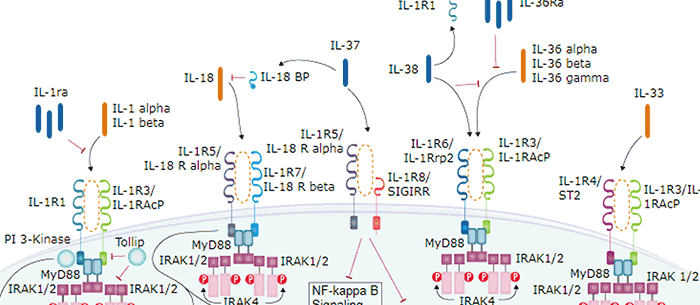
Scientific images may be resized, cropped, or adjusted for brightness or contrast for presentation purposes. These updates are limited to presentation and do not affect the underlying scientific interpretation of the data. Where available, additional source data may be provided upon request.
Key Product Details
Species Reactivity
Validated:
Cited:
Applications
Validated:
Cited:
Label
Antibody Source
Product Specifications
Immunogen
His37-Ser194
Accession # P97636
Specificity
Clonality
Host
Isotype
Endotoxin Level
Scientific Data Images for Rat IL-18/IL-1F4 Antibody
IFN‑ gamma Secretion Induced by IL‑18/IL‑1F4 and Neutralization by Rat IL‑18/IL‑1F4 Antibody.
In the presence of Recombinant Mouse IL-12 (0.1 ng/mL, Catalog # 419-ML), Recombinant Rat IL-18/IL-1F4 (Catalog # 521-RL) stimulates IFN-gamma secretion in activated mouse T cells in a dose-dependent manner (orange line), as measured by the Mouse IFN-gamma Quantikine ELISA Kit (Catalog # MIF00). Under these conditions, IFN-gamma secretion elicited by Recombinant Rat IL-18/IL-1F4 (15 ng/mL) is neutralized (green line) by increasing concentrations of Rat IL-18/IL-1F4 Antigen Affinity-purified Polyclonal Antibody (Catalog # AF521). The ND50 is typically 1-3 µg/mL.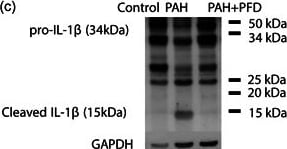
Detection of IL-18/IL-1F4 by Western Blot
Effects of pirfenidone (PFD) on NLRP3 inflammasome activation in PAH lungs and in macrophages in vitro: Lung tissue was isolated from the rats as described in Figures 1, 2, 3, homogenized and cleavage of caspase‐1 (a, b), IL‐1 beta (c, d), and IL‐18 (e, f) were assessed by Western blot. Representative pictures are shown (a, c, e), and quantified (b, d, f). (g, h) Bone marrow was isolated from mice and differentiated into bone marrow‐derived macrophages (BMDMs) in DMEM supplemented with a 20% l‐cell conditioned medium for 7 days. Subsequently, BMDMs were treated with or without PFD (500 µg/ml) o/n, and subsequently with lipopolysaccharide (LPS) (100 ng/ml) for 4 h. (g) Cells were lysed, RNA was isolated, and the expression of NLRP3, pro‐IL‐1 beta, and pro‐IL‐18 mRNA was measured by qPCR and corrected for 36B4, cyclophilin B, and GAPDH (housekeeping genes). (h) Cells were subsequently treated with nigericin (NG) (20 µM) for 30 min and IL‐1 beta secretion into the medium was assessed by ELISA and corrected for cell protein; *p < 0.05; **p < 0.01; ***p < 0.001 by two‐sided one‐way ANOVA with Holm–Sidak's post hoc correction. ANOVA, analysis of variance; ELISA, enzyme‐linked immunosorbent assay; IL‐1 beta, interleukin‐1 beta ; mRNA, messenger RNA; PAH, pulmonary arterial hypertension; qPCR, quantitative polymerase chain reaction. Image collected and cropped by CiteAb from the following open publication (https://pubmed.ncbi.nlm.nih.gov/35833096), licensed under a CC-BY license. Not internally tested by R&D Systems.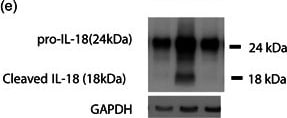
Detection of IL-18/IL-1F4 by Western Blot
Effects of pirfenidone (PFD) on NLRP3 inflammasome activation in PAH lungs and in macrophages in vitro: Lung tissue was isolated from the rats as described in Figures 1, 2, 3, homogenized and cleavage of caspase‐1 (a, b), IL‐1 beta (c, d), and IL‐18 (e, f) were assessed by Western blot. Representative pictures are shown (a, c, e), and quantified (b, d, f). (g, h) Bone marrow was isolated from mice and differentiated into bone marrow‐derived macrophages (BMDMs) in DMEM supplemented with a 20% l‐cell conditioned medium for 7 days. Subsequently, BMDMs were treated with or without PFD (500 µg/ml) o/n, and subsequently with lipopolysaccharide (LPS) (100 ng/ml) for 4 h. (g) Cells were lysed, RNA was isolated, and the expression of NLRP3, pro‐IL‐1 beta, and pro‐IL‐18 mRNA was measured by qPCR and corrected for 36B4, cyclophilin B, and GAPDH (housekeeping genes). (h) Cells were subsequently treated with nigericin (NG) (20 µM) for 30 min and IL‐1 beta secretion into the medium was assessed by ELISA and corrected for cell protein; *p < 0.05; **p < 0.01; ***p < 0.001 by two‐sided one‐way ANOVA with Holm–Sidak's post hoc correction. ANOVA, analysis of variance; ELISA, enzyme‐linked immunosorbent assay; IL‐1 beta, interleukin‐1 beta ; mRNA, messenger RNA; PAH, pulmonary arterial hypertension; qPCR, quantitative polymerase chain reaction. Image collected and cropped by CiteAb from the following open publication (https://pubmed.ncbi.nlm.nih.gov/35833096), licensed under a CC-BY license. Not internally tested by R&D Systems.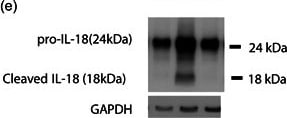
Detection of IL-18/IL-1F4 by Western Blot
Effects of pirfenidone (PFD) on NLRP3 inflammasome activation in PAH lungs and in macrophages in vitro: Lung tissue was isolated from the rats as described in Figures 1, 2, 3, homogenized and cleavage of caspase‐1 (a, b), IL‐1 beta (c, d), and IL‐18 (e, f) were assessed by Western blot. Representative pictures are shown (a, c, e), and quantified (b, d, f). (g, h) Bone marrow was isolated from mice and differentiated into bone marrow‐derived macrophages (BMDMs) in DMEM supplemented with a 20% l‐cell conditioned medium for 7 days. Subsequently, BMDMs were treated with or without PFD (500 µg/ml) o/n, and subsequently with lipopolysaccharide (LPS) (100 ng/ml) for 4 h. (g) Cells were lysed, RNA was isolated, and the expression of NLRP3, pro‐IL‐1 beta, and pro‐IL‐18 mRNA was measured by qPCR and corrected for 36B4, cyclophilin B, and GAPDH (housekeeping genes). (h) Cells were subsequently treated with nigericin (NG) (20 µM) for 30 min and IL‐1 beta secretion into the medium was assessed by ELISA and corrected for cell protein; *p < 0.05; **p < 0.01; ***p < 0.001 by two‐sided one‐way ANOVA with Holm–Sidak's post hoc correction. ANOVA, analysis of variance; ELISA, enzyme‐linked immunosorbent assay; IL‐1 beta, interleukin‐1 beta ; mRNA, messenger RNA; PAH, pulmonary arterial hypertension; qPCR, quantitative polymerase chain reaction. Image collected and cropped by CiteAb from the following open publication (https://pubmed.ncbi.nlm.nih.gov/35833096), licensed under a CC-BY license. Not internally tested by R&D Systems.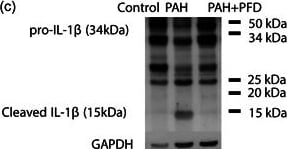
Detection of IL-18/IL-1F4 by Western Blot
Effects of pirfenidone (PFD) on NLRP3 inflammasome activation in PAH lungs and in macrophages in vitro: Lung tissue was isolated from the rats as described in Figures 1, 2, 3, homogenized and cleavage of caspase‐1 (a, b), IL‐1 beta (c, d), and IL‐18 (e, f) were assessed by Western blot. Representative pictures are shown (a, c, e), and quantified (b, d, f). (g, h) Bone marrow was isolated from mice and differentiated into bone marrow‐derived macrophages (BMDMs) in DMEM supplemented with a 20% l‐cell conditioned medium for 7 days. Subsequently, BMDMs were treated with or without PFD (500 µg/ml) o/n, and subsequently with lipopolysaccharide (LPS) (100 ng/ml) for 4 h. (g) Cells were lysed, RNA was isolated, and the expression of NLRP3, pro‐IL‐1 beta, and pro‐IL‐18 mRNA was measured by qPCR and corrected for 36B4, cyclophilin B, and GAPDH (housekeeping genes). (h) Cells were subsequently treated with nigericin (NG) (20 µM) for 30 min and IL‐1 beta secretion into the medium was assessed by ELISA and corrected for cell protein; *p < 0.05; **p < 0.01; ***p < 0.001 by two‐sided one‐way ANOVA with Holm–Sidak's post hoc correction. ANOVA, analysis of variance; ELISA, enzyme‐linked immunosorbent assay; IL‐1 beta, interleukin‐1 beta ; mRNA, messenger RNA; PAH, pulmonary arterial hypertension; qPCR, quantitative polymerase chain reaction. Image collected and cropped by CiteAb from the following open publication (https://pubmed.ncbi.nlm.nih.gov/35833096), licensed under a CC-BY license. Not internally tested by R&D Systems.Applications for Rat IL-18/IL-1F4 Antibody
Western Blot
Sample: Recombinant Rat IL‑18/IL‑1F4 (Catalog # 521-RL)
Neutralization
Reviewed Applications
Read 1 review rated 4 using AF521 in the following applications:
Formulation, Preparation, and Storage
Purification
Reconstitution
Reconstitute at 0.2 mg/mL in sterile PBS. For liquid material, refer to CoA for concentration.
Formulation
Shipping
Stability & Storage
- 12 months from date of receipt, -20 to -70 °C as supplied.
- 1 month, 2 to 8 °C under sterile conditions after reconstitution.
- 6 months, -20 to -70 °C under sterile conditions after reconstitution.
Calculators
Background: IL-18/IL-1F4
References
- Arend, W.P. et al. (2008) Immunol. Rev. 223:20.
- Culhane, A.C. et al. (1998) Mol. Psychiatry 3:362.
- Ghayur, T. et al. (1997) Nature 386:619.
- Gu, Y. et al. (1997) Science 275:206.
- Boraschi, D. and C.A. Dinarello (2006) Eur. Cytokine Netw. 17:224.
- Novick, D. et al. (1999) Immunity 10:127.
- Torigoe, K. et al. (1997) J. Biol. Chem. 272:25737.
- Born, T.L. et al. (1998) J. Biol. Chem. 273:29445.
- Bufler, P. et al. (2002) Proc. Natl. Acad. Sci. USA 99:13723.
- Takeda, K. et al. (1998) Immunity 8:383.
- Park, S. et al. (2007) Cell. Mol. Immunol. 4:329.
- Yoshimoto, T. et al. (1998) J. Immunol. 161:3400.
- Hoshino, T. et al. (2001) J. Immunol. 166:7014.
- Iannello, A. et al. (2009) AIDS Rev. 11:115.
- Rabkin, S.W. (2009) Nat. Clin. Pract. Cardiovasc. Med. 6:192.
- Netea, M.G. et al. (2006) Nat. Med. 12:650.
Long Name
Alternate Names
Gene Symbol
UniProt
Additional IL-18/IL-1F4 Products
Product Documents for Rat IL-18/IL-1F4 Antibody
Certificate of Analysis
To download a Certificate of Analysis, please enter a lot or batch number in the search box below.
Note: Certificate of Analysis not available for kit components.
Product Specific Notices for Rat IL-18/IL-1F4 Antibody
For research use only
Citations for Rat IL-18/IL-1F4 Antibody
 Powered by Bioz
Customer Reviews for Rat IL-18/IL-1F4 Antibody (1)
Have you used Rat IL-18/IL-1F4 Antibody?
Submit a review and receive an Amazon gift card!
$25/€18/£15/$25CAN/¥2500 for a review with an image
$10/€7/£6/$10CAN/¥1110 for a review without an image
Submit a review
-
Application: Immunocytochemistry/ImmunofluorescenceSample Tested: Rat,spinal cord dorsal horn, particle nerve injury (CCI)Verified Customer | Posted 10/26/2015Fixed with 4%Polyoxymethylene and 15%saturation picric acid. Without antigen retrieval. <br/> Frozen section, 20m, floating slice method.<br/> First antibody 4 degrees over night and secondary antibody 2 hours at room-temperature.<br/> Antigen retrieval in 99 degrees citrate buffer(pH 4.6) for 5min would benefit the output (not tested).<br/> Green: Interleukin-18; red: Iba-1 (microglia marker). <br />Specificity: Reasonably specific<br />Sensitivity: Reasonably sensitive<br />Buffer: PBS<br />Dilution: 1/100
There are no reviews that match your criteria.
Protocols
Find general support by application which include: protocols, troubleshooting, illustrated assays, videos and webinars.
- Cellular Response to Hypoxia Protocols
- R&D Systems Quality Control Western Blot Protocol
- Troubleshooting Guide: Western Blot Figures
- Western Blot Conditions
- Western Blot Protocol
- Western Blot Protocol for Cell Lysates
- Western Blot Troubleshooting
- Western Blot Troubleshooting Guide
- View all Protocols, Troubleshooting, Illustrated assays and Webinars