
ADAM10 (also known as Kuzbanian, mammalian disintegrin metalloprotease, and myelin-associated metalloproteinase) is a member of the ADAM family that contains a disintegrin and metalloprotease-like domain (1, 2). Like other membrane-anchored ADAMs, ADAM10 consists of the following domains, pro with a cysteine switch and furin cleavage sequence, catalytic with the zinc-binding site and Met-turn expected for reprolysins, disintegrin-like, cysteine-rich, EGF-like, transmembrane, and cytoplasmic. ADAM10 is highly conserved, with 97% amino acid identity between mouse, rat, bovine, and human and 45% identity between mouse and Drosophila. The active enzyme processes notch, notch ligand delta, and amyloid protein precursor at the alpha site, playing an important role in neurogenesis (3, 4). It also processes the 26 kDa membrane-anchored pro-tumor necrosis factor-alpha (TNF-alpha ) to the 17 kDa mature TNF-alpha (5). It cleaves myelin basic protein and type IV collagen (6, 7). ADAM10 is widely expressed in tissues and resides both on the cell surface and in the cell (8, 9).
Human ADAM10 Ectodomain Antibody
R&D Systems | Catalog # AB936

Loading...
Key Product Details
Species Reactivity
Validated:
Human
Cited:
Human
Applications
Validated:
Immunohistochemistry, Western Blot
Cited:
Immunohistochemistry, Western Blot, Immunocytochemistry, SDS-PAGE
Label
Unconjugated
Antibody Source
Polyclonal Goat IgG
Loading...
Product Specifications
Immunogen
S. frugiperda insect ovarian cell line Sf 21-derived recombinant human ADAM10
Thr214-Glu672
Accession # O14672
Thr214-Glu672
Accession # O14672
Specificity
Detects human ADAM10 in direct ELISAs and Western blots. In direct ELISAs, approximately 20% cross-reactivity with recombinant mouse ADAM10, approximately 5% cross-reactivity with recombinant human (rh) TACE, and less than 1% cross-reactivity with rhADAM8, rhADAM9, rhADAM15, and rhBACE is observed.
Clonality
Polyclonal
Host
Goat
Isotype
IgG
Scientific Data Images for Human ADAM10 Ectodomain Antibody
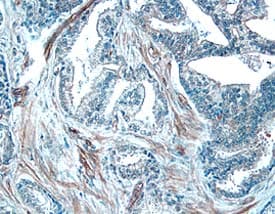
ADAM10 in Human Prostate Cancer Tissue.
ADAM10 was detected in immersion fixed paraffin-embedded sections of human prostate cancer tissue using 5 µg/mL Goat Anti-Human ADAM10 Ectodomain Polyclonal Antibody (Catalog # AB936) overnight at 4 °C. Tissue was stained with the Anti-Goat HRP-DAB Cell & Tissue Staining Kit (brown; Catalog # CTS008) and counterstained with hematoxylin (blue). View our protocol for Chromogenic IHC Staining of Paraffin-embedded Tissue Sections.Applications for Human ADAM10 Ectodomain Antibody
Application
Recommended Usage
Immunohistochemistry
5-15 µg/mL
Sample: Immersion fixed paraffin-embedded sections of human prostate cancer tissue
Sample: Immersion fixed paraffin-embedded sections of human prostate cancer tissue
Western Blot
1 µg/mL
Sample: Recombinant Human ADAM10 (Catalog # 936-AD)
under non-reducing conditions only
Sample: Recombinant Human ADAM10 (Catalog # 936-AD)
under non-reducing conditions only
Formulation, Preparation, and Storage
Purification
Protein A or G purified
Reconstitution
Reconstitute at 1 mg/mL in sterile PBS.
Loading...
Formulation
Lyophilized from a 0.2 μm filtered solution in PBS with Trehalose.
Shipping
The product is shipped at ambient temperature. Upon receipt, store it immediately at the temperature recommended below.
Stability & Storage
Use a manual defrost freezer and avoid repeated freeze-thaw cycles.
- 12 months from date of receipt, -20 to -70 °C as supplied.
- 1 month, 2 to 8 °C under sterile conditions after reconstitution.
- 6 months, -20 to -70 °C under sterile conditions after reconstitution.
Calculators
Background: ADAM10
References
- Rooke, et al. (1996) Science 273:1227.
- Pan and Rubin (1997) Cell 90:271.
- Qi, et al. (1999) Science 283:91.
- Lammich, et al. (1999) Proc. Natl. Acad. Sci. USA 96:3922.
- Rosendahl, et al. (1997) J. Biol. Chem. 272:24588.
- Chantry, et al. (1989) J. Biol. Chem. 264:21603.
- Millichip, et al. (1998) Biochem. Biophys. Res. Comm. 245:594.
- Chantry and Glynn (1990) Biochem. J. 268:245.
- Fahrenholz, et al. (2000) Ann. N.Y. Acad. Sci. 920:215.
Long Name
A Disintegrin and Metalloprotease-like Domain 10
Alternate Names
CD156c, Kuzbanian, MADM
Gene Symbol
ADAM10
UniProt
Additional ADAM10 Products
Product Documents for Human ADAM10 Ectodomain Antibody
Certificate of Analysis
To download a Certificate of Analysis, please enter a lot or batch number in the search box below.
Note: Certificate of Analysis not available for kit components.
Product Specific Notices for Human ADAM10 Ectodomain Antibody
For research use only
Related Research Areas
Citations for Human ADAM10 Ectodomain Antibody
 Powered by Bioz
Customer Reviews for Human ADAM10 Ectodomain Antibody
There are currently no reviews for this product. Be the first to review Human ADAM10 Ectodomain Antibody and earn rewards!
Have you used Human ADAM10 Ectodomain Antibody?
Submit a review and receive an Amazon gift card!
$25/€18/£15/$25CAN/¥2500 for a review with an image
$10/€7/£6/$10CAN/¥1110 for a review without an image
Submit a review
Protocols
Find general support by application which include: protocols, troubleshooting, illustrated assays, videos and webinars.
- Antigen Retrieval Protocol (PIER)
- Antigen Retrieval for Frozen Sections Protocol
- Appropriate Fixation of IHC/ICC Samples
- Cellular Response to Hypoxia Protocols
- Chromogenic IHC Staining of Formalin-Fixed Paraffin-Embedded (FFPE) Tissue Protocol
- Chromogenic Immunohistochemistry Staining of Frozen Tissue
- ClariTSA™ Fluorophore Kits
- Detection & Visualization of Antibody Binding
- Fluorescent IHC Staining of Frozen Tissue Protocol
- Graphic Protocol for Heat-induced Epitope Retrieval
- Graphic Protocol for the Preparation and Fluorescent IHC Staining of Frozen Tissue Sections
- Graphic Protocol for the Preparation and Fluorescent IHC Staining of Paraffin-embedded Tissue Sections
- Graphic Protocol for the Preparation of Gelatin-coated Slides for Histological Tissue Sections
- IHC Sample Preparation (Frozen sections vs Paraffin)
- Immunofluorescent IHC Staining of Formalin-Fixed Paraffin-Embedded (FFPE) Tissue Protocol
- Immunohistochemistry (IHC) and Immunocytochemistry (ICC) Protocols
- Immunohistochemistry Frozen Troubleshooting
- Immunohistochemistry Paraffin Troubleshooting
- Preparing Samples for IHC/ICC Experiments
- Preventing Non-Specific Staining (Non-Specific Binding)
- Primary Antibody Selection & Optimization
- Protocol for Heat-Induced Epitope Retrieval (HIER)
- Protocol for Making a 4% Formaldehyde Solution in PBS
- Protocol for VisUCyte™ HRP Polymer Detection Reagent
- Protocol for the Preparation & Fixation of Cells on Coverslips
- Protocol for the Preparation and Chromogenic IHC Staining of Frozen Tissue Sections
- Protocol for the Preparation and Chromogenic IHC Staining of Frozen Tissue Sections - Graphic
- Protocol for the Preparation and Chromogenic IHC Staining of Paraffin-embedded Tissue Sections
- Protocol for the Preparation and Chromogenic IHC Staining of Paraffin-embedded Tissue Sections - Graphic
- Protocol for the Preparation and Fluorescent IHC Staining of Frozen Tissue Sections
- Protocol for the Preparation and Fluorescent IHC Staining of Paraffin-embedded Tissue Sections
- Protocol for the Preparation of Gelatin-coated Slides for Histological Tissue Sections
- R&D Systems Quality Control Western Blot Protocol
- TUNEL and Active Caspase-3 Detection by IHC/ICC Protocol
- The Importance of IHC/ICC Controls
- Troubleshooting Guide: Immunohistochemistry
- Troubleshooting Guide: Western Blot Figures
- Western Blot Conditions
- Western Blot Protocol
- Western Blot Protocol for Cell Lysates
- Western Blot Troubleshooting
- Western Blot Troubleshooting Guide
- View all Protocols, Troubleshooting, Illustrated assays and Webinars
Loading...
Associated Pathways
