
HCC-1 (Hemofiltrate CC Chemokine-1) was originally isolated from the hemofiltrate of human patients with chronic renal failure (1). It belongs to the CC chemokine superfamily and has been designated CCL14a. HCC-1/CCL14a cDNA encodes a 93 amino acid (aa) residue precursor with a 19 aa signal peptide that is cleaved to form the 74 aa secreted protein (aa 20‑93). By alternative splicing, a second longer isoform named HCC-3/CCL14b, which includes sequences from exon 3, also exists (2). HCC-1/CCL14a is expressed constitutively in various normal tissues including spleen, liver, muscle, gut and bone marrow. It circulates at nanomolar concentrations in human plasma. Different post-translationally modified HCC-1/CCL14a, including O-glycosylated and N-terminally truncated variants of HCC‑1/CCL14a, have been identified (3, 4). Whereas the 74 aa peptide is a weak CCR1 agonist, the proteolytically processed, truncated HCC‑1/CCL14a (aa 28‑93) is a highly potent agonist of CCR1, CCR5 and to a lesser extent, CCR3. HCC-1/CCL14a (aa 28‑93) promotes chemotaxis of T lymphocytes, monocytes and eosinophils, and inhibits infection of M-tropic human immunodeficiency virus type 1. Activation of the HCC-1/CCL14a precursor to active peptide is mediated by the urokinase type plasminogen activator or plasmin (5).

Scientific images may be resized, cropped, or adjusted for brightness or contrast for presentation purposes. These updates are limited to presentation and do not affect the underlying scientific interpretation of the data. Where available, additional source data may be provided upon request.
Key Product Details
Species Reactivity
Applications
Label
Antibody Source
Product Specifications
Immunogen
Thr20-Asn93
Accession # Q16627
Specificity
Clonality
Host
Isotype
Endotoxin Level
Scientific Data Images for Human CCL14a/HCC-1 Antibody
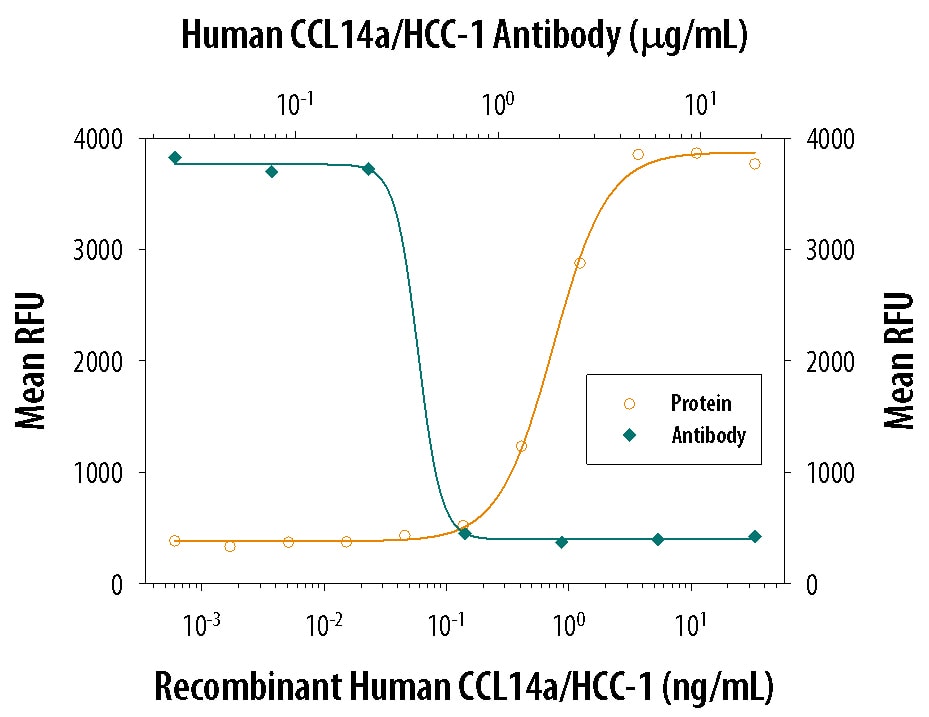
Chemotaxis Induced by CCL14a/HCC‑1 and Neutral-ization by Human CCL14a/HCC‑1 Antibody.
Recombinant Human CCL14a/HCC-1 (Catalog # 1578-HC) chemoattracts the BaF3 mouse pro-B cell line transfected with human CCR1 in a dose-dependent manner (orange line). The amount of cells that migrated through to the lower chemotaxis chamber was measured by Resazurin (Catalog # AR002). Chemotaxis elicited by Recombinant Human CCL14a/HCC-1 (10 ng/mL) is neutralized (green line) by increasing concentrations of Goat Anti-Human CCL14a/ HCC-1 Antigen Affinity-purified Polyclonal Antibody (Catalog # AF-324-PB). The ND50 is typically 0.15-0.75 µg/mL.
Human CCL14a / HCC-1 ELISA Standard Curve
Recombinant Human CCL14a/HCC‑1 aa 20-93 (Catalog # 324-HC) was serially diluted and captured by Rat Anti-Human CCL14/HCC‑1/HCC‑3 Monoclonal Antibody (Catalog # MAB3241) coated on a Clear Polystyrene Microplate (Catalog # DY990). Goat Anti-Human CCL14a/HCC‑1 Antigen Affinity-purified Polyclonal Antibody (Catalog # AF-324-PB) was biotinylated and incubated with the protein captured on the plate. Detection of the standard curve was achieved by incubating Streptavidin-HRP (Catalog # DY998)Applications for Human CCL14a/HCC-1 Antibody
Western Blot
Sample: Recombinant Human CCL14a/HCC‑1 aa 20-93 (Catalog # 324-HC)
Neutralization
Formulation, Preparation, and Storage
Purification
Reconstitution
Reconstitute at 0.2 mg/mL in sterile PBS. For liquid material, refer to CoA for concentration.
Formulation
Shipping
Stability & Storage
- 12 months from date of receipt, -20 to -70 °C as supplied.
- 1 month, 2 to 8 °C under sterile conditions after reconstitution.
- 6 months, -20 to -70 °C under sterile conditions after reconstitution.
Calculators
Background: CCL14a/HCC-1
References
- Schulz-Knappe, P. et al. (1996) J. Exp. Med. 183:295.
- Forssmanns, U. et al. (2001) J. Leukocyte Biology 70:357.
- Richter, R. et al. (2000) Biochemistry 39:10799.
- Munch, J. et al. (2002) Antimicrob. Agents Chemother. 46:982.
- Vakili, J. et al. (2001) J. Immunol. 167:3406.
Alternate Names
Entrez Gene IDs
Gene Symbol
UniProt
Additional CCL14a/HCC-1 Products
Product Documents for Human CCL14a/HCC-1 Antibody
Certificate of Analysis
To download a Certificate of Analysis, please enter a lot or batch number in the search box below.
Note: Certificate of Analysis not available for kit components.
Product Specific Notices for Human CCL14a/HCC-1 Antibody
For research use only
Related Research Areas
Customer Reviews for Human CCL14a/HCC-1 Antibody
There are currently no reviews for this product. Be the first to review Human CCL14a/HCC-1 Antibody and earn rewards!
Have you used Human CCL14a/HCC-1 Antibody?
Submit a review and receive an Amazon gift card!
$25/€18/£15/$25CAN/¥2500 for a review with an image
$10/€7/£6/$10CAN/¥1110 for a review without an image
Submit a review
Protocols
Find general support by application which include: protocols, troubleshooting, illustrated assays, videos and webinars.
- Cellular Response to Hypoxia Protocols
- R&D Systems Quality Control Western Blot Protocol
- Troubleshooting Guide: Western Blot Figures
- Western Blot Conditions
- Western Blot Protocol
- Western Blot Protocol for Cell Lysates
- Western Blot Troubleshooting
- Western Blot Troubleshooting Guide
- View all Protocols, Troubleshooting, Illustrated assays and Webinars
Associated Pathways
