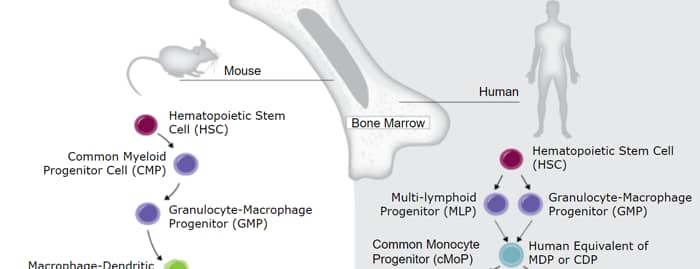
CD163, previously called M130 or p155, is a 130-160 kDa type I transmembrane glycoprotein that belongs to group B of the cysteine-rich scavenger receptor family (1-3). It is essential for clearance of hemoglobin-haptoglobin (Hb-Hp) complexes in the liver, spleen and circulation (4). The human CD163 contains a 41 amino acid (aa) signal sequence, a 1009 aa extracellular domain (ECD) with 9 scavenger receptor cysteine-rich (SRCR) domains, a 22 aa transmembrane segment, and a
39‑84 aa cytoplasmic region (1). The third SRCR domain is crucial for calcium-dependent binding of hemoglobin/haptoglobin complexes (3). Three splice forms (isoforms 2, 3 and 4) vary within their intracellular regions (1, 5), while one isoform (# 4) also has a 34 aa insert between SRCR domains 5 and 6 within the ECD. While all are expressed, isoform 3 is the most abundant, being generally expressed on the cell surface and most active in endocytosis (5). An approximately 130 kDa soluble form of human CD163 (sCD163) is assumed to contain virtually all of the ECD, which shares 74%, 75%, 84%, 86%, 86%, and 87% aa identity with mouse, rat, bovine, equine, porcine and canine CD163 ECD, respectively (6, 7). It is released from the cell surface by proteolysis after oxidative stress or inflammatory stimuli, including bacterial endotoxins and activation of the Toll-like receptors TLR2 or TLR5 (7 - 10). Expression of CD163 is constitutive, and induced by glucocorticoids, IL-10, IL-6 or endotoxin on circulating monocytes, tissue macrophages, and at low levels on monocyte-derived dendritic cells (1, 2, 11, 12). In addition to clearing Hb-Hp complexes, CD163 is also a scavenger receptor for free Hb (if Hp is depleted) and TWEAK (TNF-like weak inducer of apoptosis), and can function as an erythroblast adhesion receptor (4, 13-15).

Scientific images may be resized, cropped, or adjusted for brightness or contrast for presentation purposes. These updates are limited to presentation and do not affect the underlying scientific interpretation of the data. Where available, additional source data may be provided upon request.
Key Product Details
Species Reactivity
Validated:
Cited:
Applications
Validated:
Cited:
Label
Antibody Source
Product Specifications
Immunogen
Gly41-Ser1045
Accession # CAA80543
Specificity
Clonality
Host
Isotype
Scientific Data Images for Human CD163 Antibody
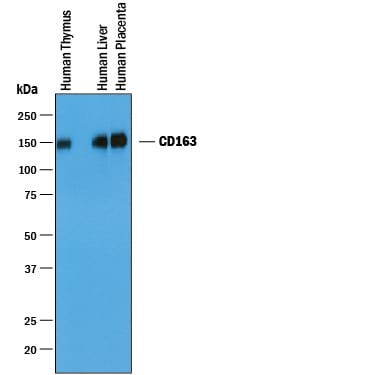
Detection of Human CD163 by Western Blot.
Western blot shows lysates of human thymus tissue, human liver tissue, and human placenta tissue. PVDF membrane was probed with 1 µg/mL of Goat Anti-Human CD163 Antigen Affinity-purified Polyclonal Antibody (Catalog # AF1607) followed by HRP-conjugated Anti-Goat IgG Secondary Antibody (HAF019). A specific band was detected for CD163 at approximately 150 kDa (as indicated). This experiment was conducted under reducing conditions and using Immunoblot Buffer Group 1.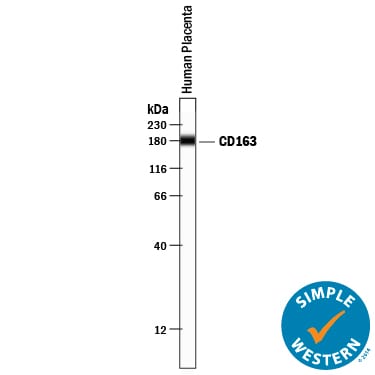
Detection of Human CD163 by Simple WesternTM.
Simple Western lane view shows lysates of human placenta tissue, loaded at 0.2 mg/mL. A specific band was detected for CD163 at approximately 179 kDa (as indicated) using 10 µg/mL of Goat Anti-Human CD163 Antigen Affinity-purified Polyclonal Antibody (Catalog # AF1607) followed by 1:50 dilution of HRP-conjugated Anti-Goat IgG Secondary Antibody (HAF109). This experiment was conducted under reducing conditions and using the 12‑230 kDa separation system.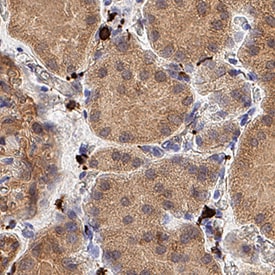
Detection of CD163 in Human Kidney.
CD163 was detected in immersion fixed paraffin-embedded sections of Human Kidney using Goat Anti-Human CD163 Antigen Affinity-purified Polyclonal Antibody (Catalog # AF1607) at 5 µg/mL for 1 hour at room temperature followed by incubation with the Anti-Goat IgG VisUCyte™ HRP Polymer Antibody (Catalog # VC004). Before incubation with the primary antibody, tissue was subjected to heat-induced epitope retrieval using VisUCyte Antigen Retrieval Reagent-Basic (Catalog # VCTS021). Tissue was stained using DAB (brown) and counterstained with hematoxylin (blue). Specific staining was localized to fibroblasts. View our protocol for IHC Staining with VisUCyte HRP Polymer Detection Reagents.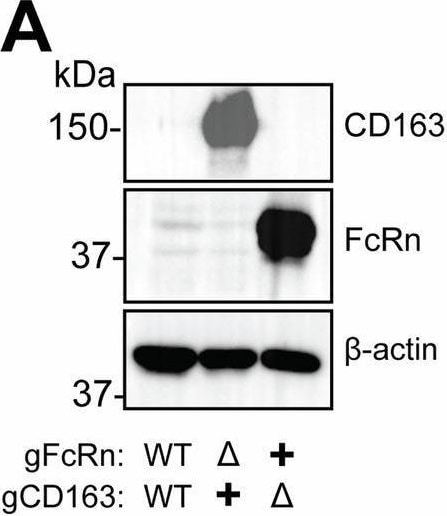
Detection of CD163 by Western Blot
CD163 overexpression does not compensate for the absence of FcRn.A Western blot showing gCD163 and gFcRn expression in wild-type (WT) MA-104 cells, overexpression of gCD163 in MA-104 delta FcRn cells, and gFcRn overexpression in MA-104 delta CD163 cells. B Kinetics of SHFV production from cells in (A) after inoculation with SHFV, MOI of 3. Graph shows mean ± SEM from three independent experiments. All plots include error bars; no error bars are shown when the SEM was smaller than the size of the symbols. C Cells from A were infected with SHFV (MOI = 30) and assayed for intracellular SHFV RNA 4 h later using single molecule RNA fluorescence in situ hybridization (smRNA FISH). Confocal microscopy (×600 magnification) was used to capture 17–21 fields of view taken at random. From each field of view, the percent viral RNA positive cells, average number of puncta per infected cell, and average puncta FISH intensity per infected cell were determined and graphed as independent points. Error bars represent the mean ± SEM. Note that data for the WT condition is the same as that shown in Fig. 4C. Data shows results from one experiment. Source data are provided as a Source Data file. Image collected and cropped by CiteAb from the following open publication (https://pubmed.ncbi.nlm.nih.gov/39112502), licensed under a CC-BY license. Not internally tested by R&D Systems.Applications for Human CD163 Antibody
Immunohistochemistry
Sample: Immersion fixed paraffin-embedded sections of Human Kidney
Simple Western
Sample: Human placenta tissue
Western Blot
Sample: Human thymus tissue, human liver tissue, and human placenta tissue
Reviewed Applications
Read 2 reviews rated 5 using AF1607 in the following applications:
Formulation, Preparation, and Storage
Purification
Reconstitution
Reconstitute at 0.2 mg/mL in sterile PBS. For liquid material, refer to CoA for concentration.
Formulation
Shipping
Stability & Storage
- 12 months from date of receipt, -20 to -70 °C as supplied.
- 1 month, 2 to 8 °C under sterile conditions after reconstitution.
- 6 months, -20 to -70 °C under sterile conditions after reconstitution.
Calculators
Background: CD163
References
- Law, S.K.A. et al. (1993) Eur. J. Immunol. 23:2320.
- Sulahian, T.H. et al. (2000) Cytokine 12:1312.
- Madsen, M. et al. (2004) J. Biol. Chem. 279:51561.
- Kristiansen, M. et al. (2001) Nature 409:198.
- Nielsen, M.J. et al. (2006) J. Leukoc. Biol. 79:837.
- Moller, H.J. et al. (2002) Blood 99:378.
- Droste, A. et al. (1999) Biochem. Biophys. Res. Commun. 256:110.
- Hintz, K. A. et al. (2002) J. Leukoc. Biol. 72:711.
- Weaver, L.K. et al. (2006) J. Leukoc. Biol. 80:26.
- Timmerman, M. and P. Hogger (2005) Free Radic. Biol. Med. 39:98.
- Buechler, C. et al. (2000) J. Leukoc. Biol. 67:97.
- Pulford, K.A. et al. (1989) J. Clin. Pathol. 42:414.
- Schaer, D.J. et al. (2006) Blood 107:373.
- Bover, L.C. et al. (2007) J. Immunol. 178:8183.
- Fabriek, B.O. et al. (2007) Blood 109:5223.
Alternate Names
Gene Symbol
UniProt
Additional CD163 Products
Product Documents for Human CD163 Antibody
Certificate of Analysis
To download a Certificate of Analysis, please enter a lot or batch number in the search box below.
Note: Certificate of Analysis not available for kit components.
Product Specific Notices for Human CD163 Antibody
For research use only
Citations for Human CD163 Antibody
 Powered by Bioz
Customer Reviews for Human CD163 Antibody (2)
Have you used Human CD163 Antibody?
Submit a review and receive an Amazon gift card!
$25/€18/£15/$25CAN/¥2500 for a review with an image
$10/€7/£6/$10CAN/¥1110 for a review without an image
Submit a review
-
Application: Western BlotSample Tested: Cancer cell lysatesSpecies: HumanVerified Customer | Posted 11/06/2017
-
Application: ELISASample Tested: See PMID 23589619Species: HumanVerified Customer | Posted 01/05/2015
There are no reviews that match your criteria.
Protocols
Find general support by application which include: protocols, troubleshooting, illustrated assays, videos and webinars.
- Antigen Retrieval Protocol (PIER)
- Antigen Retrieval for Frozen Sections Protocol
- Appropriate Fixation of IHC/ICC Samples
- Cellular Response to Hypoxia Protocols
- Chromogenic IHC Staining of Formalin-Fixed Paraffin-Embedded (FFPE) Tissue Protocol
- Chromogenic Immunohistochemistry Staining of Frozen Tissue
- ClariTSA™ Fluorophore Kits
- Detection & Visualization of Antibody Binding
- Fluorescent IHC Staining of Frozen Tissue Protocol
- Graphic Protocol for Heat-induced Epitope Retrieval
- Graphic Protocol for the Preparation and Fluorescent IHC Staining of Frozen Tissue Sections
- Graphic Protocol for the Preparation and Fluorescent IHC Staining of Paraffin-embedded Tissue Sections
- Graphic Protocol for the Preparation of Gelatin-coated Slides for Histological Tissue Sections
- IHC Sample Preparation (Frozen sections vs Paraffin)
- Immunofluorescent IHC Staining of Formalin-Fixed Paraffin-Embedded (FFPE) Tissue Protocol
- Immunohistochemistry (IHC) and Immunocytochemistry (ICC) Protocols
- Immunohistochemistry Frozen Troubleshooting
- Immunohistochemistry Paraffin Troubleshooting
- Preparing Samples for IHC/ICC Experiments
- Preventing Non-Specific Staining (Non-Specific Binding)
- Primary Antibody Selection & Optimization
- Protocol for Heat-Induced Epitope Retrieval (HIER)
- Protocol for Making a 4% Formaldehyde Solution in PBS
- Protocol for VisUCyte™ HRP Polymer Detection Reagent
- Protocol for the Preparation & Fixation of Cells on Coverslips
- Protocol for the Preparation and Chromogenic IHC Staining of Frozen Tissue Sections
- Protocol for the Preparation and Chromogenic IHC Staining of Frozen Tissue Sections - Graphic
- Protocol for the Preparation and Chromogenic IHC Staining of Paraffin-embedded Tissue Sections
- Protocol for the Preparation and Chromogenic IHC Staining of Paraffin-embedded Tissue Sections - Graphic
- Protocol for the Preparation and Fluorescent IHC Staining of Frozen Tissue Sections
- Protocol for the Preparation and Fluorescent IHC Staining of Paraffin-embedded Tissue Sections
- Protocol for the Preparation of Gelatin-coated Slides for Histological Tissue Sections
- R&D Systems Quality Control Western Blot Protocol
- TUNEL and Active Caspase-3 Detection by IHC/ICC Protocol
- The Importance of IHC/ICC Controls
- Troubleshooting Guide: Immunohistochemistry
- Troubleshooting Guide: Western Blot Figures
- Western Blot Conditions
- Western Blot Protocol
- Western Blot Protocol for Cell Lysates
- Western Blot Troubleshooting
- Western Blot Troubleshooting Guide
- View all Protocols, Troubleshooting, Illustrated assays and Webinars
Associated Pathways