
CD55, also known as DAF or decay-accelerating factor, is a 70‑75 kDa member of the RCA family of proteins. Human RCA (regulators of complement/C’ activation) proteins are products of chromosome 1 genes that are ubiquitously expressed on cells exposed to plasma complement proteins (1‑4). A hallmark of RCA proteins is the presence of 4 to 30 SCRs (short consensus repeats; also called CCPs for C’ control protein modules) in their plasma-exposed regions. SCRs are a 60‑65 amino acid (aa) module that contains a highly conserved Trp residue and two internal disulfide bonds that create a beta -barrel structure (1). Human CD55 is synthesized as a 381 aa precursor that contains a 34 aa signal sequence, a 319 aa mature region and a 28 aa C-terminal prosegment (5, 6). The mature region contains four SCR modules and a C-terminal O-glycosylated extension (7). Following cleavage of the prosegment, a serine is exposed that serves as an anchor for a GPI-linkage (8). Multiple polymorphisms are found in the molecule. Alternate splicing also exists. One form that may not be translated shows an intron insertion in the prosegment, resulting in a 79 aa substitution for the standard C-terminal 20 aas of the prosegment (6). Another form generates a truncated 199 aa precursor that cannot be membrane-bound and may not be secreted (9). Mature human CD55 shares 53% and 84% aa identity with mouse and monkey CD55, respectively. CD55 is known to bind CD97 via the first SCR (4). It also binds physiologically-generated C3 convertases with its second and third SCRs (7, 10). Binding results in an accelerated “decay”, or dissociation of active C3 convertases, thus blocking the development of C’ attack complexes on nonforeign cells (1, 2). Finally, viruses and bacteria are also known to use multiple SCR sites for infection (4).
Human CD55/DAF Antibody (278803)
R&D Systems | Catalog # MAB2009

Scientific images may be resized, cropped, or adjusted for brightness or contrast for presentation purposes. These updates are limited to presentation and do not affect the underlying scientific interpretation of the data. Where available, additional source data may be provided upon request.
Key Product Details
Species Reactivity
Validated:
Cited:
Applications
Validated:
Cited:
Label
Antibody Source
Product Specifications
Immunogen
Asp35-Ser353
Accession # P08174.4
Specificity
Clonality
Host
Isotype
Endotoxin Level
Scientific Data Images for Human CD55/DAF Antibody (278803)
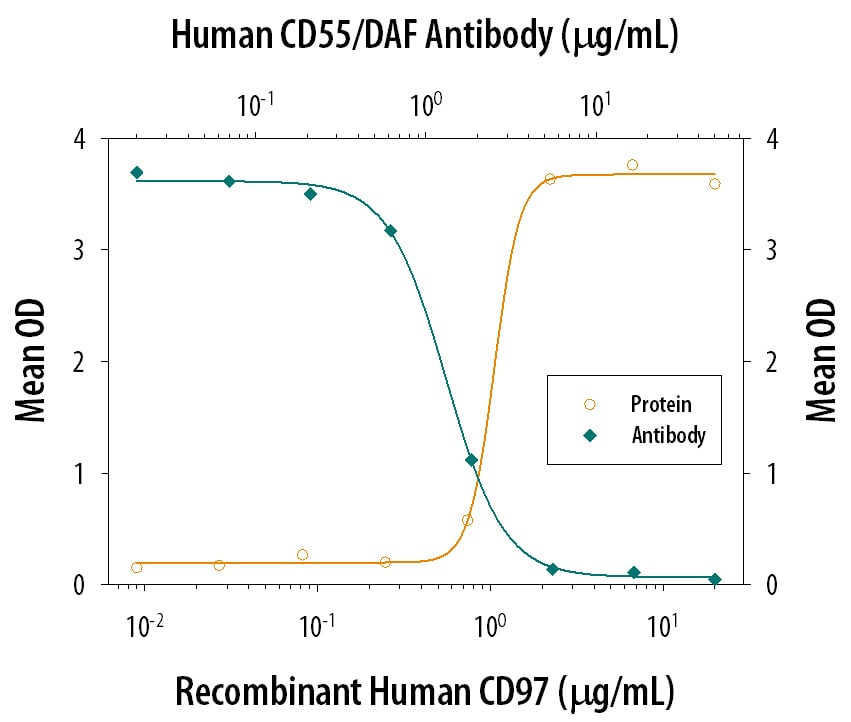
Cell Adhesion Mediated by CD55 and Neutralization by Human CD55/DAF Antibody.
Recombinant Human CD97 (Catalog # 2529-CD), immobilized onto a microplate, supports the adhesion of human red blood cells in a dose-dependent manner (orange line). Adhesion elicited by Recombinant Human CD97 (5 µg/mL) is neutralized (green line) by increasing concentrations of Mouse Anti-Human CD55/DAF Monoclonal Antibody (Catalog # MAB2009). The ND50 is typically 0.5-2 µg/mL.Applications for Human CD55/DAF Antibody (278803)
Western Blot
Sample: Recombinant Human CD55/DAF (Catalog # 2009-CD) under non-reducing conditions only
Neutralization
Formulation, Preparation, and Storage
Purification
Reconstitution
Reconstitute at 0.5 mg/mL in sterile PBS. For liquid material, refer to CoA for concentration.
Formulation
Shipping
Stability & Storage
- 12 months from date of receipt, -20 to -70 °C as supplied.
- 1 month, 2 to 8 °C under sterile conditions after reconstitution.
- 6 months, -20 to -70 °C under sterile conditions after reconstitution.
Calculators
Background: CD55/DAF
References
- Herbert, A. et al. (2002) Biochem. Soc. Trans. 30:990.
- Miwa, T. and W-C. Song (2001) Int. Immunopharmacol. 1:445.
- Hourcade, D. et al. (2000) Immunopharmacology 49:103.
- Lea, S. (2002) Biochem. Soc. Trans. 30:1014.
- Medof, M.E. et al. (1987) Proc. Natl. Acad. Sci. USA 84:2007.
- Caras, I.W. et al. (1987) Nature 325:545.
- Lukacik, P. et al. (2004) Proc. Natl. Acad. Sci. USA 101:1279.
- Moran, P. et al. (1991) J. Biol. Chem. 266:1250.
- Lublin, D.M. et al. (1994) Blood 84:1276.
- Williams, P. et al. (2003) J. Biol. Chem. 278:10691.
Alternate Names
Gene Symbol
UniProt
Additional CD55/DAF Products
Product Documents for Human CD55/DAF Antibody (278803)
Certificate of Analysis
To download a Certificate of Analysis, please enter a lot or batch number in the search box below.
Note: Certificate of Analysis not available for kit components.
Product Specific Notices for Human CD55/DAF Antibody (278803)
For research use only
Related Research Areas
Citations for Human CD55/DAF Antibody (278803)
 Powered by Bioz
Customer Reviews for Human CD55/DAF Antibody (278803)
There are currently no reviews for this product. Be the first to review Human CD55/DAF Antibody (278803) and earn rewards!
Have you used Human CD55/DAF Antibody (278803)?
Submit a review and receive an Amazon gift card!
$25/€18/£15/$25CAN/¥2500 for a review with an image
$10/€7/£6/$10CAN/¥1110 for a review without an image
Submit a review
Protocols
Find general support by application which include: protocols, troubleshooting, illustrated assays, videos and webinars.
- Cellular Response to Hypoxia Protocols
- R&D Systems Quality Control Western Blot Protocol
- Troubleshooting Guide: Western Blot Figures
- Western Blot Conditions
- Western Blot Protocol
- Western Blot Protocol for Cell Lysates
- Western Blot Troubleshooting
- Western Blot Troubleshooting Guide
- View all Protocols, Troubleshooting, Illustrated assays and Webinars